
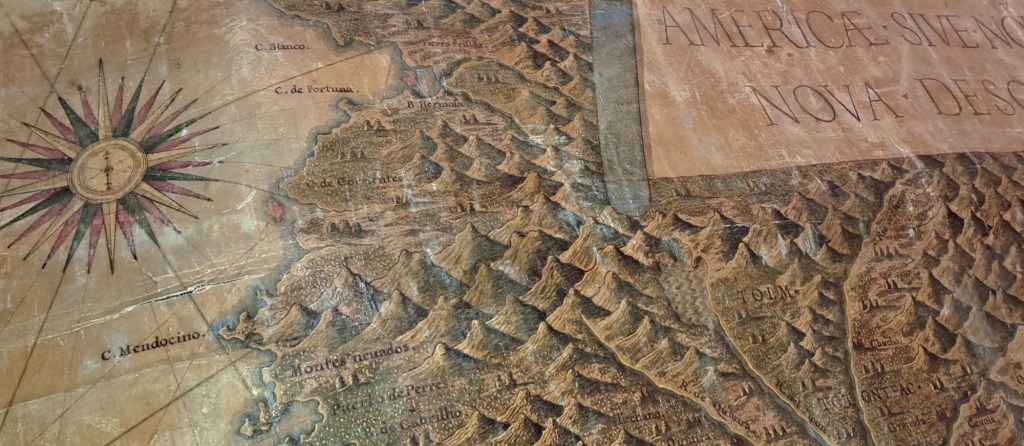
Nearly eight decades prior to the Mayflower’s arrival in Plymouth, Mass., João Rodrigues Cabrilho’s 1542-1543 epic voyage to the West Coast of America brought Europeans their first glimpse of California, literally putting its shores on the world’s maps. San Diego’s Cabrilho National Monument honors this achievement.
According to Spain’s 17th-century royal chronicler, Antonio de Herrera, Cabrilho was a Portuguese navigator, making Cabrilho National Monument the pride of 350,000 Portuguese Californians, with San Diego’s first public celebrations of a Portuguese Cabrilho dating back to 1892.
For decades, in collaboration with Cabrilho National Monument, San Diego’s Portuguese community organized Cabrilho’s Festival, combining identitarian and universalist approaches, and showcasing the Portuguese, native Kumeyaay (their endangered language being a treasure we all must protect), Spanish and Mexican cultures.
For centuries, though, not much more was known about Cabrilho’s birthplace, until this past decade’s discoveries.
In 2015, Wendy Kramer found insightful 16th-century documents, in which Cabrilho declared to be “natural of Palma del Río” (Spain). In her interpretation, the word “natural” meant Cabrilho was necessarily Spanish-born.
This assumption is simply not true. Cabrilho never explicitly declared he was born in Palma del Río.
Many historians have written about this misinterpretation. While being “natural” of a place often meant being born there, frequently though, it meant only naturalization, especially when related to Spanish Americas, where foreigners even paid to become naturalized.
Paradigmatically, Francisco Pizarro declared in his testament to be “natural and born” (in Castilian language: “natural y nacido”) in Trujillo (Spain). The ambiguous meaning of “natural” drove Pizarro (and plenty others) to add “and born” to such statements.
Similar mistakes, confusing “natural” with being born, were made in older debunked nationality disputes of distinguished Portuguese navigators, such as João Dias de Solis (Spain’s pilot-major, 1512) and several others. Cabrilho is just the latest episode.
In 2023, I began publishing my own historical discoveries supporting Cabrilho’s Portuguese origins, deconstructing misconceptions and putting to rest the thesis of a Spanish-born Cabrilho based only on ambiguous “natural” statements.
I discovered an extremely rare Spanish-based map of ancient California from 1604, made by the Florentine cartographer Matteo Neroni, that shows the toponym Bay of Cabrilho, spelled with the Portuguese “lh” rather than the Castilian “ll.” Corroborating Herrera’s singular statement, this is the oldest known document showing Cabrilho’s Portuguese name.
I also discovered that the co-owner of Cabrilho fleet’s second-largest ship was the Portuguese pilot Alvar Nunes. Furthermore, Luís Gonçales (not Gonzalez), the owner of the fleet’s smallest ship, may be Portuguese too. Remarkably, all three vessels that mapped California were, likely, Portuguese seamen’s property!
Additionally, the Rodrigues family, living in Lapela de Cabril (seven miles from Mount Cabrilho), kept for centuries a crucifix they claim was Cabrilho’s gift. With the family’s permission and their assistance, I sent a piece of the crucifix for a radiocarbon-14 dating which confirmed it dates to the 1530s, exactly when Cabrilho would have given it to his Portuguese family.
Not everyone accepts this data, insisting on “Spanish-born Cabrilho” misconceptions, while repeatedly being hostile to Cabrilho National Monument and the Portuguese-Californian community (outrageously accused of influencing the removal of a Cabrilho National Monument Spanish plaque).
The president of San Diego’s House of Spain, Jesus Benayas, and professor Iris Engstrand recurrently insist on removing Cabrilho’s Portuguese references and Portuguese Navy plaques from Cabrilho National Monument, and systematically pressured Cabrilho National Monument by presenting formal complaints to the Department of Interior, National Park Service regional directors, Congressman Scott Peters, and Cabrilho National Monument superintendents. Their latest focus is Cabrilho National Monument’s 2024 updated visitors brochure, for no longer indicating Cabrilho’s putative Spanish birthplace.
In Ensenada, Baja California — Cabrilho’s fleet anchored there in 1542 — they already forced the replacement of the original Portuguese Cabrilho statue plaque, by another mentioning Spanish-birth.
They argue, relentlessly, that the name Cabrilho is nonexistent even in Portugal, being a fabrication (sic) of San Diego’s Portuguese community. The fact that there is a Mount Cabrilho in Portugal, plus the 1604 California map’s Bay of Cabrilho, written with Portuguese spelling, refutes this.
This hostility must stop. History’s finer details, taken together, indicate Cabrilho’s Portuguese birth.
History and facts matter. Among California’s oldest national monuments, receiving nearly 1 million visitors annually, Cabrilho National Monument should continue to be an educational meeting point open for all Californians and history research.
Afonso has published peer-reviewed research about Cabrilho and lives in Auburn.