
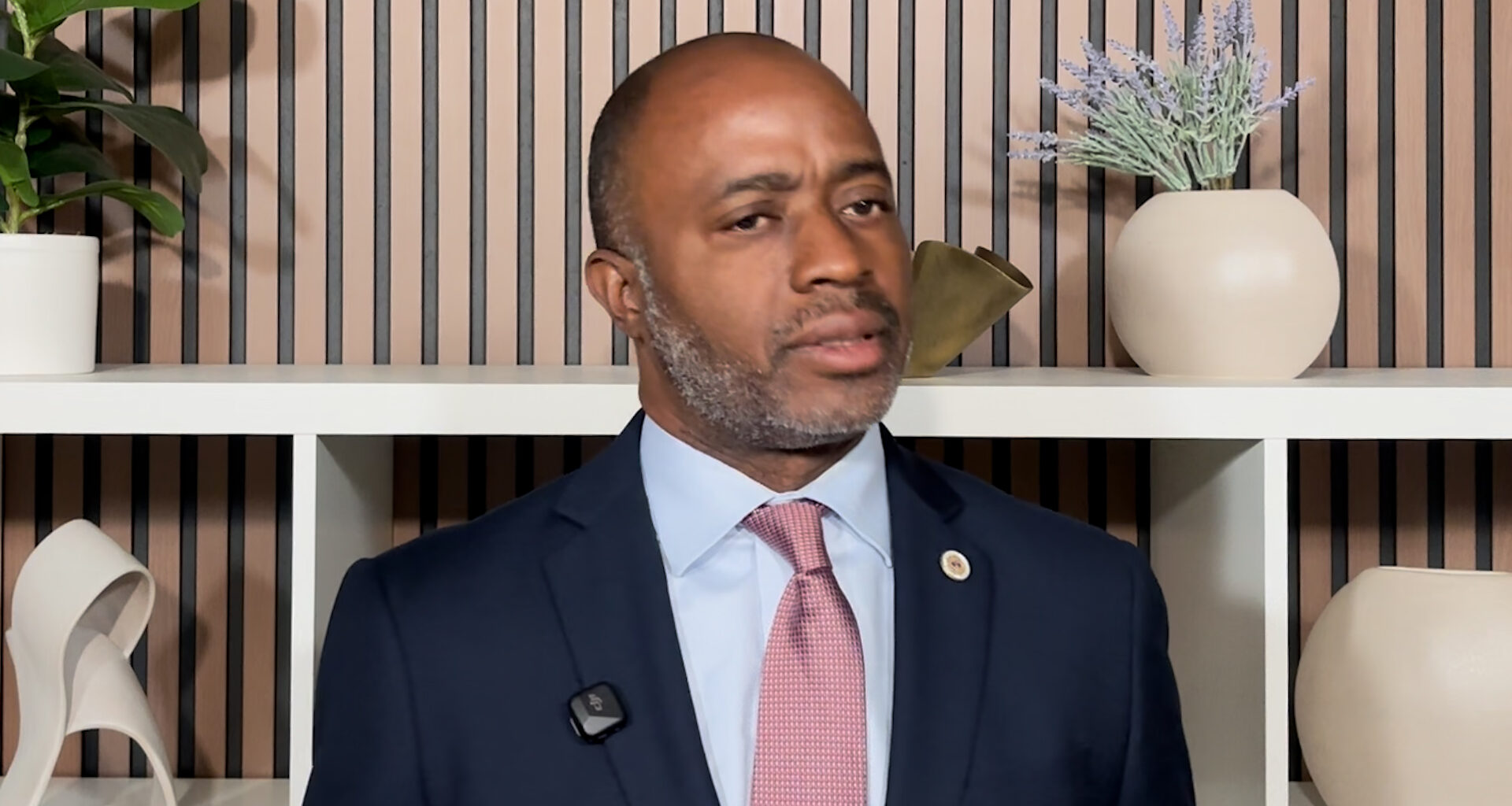
Politics reporter Sophia Bollag interviewed Tony Thurmond, one of the candidates in the governor’s race, ahead of California’s June primary.
Sophia Bollag, Joy Jeong
Tony Thurmond, the state superintendent of public instruction, is the longshot candidate in California’s governor’s race.
The longtime East Bay Assembly member who was elected state schools chief in 2018 has earned union backing throughout his career, but has failed to gain traction in the race. He has not broken past 3% support in independent polls since he declared his candidacy. He has resisted calls to drop out as Democrats fret about the possibility they could be locked out of the general election because so many candidates are dividing the liberal vote.
Article continues below this ad
Thurmond has run on a progressive platform supporting state-funded single-payer health insurance and a proposed billionaire’s tax. In an interview with the Chronicle, he also endorsed a range of other policy proposals, including creating a state-run insurance pool for struggling school districts modeled on the FAIR plan for wildfire insurance and hiring more state police officers.
Here are the highlights from Thurmond’s interview with the Chronicle, part of a series the paper is conducting with the leading candidates in the race for governor. The conversation below has been edited for length and clarity.
What do you see as the biggest problem facing California schools today, and what would you do to address it if you’re elected governor?
Thurmond: If you look at all of the strikes that we’re seeing right now, they stem from the declining enrollment that districts have experienced over the years. And there’s a direct financial tie to that.
Article continues below this ad
And so even as our schools are beginning to see progress in reading, math and science, they need more. And right now they have fewer resources. And California is one of only six states that still is based on an average daily attendance system. And so as governor, I would like to change that to enrollment-based, so there’s more revenue that’s predictable, that districts can count on, but on top of that, there’s stuff that we need to do. We need to really roll out a long-term plan for making sure kids learn to read by third grade, like they’ve done in Mississippi and Tennessee and other places.
I’ve actually written that plan, and it will have more dyslexia screening, more phonics-based professional development for all educators, especially new educators, some family engagement so families know the importance of reading with their kids. That’s what we have to do going forward, and figure out ways to help the homeless students in our state — 240,000 homeless students, even though we’re the fourth wealthiest economy in the world.
How much more do you think that’s going to cost from what the state is currently spending on education?
What’s difficult is that the state doesn’t really have it, right? Even though education is the top line in California’s budget, we don’t spend what you would expect for a state of our size. We don’t spend what New York spends. We still fall somewhere, I guess, in the 30s in per-pupil spending, even though it’s gone up over the course of my tenure. I think at one point we got to 13th in the nation in per-pupil spending, but we still struggle.
Article continues below this ad
(Editor’s note: Data for the 2024-25 school year compiled by the National Education Association ranked California 13th among states for per-pupil spending at $24,296 per student. New York ranked No. 1 with $37,193 spent per student.)
California has to figure out that just right amount so that we have enough to pay staff a decent wage and make sure that our kids have access to resources. I mean, unbelievable going into the pandemic, a million students without a computer, without access to the internet.And here we are trying to cobble together donations at a time when the only way that students can be connected to school or connected to mental health is through a computer. And so we did get donations, and I sponsored the legislation that got us $6 billion for broadband so our kids have access to technology.
I want them ready for the jobs in AI, ready for jobs in computer science and biotech and cybersecurity or nursing or accounting, and that means we have to invest more in our schools, invest more in the career technical training where kids get hands-on experience. We have a long way to go to also address a bump that’s needed in the graduation rate, reducing chronic absenteeism. Things are trending in the right direction but we have a long way to go. As a 57-year-old person who’s been here in the achievement gap talked about my whole life, I want us to close it once and for all.
Sorry if I missed it, but did you have a dollar figure for how much more you want to spend on education?
Well, I think if you’re going to do reading by third grade, and again, I’ve written a five-year plan that would have dyslexia screening, extra tutoring, access to more preparation for educators. We’re talking easily $1.5 billion over the next five years. The state doesn’t have it. And so I’m actually mounting a separate campaign to create a public-private partnership to help us raise the money for our five-year plan to get our kids to read in by third grade. I’m trying this out to see if we get some of the money from the state, some from foundations and businesses, and some high-net-worth donors who we are reaching out to to contribute to our plan.
Article continues below this ad
Have you gotten any commitments yet from any of those donors or those foundations?
Not yet. A few foundations have said let’s talk some more. It’s too early in the process to point to, you know, who might support. But I’ve got a good list of folks who I think are the right people to be talking to.
In terms of your work as state superintendent of public instruction, what would you describe as your primary achievements since you’ve taken on that role?
Yeah, as I mentioned, securing the $6 billion for broadband, I mean we are in a place now where we will close the digital divide.
I’m a kid who grew up on the free lunch program. I grew up in a household where we didn’t have food. I grew up on food stamps and government cheese and free lunch and so I’m deeply proud of the work that we’ve done to create universal meals for every student, two meals a day for everyone.
Article continues below this ad
I sponsored the transitional kindergarten legislation. But there’s so much more that needs to happen. As state superintendent, I’ve realized that my job, I don’t really have the authority or the tools to affect what happens in any individual district, but I have the ability through the microphone that this job gives me to get resources for a thousand school districts. I’ve tried to help districts amplify the message here in Sacramento about what they need and to try to tamp down on the unfunded mandates that are really burdening them. I’ve used my relationship with the Legislature, with the governor, to really advance policies that I think will help our districts, and we’ve secured the funding that will help us to get there. I just think now we have to be in implementation mode, in push mode. And focused on closing achievement gaps over the next five to 10 years and making sure that we’re preparing students for the jobs of tomorrow. I’ve written guidance for our school districts on how to use AI as a tool. I have supported students getting hands-on experience in technology.
I’m proud of these things, but I made the decision when I was in the Assembly to run for state superintendent because I realized this is a job that’s all about helping education. I don’t think I realized how difficult it was gonna be or that we’d step into a pandemic, but I wouldn’t do anything differently. And now that I know, I want to be able to use that knowledge as governor to bring the state’s resources to bear to really help close those gaps and move things forward for California education.
I wanted to ask you about the governor’s proposal to essentially take some power away from the job that you currently have. What do you think about that?
I don’t think it’s a bad thing in and of itself to say that the governor would have more direct control over the Department of Education. I think whenever a governor says they want to be an education governor that’s a great thing. And this governor and I have partnered together on all the programs that I mentioned — the transitional kindergarten, the broadband funding. What I don’t understand is how the shift that he proposes will directly tie to any student outcome. That’s what I keep asking, is to show what’s going to be different. Making the shift by itself won’t change anything. The Department of Education has been underfunded for decades. The position of state superintendent is structurally a weakened position as it is, but I’ve been able to counter that by using my relationships in the Legislature and with the governor to focus on getting funds directly for our school districts. This new structure, as it is envisioned, I think would devastate the state superintendent position. It would essentially relegate that person to attending a few board meetings. And I just think that you’re losing the ability to influence education, to be a great supporter for the districts, to be a partner to the governor.
Are there alternatives that you’ve suggested either to the governor or your former colleagues in the Legislature that you would support?
Yes, over the course of the last several years, I’ve suggested that we build out the staffing at the Department of Education. Right now, the department is only able to focus on monitoring districts and reporting to the federal government, but what about the aspirational work that needs to happen? We need to build mentoring programs and tutoring programs that help students who struggle. We need to have programs that put wraparound supports around the 240,000 homeless students who are in our state. So I think that the proposal should be going the other way and strengthening the department and strengthening the state superintendent’s position.
There have been calls from a lot of school districts for changes to California’s laws that extended the amount of time that people have to file lawsuits over sexual abuse that they say they experienced as children. What do you think of those calls for some sort of change to those laws or some sort of financial relief as they’re now facing these, in some cases, multimillion-dollar settlements or judgments that they have to pay?
We have to do everything that we can to support those who are the survivors of sexual assault and abuse. That has to be top priority. I do understand that the districts don’t have the financial means, especially for some of these lawsuits that might go back decades. And these lawsuits have the ability to bury districts that are just struggling to make ends meet on a day-to-day basis. And so I think that the state will have to work with districts to create a very specific type of liability insurance pool that gives help to the districts to cover the costs.
I mean if you look as a parallel, the foster family agencies in the state, many of them have closed their doors because they can no longer even get liability insurance because of the number of lawsuits that they have to deal with. And so the state has done this before in terms of creating its own form of homeowner’s insurance. Which I’m not a big fan of, and I’ll talk about that, I think the market needs to do a better job in insuring Californians for disaster. But I do think that this is a place where state government can play a role in creating the kind of liability insurance that will help districts.
What are some of the criticisms that you have of that wildfire insurance policy?
I think it’s well-intentioned that California has created its own system to say that if you can’t get homeowner’s insurance through the commercial sector that our state will provide one, but it’s very limited. And for those who experience the fires in the Palisades and Altadena and Pasadena, this program cannot help them in their time of need.
As governor, I intend to hold the insurance industry more accountable. Californians have paid their premiums for a long time. And in our greatest need, the companies have said, “Sorry, we can’t be there for you. Either we can’t insure you or we won’t pay out or we won’t help you rebuild.” What’s the point of paying into these companies and then you don’t get help in your moment of greatest need? And then to make it worse, these companies got a rate increase right after those fires. From my perspective, you don’t get a raise when you’re not doing a good job, and California should hold the line to say that the only way that you’re going to get a rate increase is if you’re writing policies for Californians.
I think that I know that as governor, my message to the insurance industry will be: If you want to do business here you have to take care of Californians. You have the write policies. And we will do our part. We have to ask homeowners to harden their homes, to be more prepared for wildfire. We have to have more planned burns. And we may have to give some vouchers and financial support initially for Californians who will need to harden their homes. There may be some areas that we have to say, “you can’t have new development here,” because the risk for a wildfire is too great.
When you say you want something similar for schools that are facing some of this liability — similar in what ways?
Similar in the sense that it’d be state-supported. The commercial industry, I think, has backed away from school districts and from foster group homes. But there is a tradition of government-sponsored liability insurance pools. I know this because I served on a city council and I served a school board. And in both those capacities, we belong to a pooled insurance plan. And it helps districts when they have to pay out sums that go beyond the general fund of that organization. So I think there’s a tradition for it. I think the FAIR plan (California’s home insurance program of last resort) is an example of what could work in terms of helping school districts.
You mentioned some of the work you’ve done on AI in schools. What do you think of the regulations that the Legislature has passed so far on AI, and are there additional laws that you would support or regulations around this emerging industry?
I think the regulations have been a good start, but I think we need to go a little further. I don’t know about you, but I don’t want to be driving next to an 18-wheeler that doesn’t have a human occupant in the cab. I’m concerned for what kind of harm could come across. And I know there needs to be more testing. I think that we have to mandate that kind of testing.
I think we have to send clear messages that AI is a great tool, but if it’s only being pursued for the purposes of replacing workers, I think that’s penny wise and pound foolish. I think that’s a mistake. I think the beauty of AI is that it can organize data so quickly and so efficiently, that yes, maybe it will solve cancer, as they say. As someone that lost both my parents to cancer, I wanna see that. But I don’t want AI to be my doctor or my teacher. I think AI can be a great aid to the doctor, and I’ve seen this, where the doctor uses AI to keep up with the meeting and write the notes. There’s even some discussion how AI might help special education teachers, you know, deal with all the paperwork requirements of writing IEPs, but AI should never be allowed to write the IEP. And so I think what I’ve written in the guidance that we’ve provided to school districts is that AI is a tool and can complement what great teachers do, but cannot and should not ever replace those great teachers. And I think we have to continue to provide that kind of guidance in every sector where AI is now accelerating, and then I think we have to acknowledge that there are going to be places where jobs are going be lost and create an expectation that those companies create some kind of transition, whether it’s financial assistance or a timeline to help those who will be replaced to get into other jobs.
These technology companies have made a lot of money, and a lot of them made tons of money during the pandemic, and then immediately started laying people off, not because they weren’t making money, but because they felt their shareholders weren’t getting enough money. If they can make that much money off of the people of California, they can do a better job of ensuring that they help those who will lose a job can transition into other work.
You’ve had a lot of support throughout your career from labor unions. What would you say to Californians who are concerned that labor unions hold too much sway in state government?
Well, I think it’s important that we have labor unions to protect those who find themselves being pushed out of a job unfairly, to help those who need to get better wages. And there have been abuses in many sectors that, but for unions, those employees wouldn’t be protected. And so I’m grateful for that. I was raised by a cousin who stepped in when my mom passed away. My cousin was a shop steward in her union. And I’ve seen the power that unions have to help everyday people get access to better benefits.
That doesn’t mean that unions should just get whatever they want, and as someone who has had a close relationship with unions, I’ve also had to say no on policies that many times they either supported or didn’t like. I sponsored the legislation to pass personal finance (curriculum) in the state of California. I think it’s so important for us to teach our kids about the markets and about business, how to avoid debt, and many unions opposed that legislation, and I said, no, we’re gonna do this. Unions opposed a bill that would have mandated more dyslexia screening in our state. When you think about the 70-plus percent of people in jail who cannot read, there’s no way I wasn’t gonna support a dyslexia screening bill. Those are just a few examples of where I’ve had to go a different way from unions, even though I believe in them. I believe in the things that they advocate for, but that doesn’t mean that I have to support everything that they ask for.
One issue that the current governor has said he has really struggled with is this issue of fairness in girls’ sports, and whether trans girls should be allowed to compete. What do you think about the debate around that issue?
It’s definitely challenging. But I think you have to start from a few things as your foundation, how you think. I’m a parent of two kids who graduated from our public schools. And I fully support parent rights. And I think that somewhere in this conversation, there’s some sense that people think that there’s legislation that would take away the rights of parents to know what their kids are doing at school. And that can never be. We have to make sure that we protect the rights of parents to know what their kids are doing, to maintain conversations that are best had between a child and their parents.
Having said that, there has been a whole backlash against trans athletes that has actually raised concerns about the safety of those athletes, and I think that takes it too far. Everyone’s entitled to their viewpoint but when you start threatening young people, teenagers, over your viewpoint, you’ve taken it too far. I have literally had to intervene in places where there was a track meet or some other sporting event where young people were being threatened by adults to say we will ensure their safety working with law enforcement. Working with other statewide agencies to ensure that our young people have the right to participate in sports. Our laws say that everyone, including those in the LGBTQ+ community, have the right to participate in sports. What I won’t stand for is any student being threatened. I can’t stand forcible outings. Outing kids at school or anywhere because we know that when you out kids, you’re pushing them to suicide and other very dangerous behaviors but when we support our LGBTQ+ kids, we help them to attend school more often to have better academic outcomes.
You have said that you support the billionaire tax proposal that SEIU-UHW has put forward. One criticism that has been brought up, particularly from Newsom, is that it would require that that revenue be spent on health, and that there other priorities that shouldn’t be shut out of that potential revenue. What do you think of that argument?
Even before the measure that is being intended for the ballot was created, I’ve always said we have to tax billionaires. We just need more revenue, but we can’t tax working people and middle-class people anymore. Californians pay more at the pump, more for housing, more for groceries, than at any time. Those who have earned the most and have the most assets, they can pay their fair share. So when this measure came along to support healthcare, I decided I’m gonna put my money where my mouth is, and I’m going to support it, because without it, many hospitals will close throughout our state, hospitals in rural communities, all of this is because of the pressure being put on us by the federal government and the big ugly bill that is going to cause premiums for the Affordable Care Act to go up, that’s causing people to be kicked off of the Medi-Cal rolls.
People say that those who get taxed will just leave our state, and I don’t want California to be vulnerable to that, and so I’ve reached out to Sen. (Bernie) Sanders to support his proposal to have a nationwide wealth tax. I don’t think California needs to go it alone. I think other states should do the same.
What’s your stance on single-payer healthcare?
I support it fully. I mean, I think some people know that I lost a brother when he was 35 years old. My brother lost his job, lost his insurance, and was diagnosed with a rare liver disorder. My brother didn’t drink or smoke, but yet this disease affected him, and because he didn’t have insurance, his condition deteriorated so quickly that ultimately the disorder took his life.
We know a single-payer system can work. It will mean less overhead, less bureaucracy, and fewer people who are on the fringes of not being insured. I think if you look at the profits at our healthcare companies, even the nonprofit healthcare organizations have record profits. I think it’s time for us to say we’re putting patients ahead of profits and a single-payer healthcare system is the best way to do that.
You’re a longtime resident of the East Bay. What unique experience do you think you would bring to the governor’s office because you’re from that specific part of the state?
Everything I learned in government, I learned in the East Bay, in the San Francisco Bay Area. When I think about the things that this state needs, I’ve been given the opportunities, you know, as a city council person in the city of Richmond, school board member in that area for West Contra Costa, state Assembly person for Richmond, Berkeley and Oakland.
When I was sworn in on the Richmond City Council, on my first day, they handed me a bulletproof vest. I thought, what did I walk into? They said, you just came to the city that’s the most dangerous in the state per capita for violent crime. And within a matter of years, we were able to reduce those statistics. We were able to scale that back. How did we do that? The same way I’ll do it as governor, we add more police for the population of our city. As governor, I’ve said I’ll help our state add 2,000 police officers, more 911 dispatchers, but I don’t think we police our way through our challenges. We have to have intervention programs at the same time. That’s how we did it in Richmond. I launched the first summer youth employment program in our city.
The Bay Area has taught me everything, and I’m grateful for the opportunity. I’m thankful for the passion that the citizens have. I’ve learned about the complexity and the diversity of our state. It’s a very expensive place to live, and it has informed my ideas about what we need to do for every Californian.