
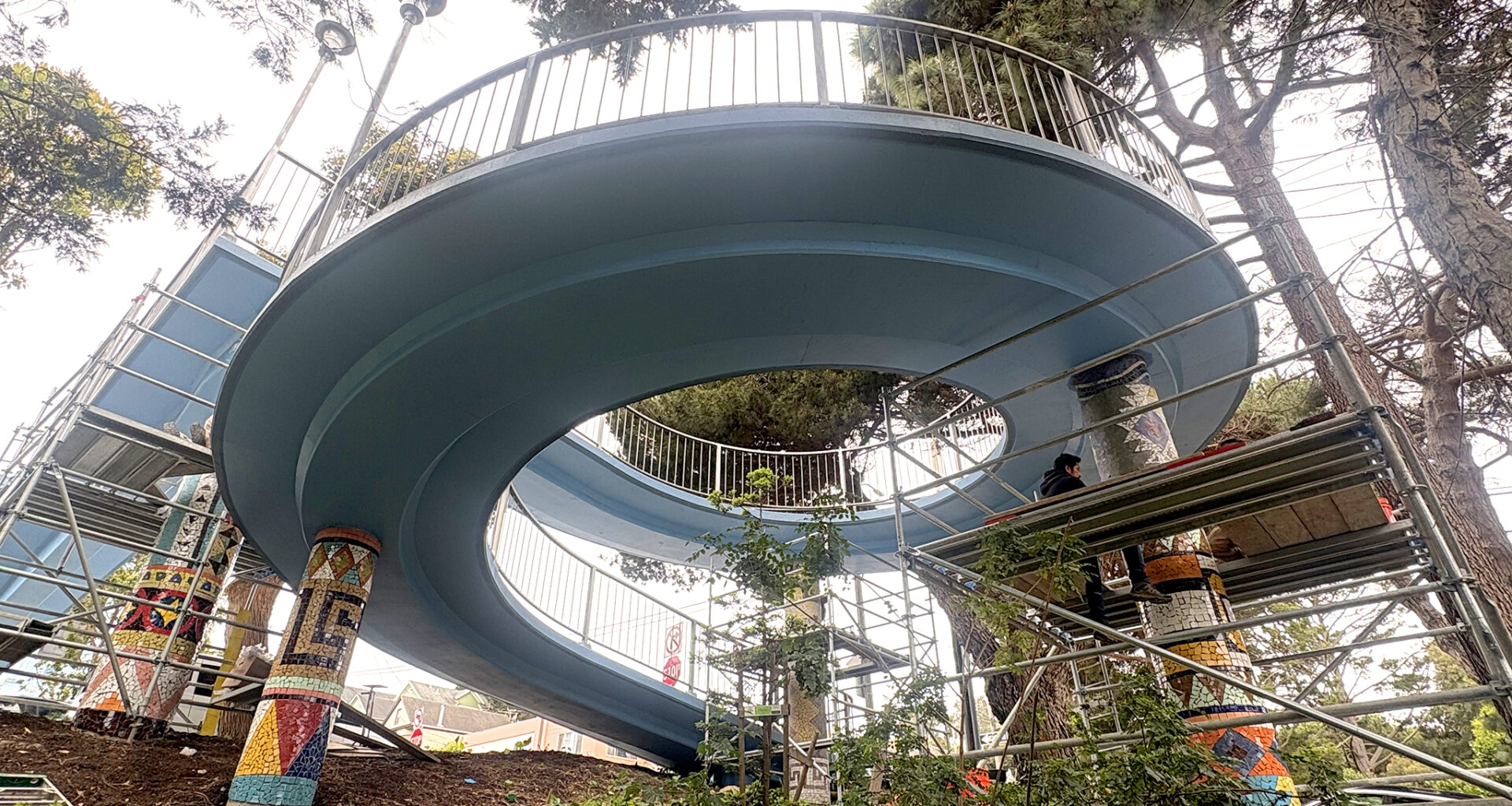
The crossing at Bosworth Street and Lippard Avenue in San Francisco’s Glen Park neighborhood was, for years, a piece of infrastructure unworthy of note. Graffiti ran under the railing, weeds pushed up around the base and worn-out concrete held water stains at the seams. It took about a hundred hands to cut back the overgrowth and wash the structure to gray.

Now it marks a first for the city — a tiled bridge.
Set against a fresh coat of bright blue, its five pillars, 400 square feet in all, are covered in mosaics, with soft semicircles beneath yellow stars and orange-rimmed diamonds tucked under thin parallel lines.
Article continues below this ad
San Francisco has a history of working on its stairs in this way — treating them as surfaces that can hold more than function. There are now north of 900 stairways across the city, and about a dozen of them are tiled sets. On California Street in Lincoln Park and 16th Avenue in Golden Gate Heights, to name a few, color and pattern have long rewarded the slow climb. As of this week, the Bosworth Pedestrian Bridge extends that logic sideways, onto a structure that doesn’t require the same exertion to traverse.
Connecting Glen Park School to the south and the Glen Park Greenway to the north, the crossing carries students and neighbors safely over the busy, often backed-up street below. It spans four lanes at Bosworth Street, which feeds directly to Highway 280.
Scaffolding wraps around the Bosworth Pedestrian Bridge in San Francisco’s Glen Park neighborhood as crews install mosaics.
Charles Russo/SFGATE
A mosaic detail wraps around one of the bridge’s pillars, with a yellow star set against deep blue and red tile, in San Francisco’s Glen Park neighborhood.
Charles Russo/SFGATE
Workers install mosaic tiles on one of the bridge’s pillars while working from scaffolding beneath the overpass in San Francisco’s Glen Park neighborhood.
Charles Russo/SFGATE
Glen Park Beautiful, a volunteer, neighborhood-run group, brought the bridge to life, with help from Glen Park School students and the Create Peace Project, a San Francisco-based arts education nonprofit. The effort took shape over months of planning, grassroots fundraising, weed-pulling, priming and painting — drawing on broad collaboration and, in part, a chance encounter.
Article continues below this ad
From staircase to bridge
On New Year’s Day 2025, Renee Berger, a longtime San Francisco resident and community organizer, was entertaining the thought of buying a ticket to a Valkyries game. Not quite ready to commit and craving some air, she stepped out of her Glen Park home for a walk.
Make SFGATE a preferred source so your search results prioritize writing by actual people, not AI.
Add Preferred Source
She made her way to the Burnside Mural and Steps, which sit in a roomy cul-de-sac two blocks up the Crosstown Trail from the Bosworth Pedestrian Bridge. Berger had spearheaded and seen through that project a few years earlier. The finished work covers paint and tile, nodding to Islais Creek — one of San Francisco’s few still-running aboveground waterways — and to the passage of time, weaving together Glen Park history with shout-outs to current local favorites.
Article continues below this ad
On the way up, Berger crossed paths with Glen Park resident Beth O’Leary, who was heading down in a Valkyries crew neck. The two got to talking — first about the up-and-coming women’s basketball team and then about Berger’s work transforming the ground beneath their feet. It was O’Leary who floated the idea of pursuing something similar at Bosworth and Lippard.
Ross Holzman references the Bosworth Pedestrian Bridge’s initial design on his phone in San Francisco’s Glen Park neighborhood.
Jessie Fisher/SFGATE
A mosaic-covered pillar, left, stands beneath the freshly painted blue bridge in San Francisco’s Glen Park neighborhood, while tile fragments and tools sit on scaffolding during installation.
Jessie Fisher/SFGATE
“Doing this bridge had been bubbling in my brain for 20 years,” O’Leary told SFGATE on a video call.
Article continues below this ad
The kismet meeting became a partnership. By Jan. 4, Berger had put out a call to a prospective muralist. The original thought was to paint the pillars.
“Sometimes, there’s forces in the universe working,” O’Leary said. “I was just taking a walk and had a specific urge to go down the tiled staircase that day. It wasn’t the normal path I would take.”
“I joined up in a less romantic way,” Libby Reder told SFGATE on the same video call. Reder, who grew up in San Francisco and landed in Glen Park in 2014, lives just down the street from Berger — close, though a bend in the road keeps their houses just out of view.
She knew about the kind of work Berger had been doing in the neighborhood and asked her to get coffee with her. “I wanted to roll up my sleeves and work in my community,” Reder said. Against an often disheartening national backdrop, she saw local work as a way to respond. “So it became the three musketeers,” Berger told SFGATE over the phone.
Article continues below this ad
Laying the groundwork
The trio, working under the name Glen Park Beautiful, began meeting weekly in March 2025, with agendas stretching up to three pages. To-do lists grew, in step with the scope of what felt possible.
A worker installs tiles on a pillar of the Bosworth Pedestrian Bridge, seen through the curve of the railing above, in San Francisco’s Glen Park neighborhood.
Charles Russo/SFGATE
Members of Glen Park Beautiful test blue paint samples on the Bosworth Pedestrian Bridge in San Francisco ahead of its transformation.
Courtesy of Glen Park Beautiful
First, Berger reached out to San Francisco Public Works. Having worked closely with the agency before, she knew how to navigate its processes. “I have a perspective of patience,” she said, crediting her ability to get things done to a mix of tolerance, tenacity and passion for the project.
Article continues below this ad
The team applied for a “Love Our Neighborhoods” permit — a relatively new department program that streamlines workflows and cuts costs for community-led projects, with staff in place to help move things along. Five years ago, the same effort would have required a “Major Encroachment Permit,” which could drag on for up to three years.
“The city has made strides in making this kind of project possible,” Reder told SFGATE. “Everyone wants neighborhoods to feel wonderful.”
Color samples went up on the bridge in late March. The trio chose two shades of blue — Nova Scotia and Bedford, one darker than the other — to harmonize with the Glen Park School without matching it outright. After a power wash from San Francisco Public Works, the gray concrete overpass was ready to become an expressive neighborhood gateway. The crew primed the undersides of the ramps, and the next day, the blues were in place.
The Bosworth Pedestrian Bridge connects the Glen Park School in San Francisco to the neighborhood across Bosworth Street, carrying pedestrians over four lanes of traffic.
Jessie Fisher/SFGATE
Come June, more than 20 community members put on gloves for a department-hosted Neighborhood Beautification Day, clearing out the growth that had crept up and around the pillars. Ivy was replaced with native plants to set the site up for mosaics — a choice that Berger, O’Leary and Reder said made for easier upkeep than a mural.
Article continues below this ad
The final stretch
The trio found their artist in Ross Holzman, who had worked with the Glen Park School on a 250-plus-foot mural in the schoolyard and the mosaic on the wall beside the bridge. The founder of the Create Peace Project, Holzman has worked with students at 300 schools in 15 countries and has completed projects at 40 schools across the Bay Area.
With Holzman, the trio hosted two community input sessions in the Glen Park Branch Library to tinker with the design. Neighbors weighed in on how abstract to go and how many patterns to include until the renderings were ready for the San Francisco Arts Commission in January of this year. Nothing struck the commission as “racist or “obscene” — what O’Leary described as the baseline — and the design cleared the hurdle.
To bring the vision off the page and into tile, Holzman enlisted students. Over seven days in the after-school program at the Glen Park School, kids from kindergarten through fifth grade used hammers to shatter donated tiles from Heath Ceramics, Fireclay and McIntyre. “Every manufacturer has seconds galore,” Holzman told SFGATE. (Seconds can include samples, prototypes and pieces with slight imperfections).
Article continues below this ad
Students at the Glen Park School in San Francisco place tile pieces onto a design template, building the mosaic pattern by hand.
Courtesy of Ross Holzman
Students at the Glen Park School in San Francisco assemble a long section of the mosaic on a table, placing tile fragments along a mapped-out design.
Courtesy of Ross Holzman
They then set the fragments into place on a large plywood board, following the hand-drawn design by Holzman, similar to a paint by numbers kit. Once assembled, the tiles were covered with a large sheet of clear tape. When lifted, the tape pulled the design up with it — a winding blue current anchored by tangerine suns — forming a flexible sheet that could be wrapped around the pillars.
The installation took three days, fueled by many sandwiches from Canyon Market on Diamond Street. By May 2, the scaffolding was down.
Article continues below this ad
From the first trace of color to a first-of-its-kind blue bridge with five tiled pillars, it all came together in just six weeks. “The speed of this project is kind of amazing,” Reder said, crediting Berger’s experience with similar efforts.
Instead of stalling on the staircase where it was first raised, the project inched forward through a steady accumulation of decisions, carried by Glen Park Beautiful and backed by neighbors whose donations — mostly between $100 and $500 — added up.
A grant from the Glen Park Association and a benefit concert at Bird & Beckett Books & Records helped push things over the finish line.
What it adds
For Holzman, the Bosworth Pedestrian Bridge stands apart from his long list of work for its circularity and its exposure. The project marked his first time tiling pillars, a form that demanded precision. “Everything was a calculation,” he said. Each section had to be measured, adjusted and reconsidered as the surface curved away from him. “This one just feels really cool,” he told SFGATE.
Article continues below this ad
The Bosworth Pedestrian Bridge takes shape in San Francisco’s Glen Park neighborhood, with scaffolding in place as mosaics fill pillars beneath freshly painted blue ramps.
Charles Russo/SFGATE
Students at the Glen Park School in San Francisco follow a hand-drawn design and arrange tile fragments on a large panel.
Courtesy of Ross Holzman
He also pointed to its setting in Glen Park. There’s a preciousness to the neighborhood, he described, that sharpens the impact. Next to Noe Valley and Bernal Heights, it’s the sort of place where the green space is well-loved, the shopkeepers are known by name (not to mention life story), and the neighborhood bar, Glen Park Station, doubles as a “living room” for the community, as Reder put it.
The bridge sits within that warmth — and adds color to it. Not trying to blend in, it turns a pass-through into something that pedestrians will stop for and take pride in, and something that will draw a second look from drivers below. For those who worked on it, it also holds the hours that went into it and the people they spent them with.
Article continues below this ad
“Because you are engaging in something that’s physical, you end up connecting with all these other people,” O’Leary told SFGATE. “It’s a way to personalize and humanize the spaces we spend time in every day,” Reder added.