
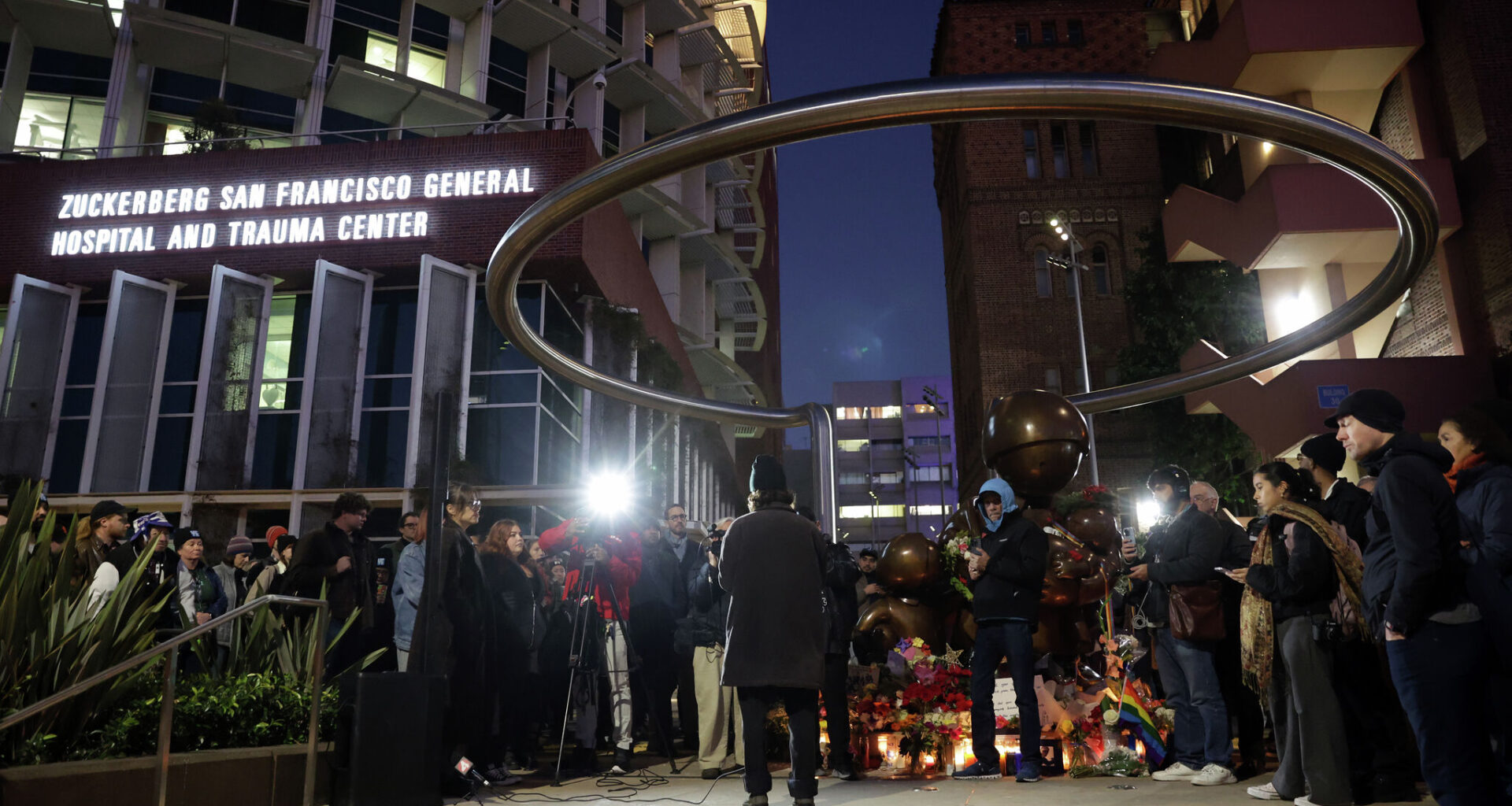
University Professional and Technical Employees union members rally outside San Francisco General Hospital on Dec. 11 in response to the fatal stabbing of social worker Alberto Rangel.
Scott Strazzante/S.F. Chronicle
Behavioral health staff at Ward 86 at Zuckerberg San Francisco General Hospital are still reeling from the fatal stabbing of our colleague Alberto Rangel on Dec. 4, 2025. Alberto was my friend, and I am still in shock. He had a way of bringing joy and groundedness to the workplace, and we deeply respected and trusted him.
His loss has brought renewed urgency to our long-held concerns about safety in our clinics. Last month, the San Francisco Department of Public Health released an internal audit showing where leadership has fallen dangerously short. UCSF supplies the frontline behavioral health staff to the department, but refuses to adequately invest in them.
For years, we’ve been raising the alarm about UCSF’s approach to our clinics: under-resourced and underpaid. This cannot continue. At Ward 86, social workers carry caseloads of as many as 600 patients. In contrast, the city of Alameda Health System enforces a patient ratio of 1 to 50 for social workers serving similar high-acuity populations.
Article continues below this ad
In the wake of Alberto’s death, the Department of Public Health added security at some hospital sites. But many UCSF campus social workers are still working in clinics without security, even as they conduct home visits and deploy with street teams.
In February, our union surveyed department-affiliated UCSF social workers. A staggering 90% of us reported experiencing some type of assault, threat or intimidation (physical, sexual or verbal) at work. Over 71% said they’re considering leaving their positions at UCSF due to safety concerns. Over half of the department-affiliated UCSF social workers have been on the job for three years or less — and 80% of staff do not stay past six years. This revolving door dynamic creates chronic short staffing, with clinics always playing catch-up.
San Francisco Chronicle Logo
Make us a Preferred Source to get more of our news when you search.
Add Preferred Source
We’re constantly trying to bring new people up to speed as we’re losing experienced clinicians, which disrupts continuity of care. We see the impacts every day in our clients’ frustration with long wait times, new faces they’re expected to trust and interrupted services. These conditions increase the risk for staff and patients. We will never make our work 100% risk-free, but we can do so much better.
To boot, we are also underpaid. Within UCSF, social workers in department-affiliated roles are paid 33% less on average than colleagues at UCSF hospital sites like Parnassus, Mission Bay and Mount Zion — who often serve more stable patient populations in lower-risk settings. Despite holding identical clinical licenses and performing the same level of work in higher-risk settings, UCSF does not allow its department-affiliated social workers to move up the career ladder available to their hospital-based counterparts.
Article continues below this ad
My colleagues love their patients. But this two-tiered system forces them to move to higher-paying hospitals, further exacerbating our staffing problems.
The Department of Public Health’s audit backs up our concerns. It recommends immediately installing new weapons detection systems, increasing on-site security and creating a new governance structure to connect us — the frontline staff — with department leadership regarding safety policies. These steps must be taken.
But the audit uncovered deeper structural issues and calls for “adequate workflow for outpatient and clinical setting grievances.” In other words, when our social workers face caseloads in the hundreds, it backs up the system and makes patients upset, creating combustible situations.
The audit identifies “staff working alone without duress buttons or escorts” as a risky practice. At many UCSF-affiliated sites, that’s not a rare occurrence. It’s standard practice.
The audit says staff feedback must be embedded into decision-making because of our “essential insight.” That’s obviously true, but we’ve had to repeatedly push just to obtain a meeting with UCSF leadership following Alberto’s death.
Article continues below this ad
Guest opinions in Open Forum and Insight are produced by writers with expertise, personal experience or original insights on a subject of interest to our readers. Their views do not necessarily reflect the opinion of The Chronicle editorial board, which is committed to providing a diversity of ideas to our readership.
Read more about our transparency and ethics policies
We have been loud and clear on the importance of increased behavioral health staffing when it comes to safety. We are calling for a real partnership between the city of San Francisco and UCSF to invest in our underfunded mental health programs. This sharing of responsibility is not unheard of. The mayor’s office recently announced a historic partnership between the city and UCSF to expand inpatient psychiatric beds by renovating UCSF’s Hyde Street Hospital. Who will now take responsibility to provide safe staffing in our high-risk settings?
As we approach six months since Alberto’s death, we’re still showing up for our patients every day. That commitment hasn’t changed. We are equally committed to breaking the vicious cycle of adverse care and preventable violence. Safe staffing in healthcare is a basic, well-established standard — not an aspirational goal. It is shameful that one of the wealthiest institutions in one of the wealthiest cities in the world has not made the investments necessary to keep San Francisco’s healthcare workers and residents safe. We are asking the city and UCSF to take concrete action now, before more harm is done.
Juliette Suarez is a licensed clinical social worker at UCSF and a behavioral health unit representative and co-chair with the UPTE-CWA Local 9119 union.