
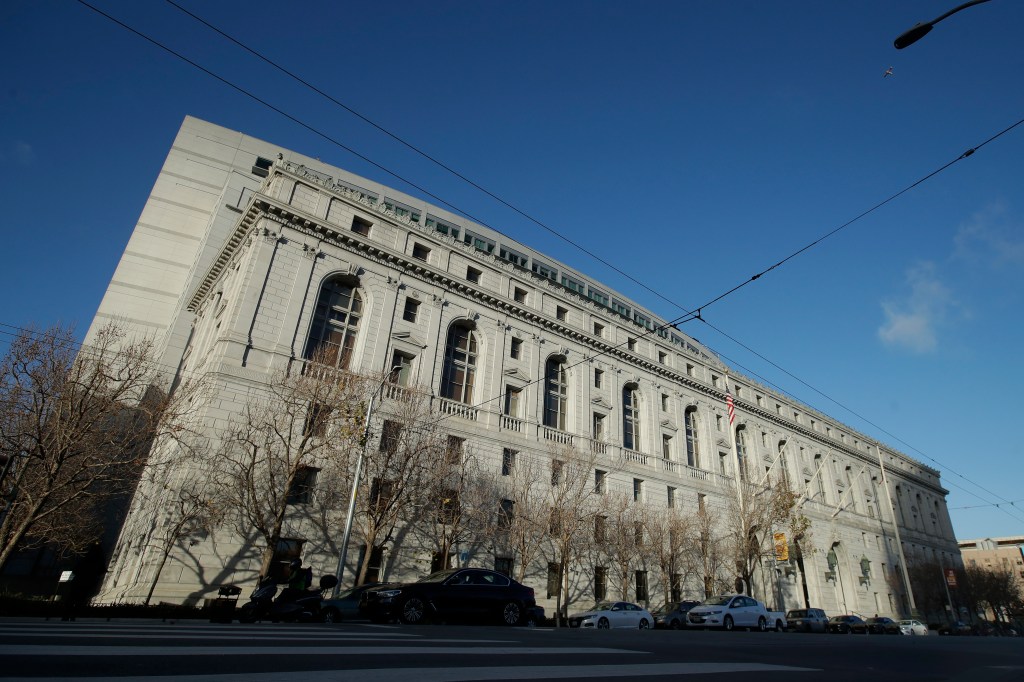
A recent California Supreme Court ruling declaring that cash bail can only be denied to criminal defendants charged with violent crimes, and prohibiting artificially high bail, has been hailed by civil rights advocates as a milestone that further erodes the injustice of thousands of people sitting in jail because they are poor due to their socioeconomic status and financial constraints.
But it’s not fully clear how sweeping the impact of the opinion — borne from a 2021 San Mateo County case where a man was jailed for six months after buying a hamburger with a lost credit card — will be. The ruling’s biggest champions assert that jail counts should swiftly tumble, while other stakeholders echo the high court’s calls for legislation to clarify things once and for all.
On Thursday, the state’s Supreme Court justices reconciled competing clauses in the state Constitution: one that uses public safety citations to deny bail, the other an enumerated list of offenses that warrant pretrial detention, namely violent crimes and sexual assault offenses.
Their conclusion was that only defendants charged with crimes in those categories can be summarily jailed prior to trial. For other criminal defendants, the justices ruled, trial-court judges must still exhaust non-bail options to ensure court appearances before resorting to bail — as the high court prescribed in its 2018 Humphrey ruling, which pushed judges to consider a defendant’s ability to pay when setting bail — and mandated that if they do find bail is appropriate, they cannot issue “artificially high or objectively unattainable bail as an end run to effectuate pretrial detention.”
That latter clause is the catalyst for significant changes going forward, said Carson White, a supervising attorney with the Washington, D.C.-based Civil Rights Corps, and who represented petitioner Gerald John Kowalczyk in appellate court arguments.
The ruling “rights this historic wrong of incarcerating presumptively innocent people pretrial, separating them from their families, coercing them into pleading guilty, and depriving them of their most basic constitutional rights just on the basis of how much money they have,” White said in an interview. “There’s a bright line now that exists that provides less latitude to try to find ways around not giving affordable bail.”
Josh Martin, a San Mateo County deputy district attorney whose office argued to uphold Kowalczyk’s detention, said he does not anticipate major changes in how he and his office will evaluate and argue for bail, but did say questions still remain, including how “reasonableness” and affordability will be determined.
“Where things become challenging is when we get into gray areas where there’s no law written,” Martin said. “This opinion indicated that if a defendant claims they cannot afford some amount of bail, after we’ve ruled out non-monetary conditions of release, that it’s their burden to demonstrate that. And I’m having a bit of a hard time envisioning how that’ll play out.”
Kowalczyk was arrested in January 2021 after he reportedly tried to use several credit cards, that were not his, to buy a hamburger at a fast-food restaurant. Several of the attempted transactions were denied before he used a card that worked; he then reportedly sought a refund, which was also denied, and he left the eatery without the hamburger.
Citing in part more than 60 prior convictions encompassing identity theft and assorted non-violent offenses, as well as his delinquency with making court appearances, a judge initially set his bail at $75,000, then revoked his bail and ordered him held in jail, where he stayed for six months until he eventually pleaded no contest to a misdemeanor identity theft charge.
During that period, he unsuccessfully petitioned the court to release him on his own recognizance, and with the help of White and her organization secured a review by the state Supreme Court to provide clarity for unresolved questions from the court’s earlier Humphrey ruling. Humphrey was itself a groundbreaking decision that moved trial-court judges away from relying on preset bail amounts for offenses, reoriented them to consider an arrestee’s ability to pay when setting bail, and pushed judges to more thoughtfully consider non-cash conditions, such as electronic monitoring programs and drug or alcohol treatment, to foster a safe jail release.
But several academic studies, including reports produced at UCLA and the UC Berkeley School of Law, found that pretrial jailings actually increased in the wake of the Humphrey ruling being affirmed in 2021, with judges aligning with prosecutors’ public-safety arguments to keep defendants detained, or issuing bail amounts too high for them to afford. That laid down the groundwork for Kowalczyk’s appeal to become an avatar for the larger conflict.
The court’s unanimous ruling, authored by Chief Justice Patricia Guerrero, echoed Humphrey language in stating that “liberty is the norm, and detention prior to trial or without trial is the carefully limited exception.” She reinforced the notion by concluding that “while the amount of bail need not be easily affordable or convenient to the defendant, the court must set bail in an amount that is consistent with, and designed to effectuate, a defendant’s general right to pretrial release.”
She added, “Our Constitution reflects a balance between a criminal defendant’s general right to pretrial release and the governmental interest in protecting public safety and ensuring the integrity of the criminal justice process while the defendant awaits trial. To the extent the voters desire to adjust that balance, it remains in their power to do so.”
The sentiment of that last line was reinforced in a concurring opinion by John Shepard Wiley Jr., a judge with the 2nd District Court of Appeal serving a temporary appointment with the high court, who urged lawmakers to take the burden off the court to reform the state bail system.
The Kowalczyk “decision invites a legislative and executive response. I hope the invitation is accepted,” he wrote.
It’s an open question that Stephanie Campos-Bui, a UC Berkeley law professor who has closely tracked the implementation of the Humphrey decision, said tells her more needs to be done to fully realize the goal of diminishing the influence of money on defendants’ presumptive liberty.
“If we want judges to adhere to Humphrey and Kowalczyk, they, I think, want cover,” she said. “I think having the legislature put something into state law that says, ‘Here is what you’re required to do, here’s what you’re required to consider and here’s what you’re not,’ allows judges then to say ‘I am following state law,’ not, ‘This is my interpretation.’ “