
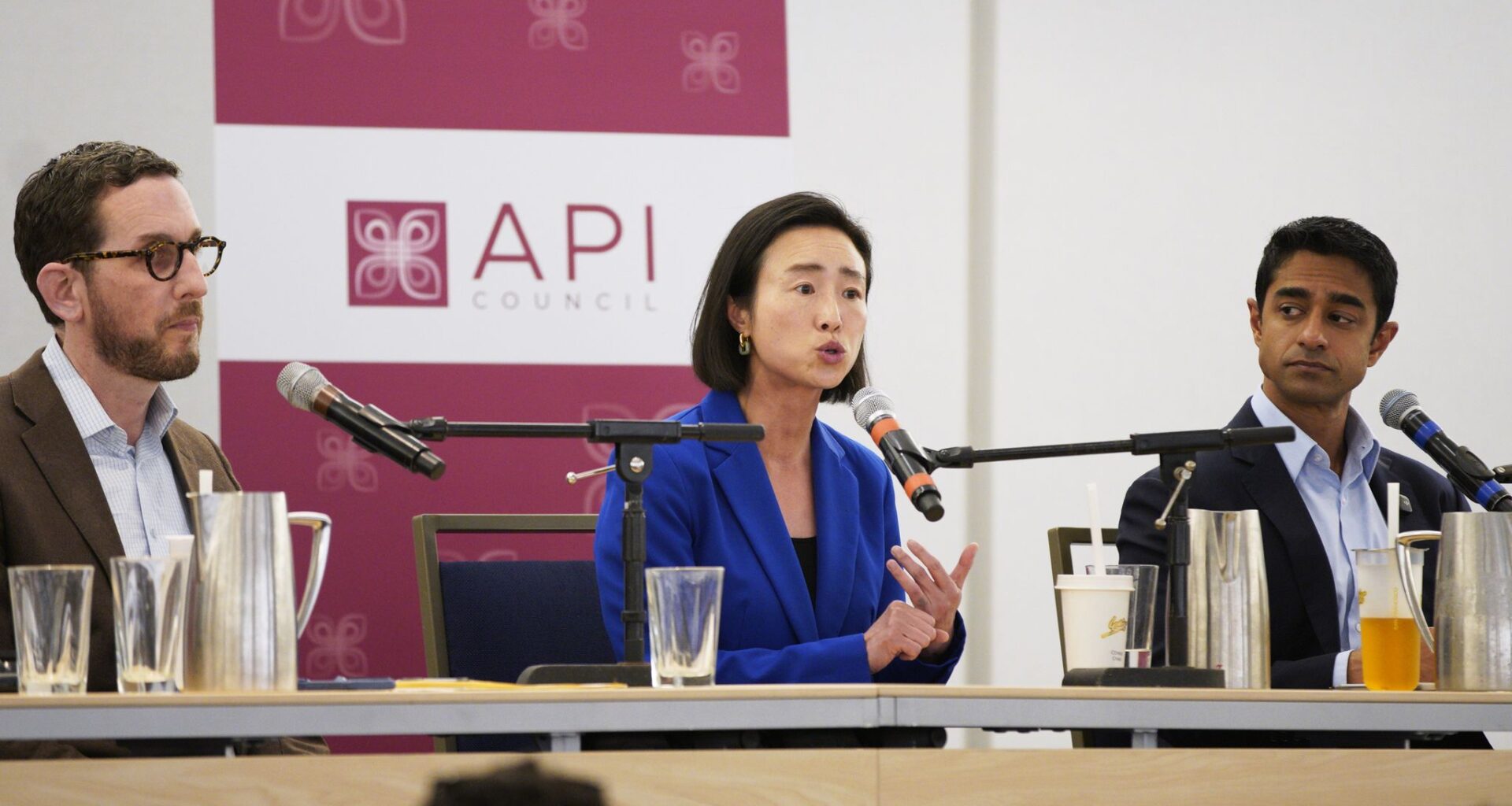
State Sen.Scott Wiener, Supervisor Connie Chan, and Saikat Chakrabarti at the API Council Congressional District 11 Town Hall in Chinatown.
Giselle Garza Lerma/S.F. Chronicle
Ken Yu was initially reserved when Supervisor Connie Chan knocked on his door in San Francisco’s Silver Terrace neighborhood to try to win his vote.
Chan, who is running to replace Rep. Nancy Pelosi in San Francisco’s upcoming congressional race, introduced herself in English, but Yu looked confused.
Article continues below this ad
“Do you speak Chinese?” she asked.
He nodded. As soon as she switched to Cantonese, he smiled and warmed up. By the time she bid him farewell, Yu had promised he would vote for her in the upcoming June primary.
“I know she’s Chinese and I always see her in Sing Tao,” Yu told the Chronicle in Mandarin, referring to the Chinese newspaper. “I know she has good ideas.”
Supervisor Connie Chan gives Bayview resident Ken Yu a poster after speaking with him about her run for Congress.
Jess Lynn Goss / For the S.F. Chronicle
In her bid to become the first Chinese American member of Congress representing San Francisco, the Richmond District supervisor is counting on the backing of the city’s large Chinese American community.
San Francisco Chronicle Logo
Make us a Preferred Source to get more of our news when you search.
Add Preferred Source
Chinese Americans — who comprise almost a quarter of the city’s population — have played pivotal roles in recent elections, helping to elect Mayor Daniel Lurie and recalling a supervisor for the Sunset District.
Article continues below this ad
Chinese-American voters could be the key demographic base that helps Chan advance from the June primary to the top-two general election in November. She is being significantly outspent by her well-funded opponents: state Sen. Scott Wiener and former tech engineer Saikrat Chakrabarti. She has won support from a broad-based coalition of Chinese Americans across the political spectrum, including Trump supporters, former moderate Republicans and moderate Democrats who opposed her supervisorial reelection campaign in 2024.
Chan’s donors point to this support. More than a third of her donors had a Chinese last name, compared with an estimated 4% of Wiener’s and less than 2% of Chakrabarti’s, according to a Chronicle analysis. The Chronicle reviewed the names of all of Chan’s donors and a random sample of hundreds of donors to Wiener and Chakrabarti’s campaigns.
Her backing among Chinese Americans in San Francisco speaks to just how much the community hopes to elect someone to Congress who looks like them, speaks their native language and has first-hand experience with their struggles. Only five representatives with Chinese ancestry sit in Congress.
Community members told the Chronicle that President Donald Trump’s hawkish policies toward China and anti-immigrant rhetoric has helped drive anti-Chinese racism and that they’re hoping a House member from their ranks would fight for them.
“I believe that our people need a voice and she will be that voice,”said San Francisco resident and businessman Dennis Wu, a former Republican who now identifies as a moderate Democrat.
Article continues below this ad
Wu previously donated to Chan’s opponent Marjan Philhour in the 2024 supervisorial election. But his feelings about Chan changed when he saw how she increased funding for the police department as budget committee chair and backed residents trying to reopen the Great Highway to cars. He’s since maxed out his individual campaign donation — $3,500 — to Chan’s primary bid.
Graham Ison talks to Supervisor Connie Chan as they canvas the Bayview neighborhood in San Francisco.
Jess Lynn Goss / For the S.F. Chronicle
Chinese Americans in the Bay Area have feted Chan with a slew of fundraiser events, including a sold-out banquet at Chinatown’s Far East Café in April and a Menlo Park fundraiser in March.
Wu pointed to Chan’s immigrant story: born in Hong Kong, raised in Taiwan, moved to the Bay Area as a teenager not speaking English. She became a community organizer, then a legislative aide before being elected to the Board of Supervisors in 2020.
“We’re so proud of her,” Wu said, “That’s the thing people don’t understand. For our people, this is like our daughter.”
Article continues below this ad
But with a big fundraising disadvantage, Chan’s support among Chinese Americans may not be enough.
Chan faces an uphill battle to be one of two candidates to advance to the general election in November. A founding engineer at Stripe, Chakrabarti has an estimated net worth of more than $160 million and has raised more than $5 million, mostly from a loan he made to himself.
Wiener has raised $3.5 million, chiefly from individual donors.
Like Chakrabarti, Chan has vowed not to take corporate donations, but unlike him, she is not a centi-millionaire. Chan has raised roughly $500,000. Even Marie Hurabiell, a former Republican who entered the race shortly before the filing deadline, has more cash on hand than Chan.
Chakrabarti has used his money to fund a massive digital and television ad blitz to introduce himself to voters in a district where he had next to zero name recognition before launching his campaign. He’s also dipped into his coffers to fund 185 street canvassers, including 30 Cantonese-speakers being paid at $45 an hour.
Article continues below this ad
Wiener, who is well known in the district after representing parts of it as a San Francisco supervisor and state senator, also has ramped up his digital presence.
Wiener enjoys longstanding support among some in the Chinese American community, while Chakrabarti has been investing heavily in winning them over. Both have Chinese-language sections on their website. Both have campaigned in heavily Chinese parts of San Francisco.
Chakrabarti’s campaign spokesperson, Tiffaney Bradley, said that the Chronicle’s donor analysis was not an accurate way to reflect his support since his focus has not been on fundraising and he’s knocked on more than 12,000 doors of people in the Chinese community.
Wiener’s campaign spokesperson, Joe Arellano, said Wiener was “proud to have the most donors from San Francisco supporting the race.”
To counteract the fundraising disparity in the race, Chan is also counting on votes from workers whose unions endorsed her, including the California Teachers Association, National Nurses United, San Francisco Labor Council and SEIU.
Congressional candidate Connie Chan phone banks with volunteers while at IBEW Local 6 in San Francisco.
Brontë Wittpenn/S.F. Chronicle
But Chan has also received support from Chinese-Americans outside the progressive community by appealing to working-class priorities.
At a recent Chinatown town hall hosted by the API Council, as Chan spoke forcefully in favor of the billionaire tax, a man listening to the live Cantonese interpretation burst into loud applause, briefly interrupting the moderator.
A Chinese immigrant from Vietnam, Harvey Chen had become a U.S. citizen five years earlier.
He was a longtime Republican and Trump fan. But he said he plans to vote for Chan, eager to see another Chinese American in Congress.
“Sometimes, politicians will say what you want to hear to get your vote, but once elected, will ignore you,” Chen, a retired San Francisco resident told the Chronicle, in Mandarin. “I’ve seen Connie Chan in the newspapers, as supervisor, getting to work.”
Similarly, Josephine Zhao, president of the Chinatown-based Chinese American Democratic Club, which endorsed Chan and Hurabiell, has historically been at odds with Chan over her opposition to the 2020 recall of then District Attorney Chesa Boudin and past criticism of policing. But as Chan’s positions on policing have evolved, so has Zhao’s opinion of her.
“We believe she understands what we’re going through and what we need on a national level,” Zhao said, including combatting anti-Asian racism and supporting working-class families.
Jason McDaniel, a political expert at San Francisco State University, said he thinks Chan is struggling to break through, with Chakrabarti likely to pull some of the progressive voters she needs.
But, he said, Chan could also draw Wiener’s Chinese-American supporters away from him, though he said Wiener was a clear frontrunner.
One thing is clear, though: “When you have the strong support of Chinese American voters in San Francisco, you can win races,” McDaniel said. “They don’t always vote monolithically but if you get the majority support in Chinese communities, that makes you able to win.”
Wiener and Chakrabarti have both made concerted efforts to court Chinese-American voters.
Wiener’s campaign has seized the nickname the late Chinatown organizer Rose Pak gave him — the “Giraffe” — printing it on posters distributed in Chinatown (Wiener is 6 foot 7 inches tall).
“He shows up,” said Hanley Chan, who sits on the San Francisco Veterans Affairs Commission and has worked with Wiener on veteran housing and legalizing psychedelics to treat PTSD.
State Sen. Scott Wiener at the API Council Congressional District 11 Town Hall in Chinatown.
Giselle Garza Lerma/S.F. Chronicle
At a recent Chinatown merchant walk, Wiener embraced Wong Tow Kuk, an 89-year-old longtime organizer who former Mayor London Breed often referred to as her “adopted grandmother.”
Leon Chow, who serves as a volunteer translator for Wiener’s campaign, said Wiener has helped Chinatown businesses struggling against unlicensed vendors. He cited a state law Wiener passed that authorized San Francisco to more aggressively curb the sale of stolen goods.
On a recent Thursday, Chakrabarti went door-knocking in the heavily Chinese Silver Terrace — the same streets where Chan had met Yu.
He said his campaign has had more than 1,100 volunteers.
When non English-speakers open the door, one of Chakrabarti’s two paid Cantonese organizers jumps in.
Saikat Chakrabarti speaks to Bayview residents while canvassing in the neighborhood in San Francisco on April 23, 2026.
Lizzy Montana Myers/For the S.F. Chronicle
But his greatest weapon might be the visibility Chakrabarti has gained from his ubiquitous social media ads.
“I heard a celebrity was in town,” 23-year-old Jeya Tadas said, approaching Chakrabarti on a residential street. Her boyfriend had told her the candidate had come knocking. “I was so excited when I heard ‘cus I’ve seen your ads all over YouTube.”
Tadas, a Filipino Chinese American, told Chakrabarti she felt like he was the only one putting in effort to “talk to the regular working class.”
“Sounds like I can maybe count on your vote in June?” he asked.
“Yeah sure!” Tadas responded.
Chronicle reporter Hanna Zakharenko contributed to this story.