
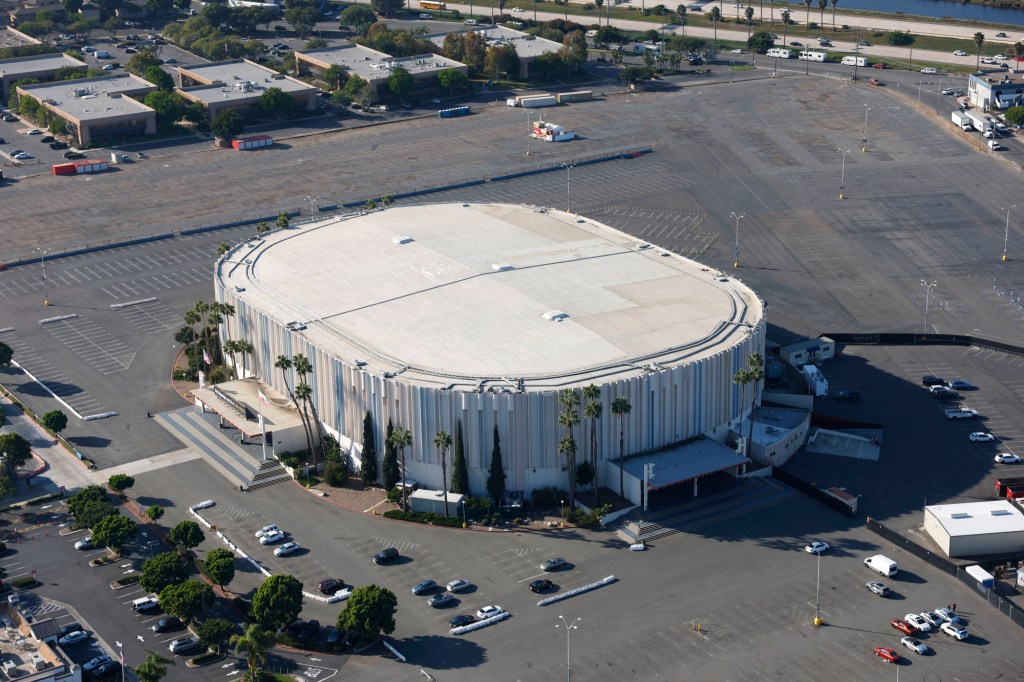
The Midway Rising development team seeking to remake San Diego’s sports arena site with thousands of apartments and a new arena recently received confirmation from a powerful agency that it can invoke a state housing law to build above the neighborhood height limit.
Last week, California’s Department of Housing and Community Development, or HCD, sent a technical assistance letter to the city of San Diego stating that the special benefits granted to housing developments under state density bonus law can be applied to the commercial components of the mixed-use mega project, including the proposed entertainment venue.
“The Midway Rising Project qualifies as a ‘housing development’ for purposes of the (state density bonus law), which makes the project eligible for concessions and waivers,” Melinda Coy, HCD’s chief of housing accountability, wrote in the April 30 letter. The letter was first reported by the Voice of San Diego.
The agency’s opinion adds credence to the team’s previously stated position. Midway Rising has maintained that the entirety of the project is entitled to a waiver from the 30-foot height limit in the Midway District because the restriction stands in the way of the project’s financial feasibility.
The team’s position is based on a prior HCD determination that opened the door to buildings taller than 30 feet in San Diego’s Coastal Height Limit Overlay Zone, as defined by Proposition D in 1972.
The Midway Rising project seemingly hangs on the interpretation of the state housing law as the height limit remains in effect. Although a 2022 voter-approved ballot measure temporarily struck the entirety of the Midway District from the coastal overlay zone, a state appellate court ordered the height limit reinstated.
“We have had a viewpoint that’s been consistent, that we could use density bonus incentives or waivers to exceed the 30-foot height limit even without the ballot measure being in place,” Michael Hansen, the project’s land-use consultant and the president of City Forward, told the Union-Tribune. “So the HCD letter that was received on Thursday is a really big deal for the project because it’s essentially confirming what we believe was the case all along.”
The favorable determination comes as San Diego Mayor Todd Gloria seeks to next month advance consideration of a long-term ground lease and development deal with Midway Rising.
“The HCD Technical Assistance Letter provides important clarity and reinforces the city’s confidence that the Midway Rising project can move forward consistent with existing state density bonus law,” Joya Patel, Gloria’s communications director, said in an emailed statement.
In September 2022, San Diego City Council members selected Midway Rising to lease and redevelop its real estate at 3220, 3240, 3250 and 3500 Sports Arena Blvd. The team is composed of market-rate housing developer Zephyr, affordable housing builder Chelsea Investment Corp., and sports-and-entertainment venue operator Legends. The Kroenke Group, a subsidiary of billionaire Stan Kroenke’s real estate firm, is the entity’s lead investor and limited partner.
The parties are now in the last leg of a protracted negotiating period designed to culminate in a long-term ground lease. The development plan, or what’s known as the Midway Rising Specific Plan, also requires a final stamp of approval by the City Council.
The land-use plan for the 49.2-acre property calls for 4,254 total residential units, a 16,000-seat replacement arena, 130,000 square feet of commercial space, 8.1 acres of parks, and another 6.4 acres of plazas and public space. It also memorializes the team’s commitment to build 2,000 residential units for households earning 80% or less of the area median income, or what’s considered affordable housing.
The plan calls for several 105-foot-tall mixed-use buildings with residential units and a 165-foot-tall entertainment center. The document is also written to allow for buildings as tall as 250 feet on 10% of the site.
The project’s momentum has been slowed in recent months.
In October, California’s 4th District Court of Appeal determined that the city violated California’s Environmental Quality Act, or CEQA, when it put the 2022 ballot measure in front of voters before sufficiently studying the environmental impacts of taller buildings. The ruling, upheld by the state Supreme Court, prompted the mayor, who proclaimed at the time that failure was not an option, to pursue other options to make the project’s tall buildings possible.
The city’s current approach relies on the application of state density bonus law, and includes potential legal cover from a bill advancing in the state Legislature.
The density bonus law, or California Government Code section 65915, was established in 1979. It exists to pull back the regulatory red tape preventing developers from building residential units reserved for low-income families. The law applies to what it refers to as “housing developments,” which the statute defines as including mixed-use projects.
Under the law, housing developments with at least 10% of units deed-restricted for low-income households, or those making 80% or less of the area median income, are entitled to build 20% more units than what’s normally allowed by local zoning laws. The bonus varies and is based on the percentage of units that are set aside for households at specific income levels.
The law also grants affordable housing developers one or more incentives to deviate from local regulations and reduce the cost of the project. It also requires cities to grant waivers from development standards that would otherwise render a project impossible.
Midway Rising did not provide an exact breakdown of the income levels — low-income, very low-income or extremely low-income — for the project’s 2,000 deed-restricted units. The team said it will set aside at least 355 units at the low-income threshold, representing 10% of the 3,545 units allowed under the base, residential mixed-use zone established in the specific plan. The set-aside secures a 20% density bonus, meaning the team can build up to 4,254 units.
The April 30 technical assistance letter from HCD appears to settle two outstanding questions pertaining to state density bonus law. The city asked the agency if it can treat the Midway Rising project as a housing development, and if it can grant an exception to the 30-foot height limit for the non-residential portions of the project.
Coy, the state agency’s housing accountability chief, said in the letter that the housing development definition applies because the project will be entitled as part of a single application for the entire site, with the developer required by development agreements with the city to build the promised number of units for low-income households.
The height-limit waiver is also appropriate because the project, constrained by the requirements in the city’s initial notice of availability for the site, would otherwise be impossible.
“Under these specific circumstances, it is apparent that the project as proposed, including relocation and reconstruction of the required arena, more than 4,000 housing units, and other project elements, would be physically precluded by the 30-foot height limit,” Coy wrote.
The letter is an unequivocal affirmation of Midway Rising’s application of state density bonus law, said Jeannette Temple, an executive at local land-use consulting firm Atlantis Group.
“It’s just confirmation that the city wanted because of the lawsuit situation, but I think that (the previous HCD letter) already made this Proposition D issue go away if you’re going to do affordable housing,” she said.
In 2022, HCD, in response to an inquiry from Temple on the Rose Creek apartment in Pacific Beach, determined that the height limit imposed by the 1972 voter initiative is a development standard that conflicts with the density bonus law. As such, the state law supersedes the local regulation for housing projects that meet affordability thresholds. The latest letter also has implications beyond Midway Rising, she said.
“Not only is this project able to use (state density bonus law), but I believe it would be available to any project that is looking for incentives and waivers where the commercial portion allows the developer to build the affordable units,” Temple said.
The city has also turned to the state Legislature to help insulate the project from legal challenges associated with state environmental law. Senate Bill 958, as currently written, prohibits the environmental impacts associated with increased building height from being considered significant impacts under CEQA. The bill, authored by state Sen. Akilah Weber Pierson, D-La Mesa, and sponsored by Gloria, could still be amended as it completes its path in the Senate and moves through the Assembly.
J. Keith Behner, a Point Loma resident who has put the city and the developer on notice about perceived deficiencies in the project’s environmental impact report, said he was disturbed by the city’s direction.
“This is just another continuation of the end run that the developer is making on this project, with the complicity of the mayor and the City Council and our state Legislature,” Behner said. “It continues to be a runaway train to build everything, everywhere, with no thought about the impacts and infrastructure needs.”
SB 958 recently passed out of the Senate Local Government Committee and is scheduled to be heard by the Senate Appropriations Committee on May 11. In June, a San Diego City Council committee is expected to consider publicly for the first time the proposed terms of the real estate deal with Midway Rising.