
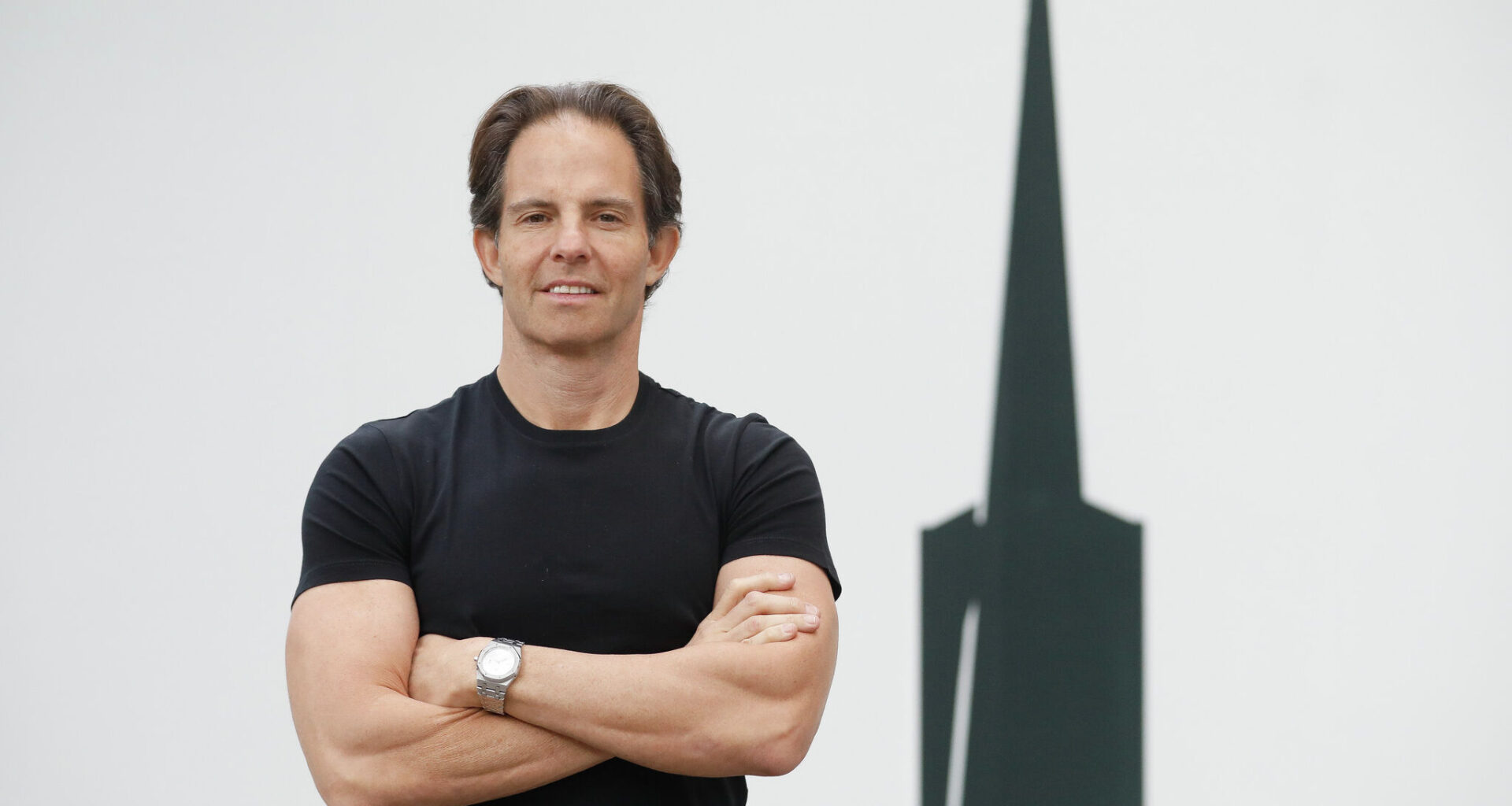
Michael Shvo, founder, Chairman, and CEO of SHVO, stands for a portrait outside the Transamerica Pyramid in 2023.
Lea Suzuki/S.F. Chronicle
By the time New York developer Michael Shvo was dismissing reports in January of behind-the-scenes turmoil related to his management of San Francisco’s Transamerica Pyramid, he had already been pushed out of his role, according to allegations made in a court filing on Monday by one of his former partners.
Deutsche Finance America, the U.S. arm of a German investment firm that was a co-manager with Shvo of the 48-story tower, said Shvo was removed as operator on Dec. 31, according to documents filed in a New York Court this week.
The new filing is part of a dispute between Deutsche Finance America and Bayerische Versorgunskammer, a major German pension fund, over the March sale of the Pyramid to Yoda PLC, an investment firm based in Cypress, for $725 million. The filing provides fresh allegations in a years-long clash between the former partners, who remain at odds regarding who gets what from the sale.
Article continues below this ad
A spokesperson for Shvo, whose name had been emblazoned on the side of the building but removed after it was sold, said Wednesday that he was the building’s asset manager until the purchase closed March 27 and remains a “managing member” of the Pyramid — contradicting Deutsche Finance’s court filing and statements made previously by the Pyramid’s new owners, who said Shvo received a payout that ended his “involvement” with the property.
The filing contradicts statements provided by Deutsche Finance to the Chronicle in January that Shvo remained “operationally responsible” for the Pyramid.
San Francisco Chronicle Logo
Make us a Preferred Source to get more of our news when you search.
Add Preferred Source
The spokesperson did not comment on other aspects of the court filing.
The new court filing states that Shvo struck a deal in February 2025 to be paid $45 million if he were to be “terminated.” At the time of the sale, it was announced that Shvo was being paid $34 million for his commission on the transaction.
Article continues below this ad
In the court filing, Deutsche Finance, believing Shvo had received a total of $79 million from BVK, said it is owed about $31 million from the sale in asset management fees. Deutsche Finance accused BVKof going to “conspicuous lengths” to avoid paying it. The filing also alleges that the German pension fundviolated European investment regulations, squandered its $2 billion U.S. real estate investment portfolio and blamed Deutsche Finance for the loss, which includes an estimated $900 million in pension capital.
BVK did not immediately respond to questions about Deutsche Finance’s complaint on Wednesday.
For a time, the venture between Shvo, Deutsche Finance and BVK looked like a model of excellent execution after BVK acquired the Pyramid in 2020 along with other buildings for $650 million. After the tower’s more than $200 million renovation wrapped up in 2024, Shvo’s firm helped drive leasing at the Pyramid, pushing rents to some of the strongest levels in its history, and he frequently described himself as the owner of the tower, calling it a reimagined trophy asset and a personal milestone — saying in interviews he had long aspired to own it.
By then, friction had already surfaced. A fraud lawsuit involving a new tenant at the Pyramid, the members-only Core Club, was an early signal of strain related to the building’s management. The legal drama and subsequent reporting by the Chronicle cast doubt over whether Shvo actually held a direct ownership stake in the tower, suggesting his role may have been more limited to management and branding.
Meanwhile in Germany, BVK came under parliamentary scrutiny as joint investments by the partners in other markets faltered. The pension fund later moved to replace several of its senior executives after acknowledging an overly close working relationship with partners in its U.S. real estate investment program.
Article continues below this ad
The partners have repeatedly declined to confirm their ownership structure for the Pyramid, though Deutsche Finance in previous comments to the Chronicle described BVK as the “majority stakeholder” in the U.S. real estate portfolio that included the Pyramid. The investment firm said in its court filing this week that it acted as a “co-manager” of the building, alongside Shvo.
In an opinion piece he wrote for the Chronicle on the resilience of San Francisco, Shvo said he was “the proud owner of the Transamerica Pyramid,” with no mention of his German partners.
“As part of BVK’s U.S. real estate investment strategy, (BVK and its affiliates) contracted with (Deutsche Finance) and Michael Shvo … to serve as asset managers for BVK’s U.S. properties,” Deutsche Finance stated in the new court documents. In exchange for managing the property, Deutsche Finance and Shvo were paid through a dedicated entity — BHSD Pyramid JVCo LLC — which was responsible for distributing the contractually agreed-upon payments.
The filing alleges that BVK’s U.S. real estate investments — including the Pyramid — ran into serious trouble in early 2024, partly due to regulatory pressure in Germany. It alleges that BVK moved beyond its role as a passive investor and began taking a more hands-on approach, but did so in a way that slowed or blocked key decisions like budgets, maintenance work, refinancing plans and lease approvals across its portfolio.
According to the complaint, that interference, along with challenging market conditions in the wake of the pandemic, dragged down performance across BVK’s U.S. holdings. The filing claims BVK avoided attributing its losses to its “own regulatory violations” and instead shifted responsibility onto Deutsche Finance, telling regulators, the media and pension beneficiaries that the investment firm was to blame for poor performance. It also alleges BVK misled German parliamentary inquiries about its role in the U.S. investments and falsely portrayed itself as a passive investor trying to exit.
Article continues below this ad
When questioned about its partnership with Shvo — who pled guilty in 2018 to a series of exotic schemes to avoid paying taxes in connection with purchases of art, jewelry and a Ferrari — BVK’s top official told the German media that Shvo was not directly selected by BVK, and that the pension fund invested indirectly through a separate asset management company.
By September 2024, Deutsche Finance and BVK agreed to revise the terms of their partnership: Deutsche Finance alleged in its complaint that it agreed to give up management of some properties to help bring management fees down — but in return locked in a safeguard: if it were pushed out of the Pyramid before the end of 2028, it would still get paid as if it had stayed on.
Shvo negotiated a nearly identical arrangement, and by February 2025 BVK had agreed to pay him roughly $45 million to unwind his role tied to the building, according to Deutsche Finance’s complaint, which states that on Dec. 31, Shvo was ousted from his role as co-asset manager.
In the weeks that followed, Shvo brushed off reports that BVK was trying to push him out, telling the San Francisco Chronicle — quoting a line from the “Formula 1” film — that it was “all noise … just drive.”
But behind the scenes, BVK was already negotiating the building’s sale, according to Deutsche Finance’s complaint, which alleges that on Jan. 27 the pension fund agreed on the “final terms” to sell the Pyramid to Yoda PLC. A March 29 press release issued by the buyer states that Shvo received the $34 million payment partially as a commission for brokering the sale “for both sides.”
Article continues below this ad
The sale of the Pyramid triggered the end of Deutsche Finance’s management role. The investment firm said it was contractually entitled to receive all fees it would have earned through 2028 under the revised 2024 term sheet. It alleged, however, that BVK tried to structure the deal’s closing in a way that would route sale proceeds away from the usual payment vehicle used to distribute those fees.
The filing argues that BVK’s refusal to pay Deutsche Finance its contractual fees is hard to square with the fact that, at the same time, it appears to have approved the $34 million payment to Shvo from the sale proceeds of the Pyramid. Deutsche Finance alleged this was on top of other payments he had already received, such as the $45 million he negotiated should his management contract for the building be terminated before 2028, effectively reducing what was left for investors. Deutsche Finance claimed this raises basic questions about how the sale was handled, what investors were told and how spending decisions were approved.
With its filing this week, Deutsche Finance is asking the court to uphold a previous order freezing proceeds from the Pyramid’s sale and keep the money locked up while arbitration decides whether it is owed about $31 million in fees.
Today, the building Shvo once described as a personal conquest is already starting to look different from the one he helped reimagine just a few years ago. As restaurants and tenant amenities on the Pyramid property continue to churn following its sale, some of the most visible traces of his renovation-era push, notably his branding on the facade, have been removed, a quiet but telling sign of how quickly his influence over the skyscraper has faded in just a matter of months.