
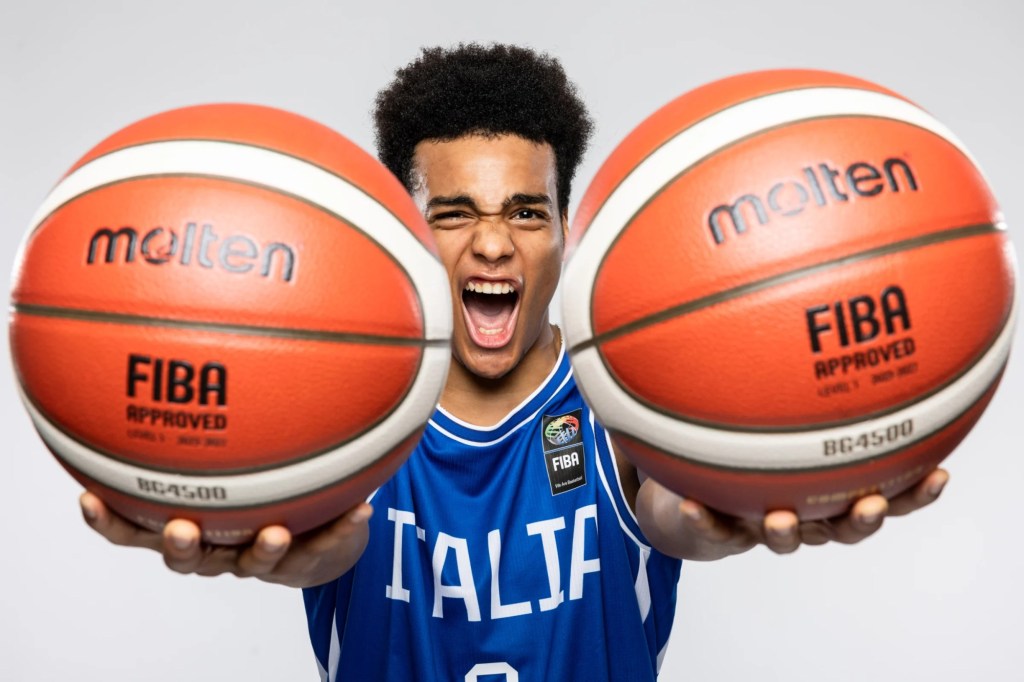
David Torresani’s father is from Milan and grew up during the heyday of soccer giant AC Milan, the 58-game unbeaten streak, the annual Serie A titles, the European Champions League trophies, the star-studded rosters, the club president who would become Italy’s prime minister.
He wasn’t interested.
“My pops hates soccer,” his 20-year-old son says, “so he never really got me into it.”
Soccer’s loss, basketball’s gain.
And now, San Diego State’s gain.
The school announced Monday that Torresani – a four-year pro in Italy’s highest division and the starting point guard on the under-20 European champions last summer – has committed to play for the Aztecs next season in what coach Brian Dutcher described as “a really good get for us.”
Dutcher isn’t oblivious to the rapid transformation of “college” basketball into what amounts to the world’s second highest-paying professional league. The Aztecs failed to make the NCAA Tournament for the first time in six seasons after losing twice against a Grand Canyon team with a 7-foot-1 Turkish pro and once against a New Mexico team after a 6-9 Croatian pro torched them for 24 points and 18 rebounds.
Next season they’ll have at least two European pros in the 6-2 Torresani and 6-9 Croatian wing Luka Skoric, and possibly three. Dutcher says they’re “close” to landing a European post as well.
Basketball IQ is generally not an issue with Europeans, particularly those who have been playing on veteran rosters loaded with former U.S. college stars in their late 20s and early 30s — and on teams that practice all week, often twice a day, before playing once on the weekend.
Or put it this way: The playbooks in Europe tend to be thicker.
The issue is assimilation, not just to language and culture but a more athletic, more explosive if less sophisticated game.
Torresani, in that regard, may have an advantage. He speaks English fluently — along with Italian, French and some German. He has a skillset predicated on attacking the basket and a commitment to defense.
“I think my game will really fit in a system like that,” says Torresani, who turns 21 on June 5. “My strengths are speed and athleticism, so I think I can play at that level. … I’m looking forward to coming there and showing what I can do.”
He also understands change.
“David knows how to adapt,” says Alessio Magarini Pellini, the founder of ItalBallers scouting service that tracks rising European prospects in Italy. “He was born and raised in Italy, then moved with family to Belgium in a different country with a different language and culture where he played until 14. Then he moved back to Italy to play and study (600 miles) away from his family.
“He can impact winning from the jump. He has pro mental strength and intangibles, played with five Americans this season, is a disruptive defender, a burner, high motor combo guard who thrives in transition, is a 38% 3-point shooter and has a 6-6 wingspan.”
For that, David (he pronounces it Dah-veed) can thank his father, a former second-division player in Italy who became a referee. And who hates soccer.
“That’s where the passion of basketball was born,” Torresani says. “When I was young, we would watch games together. One day when I was 5 years old, he said we can go somewhere and play basketball, and if you like it, you can keep going.
“I did the first practice, I really liked it. I kept playing. That’s it.”
His younger sister, Nicole, will play for VCU this fall. His 15-year-old brother plays as well.
His mother is from Benin, a sliver of land in West Africa squeezed between Togo, Nigeria and Burkina Faso. She came to Italy to join an older sister and met Torresani’s father in Milan.
They moved to Belgium when he was 11, then to Luxembourg at 14. From there, Torresani went to Nutribullet Treviso, a storied Italian club outside Venice, first playing for its youth teams, practicing with the senior roster at 16 and turning pro at 17.
Last spring he was invited to the Adidas Eurocamp, an annual event featuring the top 80 or so international players between 16 and 22 that is attended by scouts from every NBA team and many college programs. At the suggestion of his agent, Torresani provisionally entered the NBA Draft to raise his profile with the intention of withdrawing and either joining a U.S. college program or returning to Treviso.
He opted for the latter, largely because he wanted to represent Italy at the U20 European Championships in late July and most college teams wanted him on campus before then. Treviso also offered the added bonus of being coached this season by Alessandro Rossi, his coach with the U20s.
Torresani averaged 10.4 points and 3.4 assists per game for Italy, then 7.0 points in 18 minutes off the bench for Treviso, the lone player in the rotation under 26. His contract expired after this season, and college seemed to be the next logical step.
“This is my fourth season I’ve been playing pro basketball,” Torresani says. “This season was actually the one where I played the most. I think I improved a lot. Experience-wise, I’m more ready than I was last year.
“Talking with my American teammates, everybody was telling me that the college atmosphere is crazy and I had to go at least one year. They told me: ‘Bet on yourself. You’re good enough to play basketball in the U.S. at a good college level.’”
One of those teammates was Deshawn Stephens, who played for SDSU for two seasons in the early 2010s.
“Deshawn was the first one to call me on the phone when he knew about San Diego State,” Torresani says. “I think he knew it before me. They asked Deshawn about me. He told me it’s an amazing place, you’ll love it. So I got on the phone with the coaches, and then I hit Deshawn back and said, ‘Yeah, that’s a very good opportunity, everything is great, I might go there.’”
He pulled up pictures of San Diego, saw weather reports, read about its melting pot demographics.
Sold.
When a photo of the Italian U20 team was posted on the federation’s website last summer showing Torresani and other multiracial players, the comment section was filled with racial attacks in a country that has yet to fully embrace immigration. After Italy won, Torresani spoke out against their detractors, saying they provided motivation for the team and calling people who hide behind anonymous social media accounts “cowards.”
San Diego, then, offers a chance to play in front of a tolerant and accepting fan base.
“I think racism is everywhere in the world,” Torresani says. “I don’t want to lose my mind over that. But I’m very happy to go there. Everybody told me San Diego is a city with a lot of cultures. You have people from everywhere. I’m very happy, because I’ve never been in a big city like this, where everybody from everywhere is there.
“I’m really excited about that.”
Now he’ll have to adjust to how the college game is officiated. But the son of a referee can’t promise patience and understanding, a longstanding joke with his father.
“When I was younger, I would say we lost because of the referees,” Torresani says. “He would say, ‘No, you made a lot of mistakes. That’s why you lost.’ We can argue a bit about it. But no, I don’t change my approach to referees because of my father.”
And yes, he got a T or two in his youth for disputing calls but not at the pro level.
“I still argue with the referees,” he says, “but when I see them getting ready to give a technical foul, I shut up. I’m smart.”