
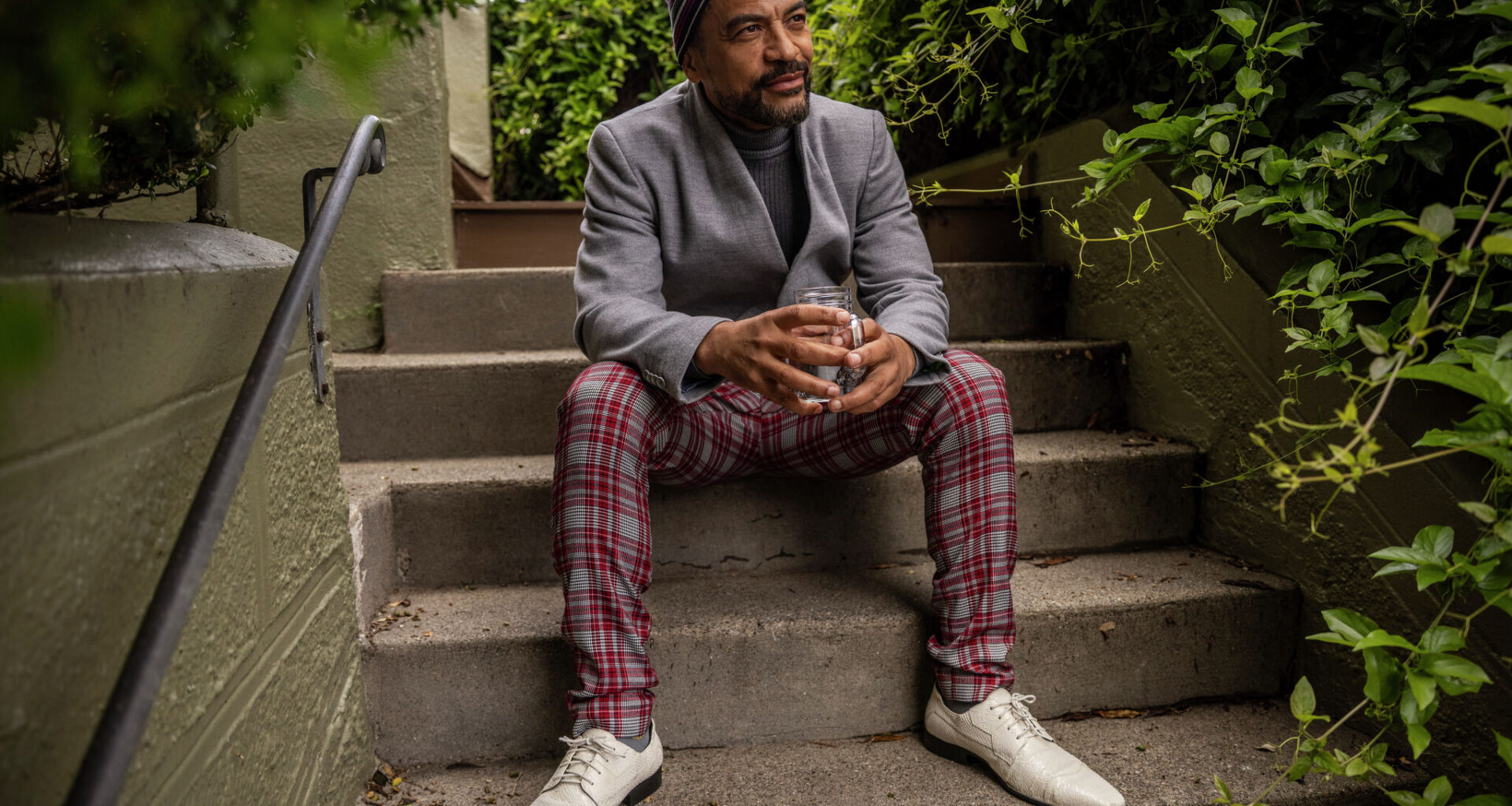
William Palmer, president of the San Francisco Sheriff’s Department Oversight Board, is seen outside his home in San Francisco on April 21.
Stephen Lam/S.F. Chronicle
One afternoon in December, San Francisco sheriff’s deputies patrolling the Tenderloin pulled over a bright red BMW convertible with expired registration tags. The driver wasted no time letting them know who he was.
“My name is president William Monroe Palmer,” he said, leaning out his window. “I’m the president of the San Francisco Sheriff’s Department Oversight Board. … How may I help you, sir?”
Palmer, 55, admitted his registration had expired, then asked why he’d been stopped, while suggesting he was being targeted for doing his job. He first declined to provide his driver’s license, citing his “constitutional rights,” then refused to hand the card over, saying, “I just have to show it to you.” After being ordered out of the car for “delaying” and cuffed, he called an attorney and implored passersby to intervene.
Article continues below this ad
William Palmer, seen near his home in San Francisco on April 21, has been booked several times into the jail that he oversees.
Stephen Lam/S.F. Chronicle
“Why am I in handcuffs?” Palmer asked, in an exchange recorded on the deputy’s body camera. “I’m the president of the Sheriff’s Department Oversight Board… You really think this is going to be swept under the rug?”
Palmer, who served 31 years of a life sentence in prison for a crime he committed as a teenager, was appointed to give voice to incarcerated people on a board created to hold deputies accountable and monitor the conditions of the jails they guard.
San Francisco Chronicle Logo
Make us a Preferred Source to get more of our news when you search.
Add Preferred Source
But a two-month Chronicle investigation found that the traffic stop was one of many recent encounters Palmer had with police. Since the Board of Supervisors installed him in July 2021, Palmer has faced a string of serious criminal allegations, undercutting the premise of his appointment. And he has openly disregarded some laws, raising questions about why city leaders appointed him and why they continue to allow him to volunteer on the commission.
Article continues below this ad
Four women have accused Palmer of violence, including one who said he raped her, and a fifth woman obtained a restraining order to protect her family from him that only recently expired, according to police and court records.
On top of those accusations, Palmer has been pulled over by law enforcement officers at least three times in recent months for low-level traffic violations and has accumulated nearly $10,000 in parking fines since 2020 that the city has largely allowed him to avoid paying.
Body-worn camera footage from Dec. 9 captured William Palmer, president of the San Francisco Sheriff’s Department Oversight Board, being pulled over by sheriff’s deputies for driving with expired tags.
Courtesy of San Francisco Sheriff’s Office
In November, Palmer applied for a parking-ticket waiver intended to help homeless people, even though he has lived in an apartment for years. The city forgave his debt, but after the Chronicle inquired about his eligibility, the City Attorney’s Office said it would investigate Palmer and his receipt of the waiver.
In hours of interviews with the Chronicle, Palmer denied using violence against or raping any women, and claimed his criminal history has rendered him vulnerable to cops and others who would weaponize his past against him. He sees the fact that he has cycled through county jail more times than he can remember since his release from prison as a strength in holding the sheriff accountable.
Article continues below this ad
The Chronicle shared its findings with every sitting city supervisor, asking whether they believed Palmer was fit to serve and, if not, why they had not acted to remove him. In response, four supervisors — board president Rafael Mandelman, Stephen Sherrill, Alan Wong and Danny Sauter — called for Palmer to resign. Mandelman, Sherrill and Wong said they were considering removing him if he did not step down. Bilal Mahmood said he supported a “fair, independent review of his fitness to serve.”
Shamann Walton, who created the oversight board and moved Palmer through the appointment process, said he had called on Palmer to resign several years ago after a stint in jail. The rest of the board either did not reply to requests for comment or provide responsive answers. Myrna Melgar said that he “sounds like a schmuck, but I have no evidence of what you are saying.”
San Francisco often touts the value of appointing people with “lived experience” to oversight boards. The city has appointed a public housing tenant to its public housing commission, a formerly homeless person to its homeless oversight panel and a former foster child to its youth commission. But Palmer’s ongoing contact with law enforcement makes his situation unique. When it comes to the criminal justice system, Mandelman said, “lived experience is one thing. Current experience is another.”
One of Palmer’s colleagues on the oversight board, Julie Soo, called on supervisors to remove him in March, saying he had acted “hostile” toward her for months and neglected his duties. She and Palmer, who denies Soo’s assertions, have verbally sparred at recent oversight board meetings.
Damon Cooke, who knows Palmer from prison, said the many allegations against Palmer were unusual for a person released from a life sentence. Unlike Palmer, Cooke said he has not had any run-ins with law enforcement since he was released from a life sentence four years ago.
Article continues below this ad
“The first time he gets himself in trouble, he gets the benefit of the doubt,” said Cooke, whose nonprofit, the Uncuffed Project, provides reentry services. “But when a pattern emerges, when it happens multiple times, then you have to start looking at him instead of the system.”
In this file photo from March 2023, William Palmer paints a honeycomb on the visiting room wall inside San Francisco’s County Jail No. 2.
Yalonda M. James/S.F. Chronicle
Perhaps as striking as the breadth of Palmer’s problems is how he talks about them. Far from owning up to any missteps, Palmer — who served a prison term that an appeals court later deemed unconstitutionally excessive — sees more injustice and evidence that he is being wronged by law enforcement and society writ large.
Palmer said his criminal past made it easier for women to accuse him of wrongdoing and that society had overcorrected for past abuses by men against women. He attributed his traffic stops to him being Black. He spoke of disobeying vehicle and parking regulations as “acts of rebellion against policies that are unjust to poor people.”
“I have earned the right to lead my people out of injustice into a community, into a nation, into a state and a city that believes in justice for all,” he said.
Article continues below this ad
“Why was Martin Luther King the right person? Why was Nelson Mandela the right person?” he said of his qualifications to continue serving. “Because we have stood strong and steadfast on justice for everybody. And that’s why Mandela got out of prison and became president of South Africa. And that is why William Palmer, after 23 years of constitutionally excessive punishment, could get out of prison and be the president of the San Francisco Sheriff’s Department Oversight Board, he could be the supervisor of District 8, and eventually he could be the mayor of San Francisco.”
A crime and a comeback
Palmer made a decision at age 17 that set the course for the rest of his life.
After earlier stints in juvenile detention, court records show, he pulled on a ski mask and carried a stolen revolver into a parking garage in Riverside. He ordered a man to drive to a nearby ATM at gunpoint, not realizing the victim was an off-duty police officer. When they arrived at a bank, the man pulled out his own gun and shot Palmer in the knee.
The young man pleaded guilty in adult court to kidnapping for robbery and began a life sentence on Feb. 17, 1988. In prison, he said, he read “The Autobiography of Malcolm X,” converted to Islam and made stacks of paintings and drawings. He started performing spoken word poetry under the stage name Soul Brother 9, a play on a nickname for James Brown, and learned about podcasting. He said he “almost gave up” on his hope of being released. But after California eased laws for youth offenders, a parole board released him on March 11, 2019.
In this file photo from December 2015, William Palmer makes a pitch to the panel for funding of his art career during a business pitch competition for prisoners enrolled in the entrepreneurs in training program at Solano State Prison in Vacaville.
Michael Macor/S.F. Chronicle
Another crucial moment came when the Washington Post Magazine profiled him in 2021. By then, an appeals court had found that his time behind bars was “grossly disproportionate to his offense.” The story documented his turbulent return to society and his early troubles complying with parole conditions that he thought were unfair, such as staying within a 50-mile radius of his home.
Palmer was arrested and accused of parole violations three times in the first six months of his release, records show, including for allegedly taking surreptitious photos of a woman’s undergarments. He told the Chronicle he was innocent and had been documenting his first trip on Caltrain. “Why is it a crime because I took a picture of a nice looking woman on a train?” Palmer said. “I was taking pictures of the train, and she was in it.”
In these early days, Palmer and his then-girlfriend co-founded a nonprofit, Life After Next, to help formerly incarcerated people and a media and entertainment company, Studio 3 Third.
In 2020, spurred by the Black Lives Matter movement, San Francisco voters approved the creation of a seven-member civilian board to watchdog the Sheriff’s Department. Intended to address persistent complaints that deputies abused people in the city’s jails, the board would make policy recommendations and appoint an inspector general to investigate in-custody deaths and complaints against the department.
Palmer was among the inaugural members appointed in 2021.
“My appointment is critical because I’m system-impacted,” Palmer said before the Board of Supervisors reappointed him in 2023. Referring to the fact he was still on parole, he added, “Not impacted in the past, but in continuation.”
‘You awaken this in me’
Asked about his subsequent arrests, Palmer offered an explanation: “I am vulnerable to women because I’m straight and I’m looking to get married and have children and a family.” He said he believed law enforcement had put people — usually women — in his path so they could make false allegations against him. He said that, in his dating life, he keeps encountering “psycho” women: “I’ve gone to spiritual houses, Christian, Muslim, and still find it there.”
“If you tell some people, ‘No, I’m not interested anymore,’ it’s like assault and battery,” Palmer said. “I am not lying. I am willing to do an undercover investigation to prove that this is happening every day.”
The Voice of San Francisco published details about some of the women’s accusations earlier this week.
In February 2023, Palmer traveled to Portugal and stayed with a woman he knew from the Bay Area. Later, records show, she told authorities his visit soured after she rejected his sexual advances. She said he grabbed her hair, scratched his nails into her face and screamed at her during an argument inside a car. “You awaken this in me,” she said he told her, records show.
The woman reported the incident to police in Portugal, but a San Francisco prosecutor who later examined the matter wrote in a filing that “nothing was done.”
Palmer told the Chronicle that he and the woman screamed and yelled at each other during a “bad breakup,” but he denied telling her “you awaken this in me.” He said he had only grabbed her by the hoodie to stop her from getting out of the car.
Several months later in San Francisco, a woman Palmer was dating reported to police that he had punched her in the jaw while she was driving, thrown her phone out of the window, taken her car keys and bitten her ear, according to police and court records.
In Palmer’s telling, his ex-girlfriend attacked him, jumped on his back and punched him. “I walked away from getting beat up from a girl,” he told the Chronicle. “I did not put one hand on her. And all I had to do was hit her one time and she would have been knocked out on the sidewalk.” He said he was not arrested.
That summer, Palmer picked up a woman near the BART station at 16th and Mission streets and took her to his apartment. She later told police he strangled and assaulted her there, on his red couch, and the district attorney charged him with sexual battery by restraint, sodomy by use of force, false imprisonment and two other assault-related counts.
William Palmer is seen in his recently flooded home in San Francisco on April 21.
Stephen Lam/S.F. Chronicle
Palmer said his attorneys told him not to talk about the case. But he did anyway.
He said he had just parked a minivan — which he used for a job he had at the time at a youth-focused restorative justice nonprofit in the East Bay — when he noticed the woman smiling at him. He said he asked her to dinner and she agreed, but that they changed plans to eat at his place. He drove her to his home and, as they lay on his couch, he realized she was transgender, he said.
“She tries to say, ‘It’s OK, it’s OK,’” Palmer said. “I’m like, it’s not OK because I’m not gay. I didn’t say that, but I’m like, ‘No.’”
Palmer said the woman balled up in a corner, crying. He said he tried to comfort her and offered her a ride back. She reluctantly got up to leave but stopped at the door, he said, so he pushed her out. He said he helped her to the sidewalk and went to get the minivan, but she ran to a nearby apartment “screaming and yelling bloody murder.” He said he got out of the minivan and tried to calm her, but she “just kept going.”
“I said, ‘Good luck, I don’t want no part of this,’” Palmer said. “I don’t date women who are loud.”
Palmer said he returned to his apartment and thought about “jetting.” Police and an ambulance arrived, but officers didn’t knock on his door. Two months later, he was arrested and charged.
Palmer spent the next five months in county jail, “presiding as a board member” from the inside, he said. Although he was unable to attend board meetings, he rejected Walton and then-Supervisor Aaron Peskin’s calls for him to step down. Then in April 2024, District Attorney Brooke Jenkins’ office dismissed his case, citing a new incident involving the victim and the need to assess her credibility.
At the time, the prosecutor on the case, Katherine Wells, said in court that the dismissal “does not negate the physical injuries to the victim, Mr. Palmer’s DNA on the victim’s neck, video of the victim running away from Mr. Palmer asking for help, her 911 call reporting the same, and Mr. Palmer’s changing statements.”
Palmer told the Chronicle the woman had made similar allegations against “another Black man in Chicago.” He said he learned the woman was a sex worker, but didn’t know she was at the time he picked her up. “When she saw me coming, she saw dollar signs,” he said. “When I saw her coming, I saw a possible date. So who was hunting who? Who was really the victim?”
Stay-away order
Five months after his release in the rape case, a woman from Santa Rosa — the ex-girlfriend who had helped Palmer start his nonprofit and for-profit company — sought a restraining order against him. She, her new partner and her teen daughter needed protection from his “violent behavior,” she wrote. “I cannot risk more harm to my family.”
The woman alleged that Palmer repeatedly came to her house uninvited, rang the doorbell while her 17-year-old daughter was inside and “stalked the house” until she came home. She said Palmer contacted her daughter through various online platforms to “try and get to me,” even though her daughter had blocked him and she had told him to stop. She said Palmer had attacked her new partner, unprovoked, leaving him with bruises, scrapes and a cracked rib.
“I have seen his volatility and I feel that we all three need protection against William Palmer,” she wrote.
Palmer said he, his ex-girlfriend, and her daughter were once like a family. He said he only went to her house once, to try to get her to transfer a phone number for the nonprofit they co-founded to his name. While he was waiting for her to show up, he said, she and her new boyfriend arrived. Palmer said the man attacked him, so he “whooped his ass.”
William Palmer, president of the San Francisco Sheriff’s Department Oversight Board, speaks during an interview near his home on April 21.
Stephen Lam/S.F. Chronicle
Palmer said police arrived and took him to a station, but that he was released after a few hours. The Santa Rosa Police Department declined to comment.
The ex-girlfriend also would not comment when reached by the Chronicle, saying only that Palmer “never physically attacked me.”
Records show a Sonoma County judge granted the restraining order in December 2024, requiring Palmer to not abuse or contact his ex-girlfriend and her family for a year.
The restraining order was still active when Palmer was arrested again in August, at his apartment, and booked into jail on suspicion of domestic battery and false imprisonment. Police described the incident as a “possible attempted sexual assault.” The DA’s office declined to charge him, citing insufficient evidence.
Palmer told a perplexing story about what had happened that involved a woman and her boyfriend staying at his apartment, a bizarre night out in North Beach and the woman “screaming” and reporting him to the police.
A month later, in a 5-1 vote, his colleagues elected him board president.
New board, new friction
The commission Palmer now leads monitors an office that has faced scrutiny for massive overtime spending, the alleged mistreatment of inmates and several recent controversies surrounding Sheriff Paul Miyamoto, including his hiring of a friend who lied to the FBI during a notorious probe into a Chinatown gang leader.
Yet the panel has struggled to get off the ground amid budget constraints and high turnover among its members. Its core duty — hiring an inspector general to investigate complaints against deputies and recommend discipline to the sheriff — remains unfulfilled.
Asked about his accomplishments on the board, Palmer could not list any. He said his focus was to change the culture of law enforcement. Meanwhile, the escalating tension between him and Soo, his predecessor as board president, has lingered over recent board meetings.
On the first Friday of March, Palmer seemed to take offense when Soo reported to the board that Mayor Daniel Lurie’s office had recently called her about an issue. Soo said the office had directed the panel to pause its search for a new inspector general to replace the last one, who left after just over a year, because of budget “uncertainties.”
William Palmer, seen near his home in San Francisco on April 21, has been accused of violence by four women.
Stephen Lam/S.F. Chronicle
“If there is a decision to be made concerning the board,” Palmer said, “the president will be there to help make that decision, period.” He then told Soo to be “silent” and that she was “dismissed.” Soo, who did not respond to a request for comment, looked around nervously as Palmer spoke, before walking off.
She later sent a letter to Mandelman and Walton calling for his removal. The oversight board’s clerk, Dan Leung, circulated a memo to its members condemning Palmer’s conduct and saying it could undermine the board at a time when San Francisco is considering culling and weakening its many boards and commissions.
Palmer said he thought the way he addressed Soo was appropriate. “Ain’t that lawyer talk?” he said. “Ain’t that official language?”
He said his work on the panel may have led deputies to pull him over and ultimately tow his BMW in December. Sheriff’s deputies rarely make traffic stops — the agency reported 142 total stops all of last year — and he had, one day earlier, toured the county jail with Sheriff Miyamoto in response to allegations that deputies had video-recorded a mass strip search of female inmates.
But stopping people with expired tags is a common, if controversial, police practice. Tara Moriarty, a spokesperson for the sheriff, said the deputies didn’t realize who Palmer was until after they pulled him over. She said the deputies, assigned to a patrol unit, “observed violations and took appropriate enforcement action.”
As president, Palmer said he intends to move forward with the search for a new inspector general, even if Lurie did not fund the position.
He also plans to serve the rest of his term, which ends next year. If he does not resign, the Board of Supervisors could remove him, but only by initiating “official misconduct” proceedings against him and proving that he misbehaved in his official capacity. The last time the board underwent such a process, which Mandelman described as “complicated,” was 14 years ago, when Mayor Ed Lee unsuccessfully tried to remove Sheriff Ross Mirkarimi for alleged domestic violence.
Cooke, the Uncuffed Project founder who knew Palmer in prison, said Palmer’s troubles could diminish the public’s appetite for having someone on the oversight board with experience behind bars. If he were in Palmer’s position, Cooke said, he would recuse himself while he sorted out his issues.
“This is not a knock on him personally, this is me understanding where he is in his development,” Cooke said. “I don’t think he has fully gotten the opportunity to grow.”
Acts of rebellion
In the years since Palmer bought his dream car in late 2020, city records show he has amassed 97 parking tickets carrying fines of $9,743, often for parking without a permit or not moving his car for street cleaning outside his apartment. His car has been towed repeatedly — sometimes, he said, because he parks in his neighbor’s driveway without permission.
Palmer said he does not believe low-income people — he puts himself in this bucket — should have to pay for a city permit to park outside their apartment because rich people have garages where they can park for free. He said he is too busy to move his car to comply with two-hour parking limits.
“I deserve the right to own a car, and I believe that what they are doing is unfair,” Palmer said. “I’m just the person who has the guts to say, ‘No, I’m not doing that.’ If your city budget is dependent on tickets and impound, there’s a problem.”
Palmer said the tickets were paid — just not by him. In November, city records show, Palmer applied for a one-time waiver to forgive the nearly $8,000 in unpaid tickets he had at the time. The application form, which Palmer completed in handwriting, said that participants needed to be “currently experiencing homelessness.”
The San Francisco Municipal Transportation Agency granted his waiver the same month, forgiving $7,740 in parking tickets. The SFMTA had first queried another city agency, the Department of Homelessness and Supportive Housing, which determined that he was “eligible,” city emails show.
Asked about Palmer’s situation, city spokespeople said they were committed to maintaining and improving the integrity of the program and their review process for determining eligibility. A department of homelessness spokesperson, Deborah Bouck, said the waivers were for people who have visited an “Access Point” for people experiencing homelessness and completed a housing assessment within six months of applying. She did not comment further on how the agency determined Palmer was eligible, but said it had asked the city attorney to investigate the issue.
William Palmer looks for an item on a table after his San Francisco home was recently flooded.
Stephen Lam/S.F. Chronicle
Palmer said he went to the city for help and was classified as homeless. He said he almost lost his place when he was in jail for five months over the rape allegation, and was still in a financial hole.
“I don’t know what homelessness means,” he said. “I’m not sleeping on no sidewalks. So if that’s what it takes to be homeless, then I ain’t homeless.”
Palmer initially told the Chronicle he was earning more than $100,000 for the first time in his life through his nonprofit work, but later said his contract with his fiscal sponsor was cancelled and that he was back to being jobless.
Palmer has made use of another SFMTA program for homeless or low-income people in order to waive $8,529 in towing fees on seven occasions since late 2021, according to the transit agency. The agency was unable to provide documents related to those waivers as of press time. The city attorney said it would examine his use of that program as well as the other homeless waiver Palmer received.
He said he hasn’t had any success getting the DMV to waive his unpaid car registration fees through a state program, but is still trying. His car will remain unregistered and his fees unpaid until they “do their job,” he said.
On a rainy day in April, Palmer pulled up in a rental car to meet a reporter at a cafe near his apartment in Duboce Triangle. His red BMW was in the shop.
Wearing white crocodile-print oxfords, red plaid pants, a long gray coat and an Adidas beanie, he led a reporter and photographer around the corner and into his apartment across the street from Duboce Park. The air inside was musty. Palmer said he had experienced flooding in the unit since February. A notice on his desk ordered him and his ex-girlfriend to pay nearly $9,000 in overdue rent. He said he was taking his landlord to court instead.
That day, he said his nonprofit had received a $500,000 grant to encourage formerly incarcerated Black men to quit smoking. He said he was trying to get a business loan to buy a cafe in Oakland to turn into a studio where he could host his podcast, Cafe Revolution, in front of a live audience.
William Palmer displays a visionary board he made while incarcerated, in San Francisco on April 21.
Stephen Lam/S.F. Chronicle
Standing next to the red couch where a woman said he raped her, Palmer shared the art he made in prison. He held up a vision board he’d made from his bunk — a collage of images representing his aspirations for life on the outside. There were the Dallas Cowboys cheerleaders, whose stadium he said he visited by pretending to be part of a school group. There was the Rock of Gibraltar; though he had yet to visit, he noted, Portugal was close enough.
“I think the only thing that’s not on there is the Sheriff’s Department Oversight Board,” he said, “but who knew?”
He gestured to a telescope in his apartment. Space was also on his vision board. “Haven’t been out there,” he said. But the stars were his inspiration. “When they say stars is the limit, I say no, that’s just my platform as I take off.”
Michael Barba can be reached at michael.barba@sfchronicle.com or via Signal at michaelbarba.42.