
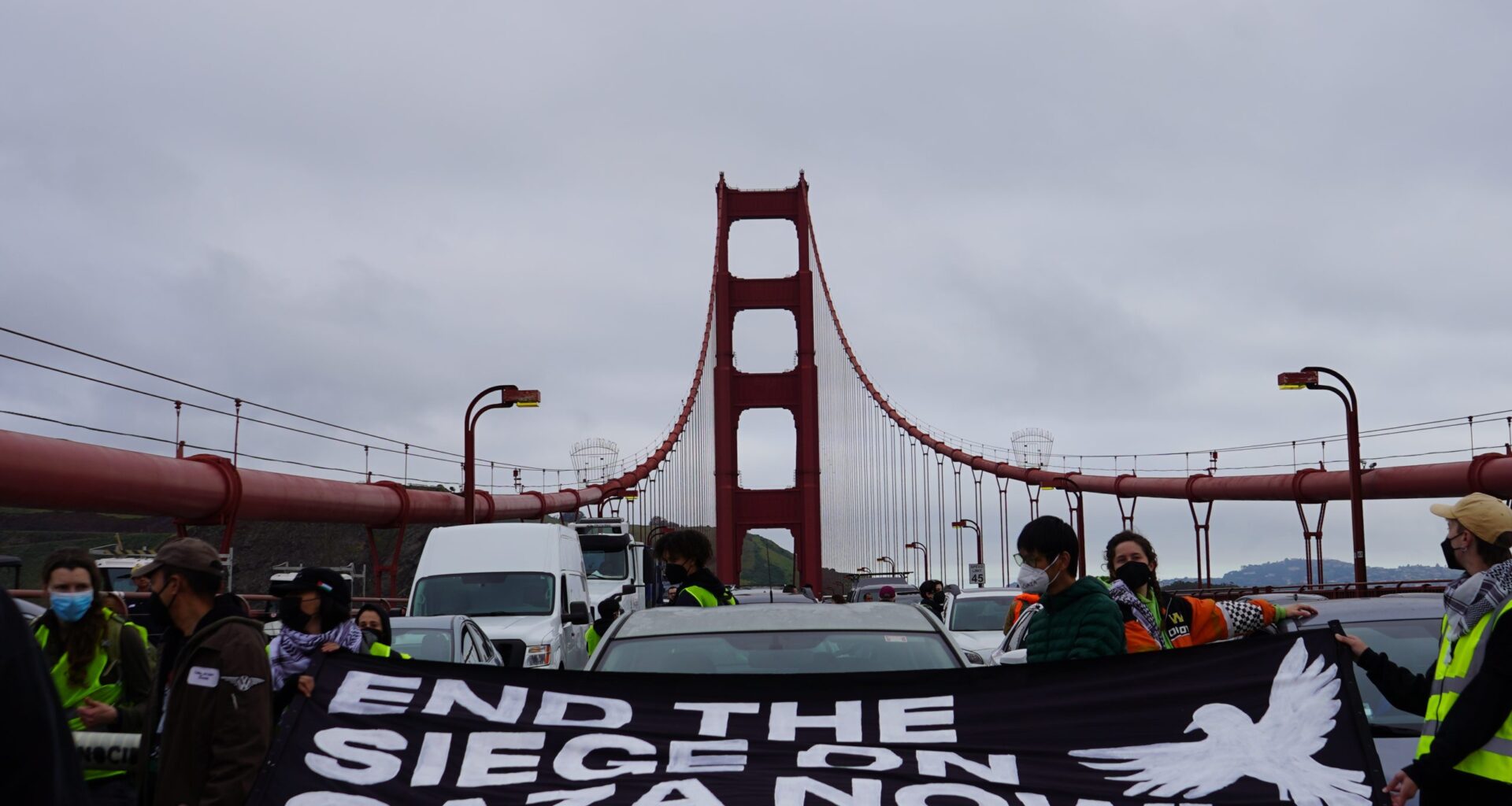
Seven activists facing felony charges for blocking traffic on the Golden Gate Bridge in a pro-Palestine protest in 2024 got a win in court on Tuesday: Judge Teresa Caffese held that the word “genocide” could be used in the trial, despite District Attorney Brooke Jenkins’ attempt to bar the word from the courtroom.
This pretrial motion mirrors one in a similar 2025 trial, in which five pro-Palestine protesters at Stanford University were also charged with conspiracy. The judge presiding over that case similarly permitted the use of the word genocide.
Caffese, who is overseeing the Golden Gate Bridge trial, also held Tuesday that keffiyeh scarves, which are often worn to signal solidarity with Palestinians, could be worn in the courtroom. The DA sought to prohibit articles of clothing intended to influence jurors, which Caffese granted; The keffiyeh, however, will not be considered such an article.
The judge also gave another small win to the defendants Wednesday, saying in a tentative ruling that likes on social media posts could not be admitted into evidence.
“A like can mean many things,” Caffese said, while maintaining that social media activity may be admitted into evidence later in the trial if relevant.
The defendants welcomed the judge’s rulings.
“Suppressing the word ‘genocide’ would set an extremely dangerous precedent,” said Manan Kocher, who serves as a spokesperson for the bridge protesters. Kocher was one of the 26 protesters arrested that day and charged by Jenkins. Kocher’s charges were diverted, and seven defendants with felony cases remain.
In an email after publication, the DA’s office emphasized that it “did not drop charges against Kocher.” Rather, “The court offered Kocher diversion and, upon successful completion of the terms the court laid out, the court dismissed Kocher’s case.”
“The DA is trying to keep any indication of what is happening in Gaza, what is happening in Palestine, out of this case,” Kocher said.
District Attorney Jenkins has brought the book down on the defendants: Six are facing up to 14 years in prison, and one a maximum of 15 years, for felony conspiracy charges and a litany of misdemeanors, including “false imprisonment.”
The Golden Gate Bridge earlier had also sought $163,000 in restitution from the group, a demand that was subsequently dropped.
Other pro-Palestine protesters have faced similarly harsh measures: 35-year-old Casey Goonan, a doctoral student at the University of California, Berkeley, was sentenced to 20 years behind bars in 2025 for a string of arsons targeting a police car and government buildings.
Much of the hearing Wednesday was spent deliberating over the DA’s motion to exclude all nine of the defendants’ expert witnesses from the trial, which has not started yet, but will once a jury is selected later this month.
Among the defense’s expert witnesses: A genocide scholar, a journalist who has reported from Gaza, a surgeon who worked in Gaza, and two employees of the U.S. Department of State.
Assistant District Attorney Angela Roze argued that most of the expert witnesses were not relevant to the case, and that testimony from the doctor would be “would be extremely inflammatory to the jury.”
The defense team — seven lawyers, each representing one of the seven defendants — disagreed.
Defense attorney Shaffy Moeel said State Department testimony would be “crucial” in providing a “behind-the-scenes view” that the American government was committing crimes in the Middle East, which influenced the protesters to take action that day.
Public defender Anthony Gedeon later said that those witnesses were being called in an attempt to prove that the United States violated its own law, not international law — a key element of the defense.
Defense attorney John Viola invited the court to think of the war in Gaza as a fire, and U.S. aid to Israel as fuel. Blocking the Golden Gate Bridge that day, he said, was part of an economic blockade with the intent of “stopping the flow of arms and aid and assistance to Israel in perpetrating these war crimes.”
But despite the defense’s attempts to widen the scope of discussion, Judge Caffese made clear she would seek to stick to the alleged crimes themselves.
She did not rule on the motion to exclude the witnesses, and instead said witnesses could be called upon if relevant, but made it clear it was highly unlikely all nine would be admitted. She advised the defense to whittle the list down, saying that they might be allowed just one.
“This is not the forum for a discussion or trial about foreign policy,” Caffese said.