
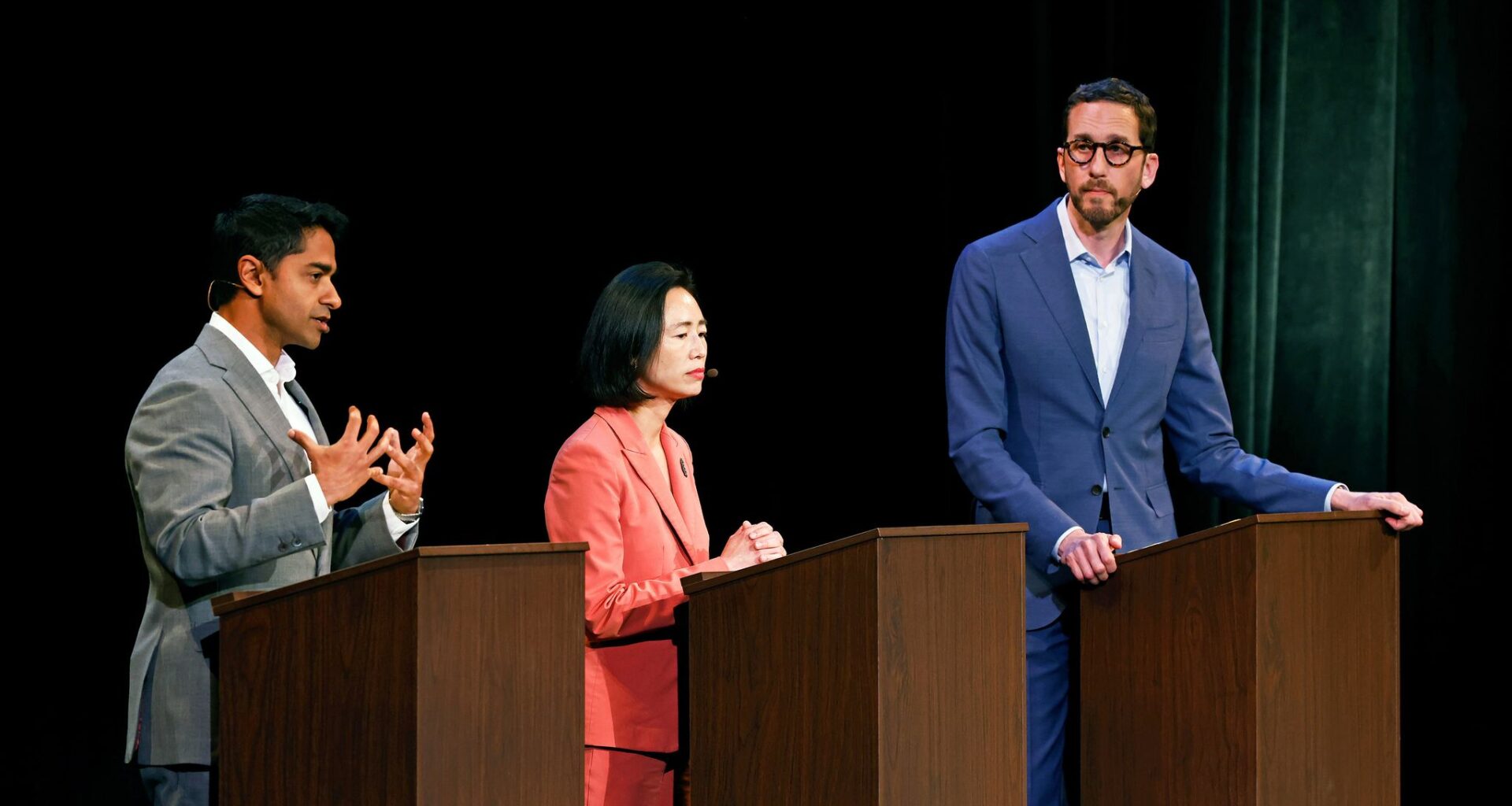
Saikat Chakrabarti, left, and Connie Chan are trailing far behind front-runner Scott Wiener in the race to represent San Francisco in the House.
Carlos Avila Gonzalez/S.F. Chronicle
Running to represent arguably the country’s most famously lefty city in Congress, former tech engineer Saikat Chakrabarti and Supervisor Connie Chan have each sought to claim the mantle of the true progressive champion in the race for San Francisco’s open House seat.
The two have split the lane and now are locked in an exceedingly tight campaign ahead of the June primary. As ballots begin arriving to voters this week, a new San Francisco Chronicle poll shows both Chakrabarti and Chan within striking distance of second place, with just a percentage point separating them.
Article continues below this ad
But they may have limited their appeal to voters in the process, making it challenging for either candidate to ultimately win.
The Chronicle poll found Chakrabarti and Chan trailing far behind state Sen. Scott Wiener, who is the preferred choice of Democrats across the ideological spectrum. Notably, all three received nearly equal support from self-identified progressives in the survey, while Wiener was a clear favorite for liberal and moderate respondents.
San Francisco Chronicle Logo
Make us a Preferred Source to get more of our news when you search.
Add Preferred Source
That has given Wiener, who won the California Democratic Party endorsement in February, a commanding advantage in the race. It would be a “very, very heavy lift” to overcome that lead, said Jonathan Brown, president of Sextant Strategies & Research, which conducted the poll for the Chronicle.
“The desire to be the progressive choice, particularly against a candidate like Wiener who has his own appeal with that audience,” Brown said, “was a short-term primary solution that’s going to leave whichever candidate makes the general election in a position where they really need to recast themselves.”
Article continues below this ad
In the Chronicle survey, 40% of likely primary voters said they plan to vote for Wiener, while Chakrabarti pulled 18% and Chan 17%, a statistical tie. No other candidate in the sprawling field came anywhere close.
Self-identified progressives broke more or less evenly: 32% for Chan, 31% for Chakrabarti and 31% for Wiener. But Wiener was the choice of nearly two-thirds of liberal respondents and 36% of moderates, about three times as many as either Chakrabarti or Chan.
The poll surveyed 819 likely voters in the district from April 28 to May 3.
Any of the three candidates — who all advocate for a universal, government-run healthcare system and fighting the Trump administration’s immigration enforcement raids — would be among the most progressive members in the House should they be elected in November. So Chakrabarti and Chan have sought to distinguish themselves by criticizing Wiener for opposing new taxes on local businesses and, most significantly, for his position on Israel’s war in Gaza after the Oct. 7, 2023, terrorist attack.
Wiener initially declined to label it a “genocide,” but reversed course after he was heckled at a forum in January. Though Wiener now aligns with Chakrabarti and Chan on rejecting future military aid for Israel, the tension continues to simmer in the campaign.
Article continues below this ad
It does not appear to be a decisive factor for most voters, however. Only 4% of respondents in the Chronicle survey singled out Israel and Palestinians as the most important issue for determining which candidate they will support. Another 4% said it was their second most important issue.
By comparison, nearly 60% of voters pointed to the cost of living as one of their two most important issues, echoing national concerns over inflation and the economy that have cratered President Donald Trump’s popularity. Housing, healthcare, Trump and homelessness all were mentioned by 20% to 30% of respondents.
“It feels like Chan and Chakrabarti are more responsive to social media than they are to where voters really are,” Brown said.
With only a few weeks remaining to win over a shrinking pool of undecided voters, who joins Wiener in the top two and the November runoff will probably depend on what advantage proves more potent: Chakrabarti’s enormous personal wealth, which has allowed him to blanket TV and social media with advertising, or Chan’s widespread support with organized labor, a powerhouse in California elections.
Chakrabarti is employing a flood-the-zone strategy to dominate the electorate’s attention. A founding engineer at Stripe whose net worth is estimated to be more than $100 million, Chakrabarti has poured nearly $5 million into his own candidacy. He planned to rally Thursday night with the popular streamer Hasan Piker, whose controversial leftist politics have become a flash point in Democratic primaries, earning a rebuke from a Wiener ally on the San Francisco Board of Supervisors.
Article continues below this ad
Chan significantly trails in fundraising, but could see a boost if the dozens of labor unions that have endorsed her send out their members to knock on voters’ doors before ballots are due. A last-minute endorsement by outgoing Rep. Nancy Pelosi, who attended a fundraiser for Chan in Washington, D.C., last month, would also provide a jolt of momentum.
The Chinese American community, which comprises a quarter of San Francisco’s population, could prove decisive in a close race.
Chan, who would be the first Chinese American to represent the city in Congress, has invested heavily in outreach to the community, but trails Wiener with those voters in the Chronicle poll, 36% to 18%. Chakrabarti, the choice of 13% of Chinese American respondents, is working hard to make further inroads, paying 30 Cantonese-speaking canvassers at $45 an hour.
If Chan is going to get ahead of Chakrabarti, Brown said, this is “an area where she’s really going to need to push in these final weeks.”