
Growing up, once I realized I didn’t have the talent to become a professional baseball player, I often imagined what my role might be if I were fortunate enough to work for a Major League Baseball team.
Four years after graduating from college, my persistence, patience, and a bit of luck paid off.
I joined the Padres in 1975 and spent three years working in the ticket office before becoming the director of promotions in 1978. Regardless of where I worked, it didn’t take long for me to understand a fundamental truth: baseball is a business.
Then, as now, revenue came from ticket sales, broadcasting, merchandise, concessions, sponsorships, parking — and yes, ticket sales. (I know, I said ticket sales twice. That’s because it was the primary revenue stream.)
My job was to generate incremental ticket sales.
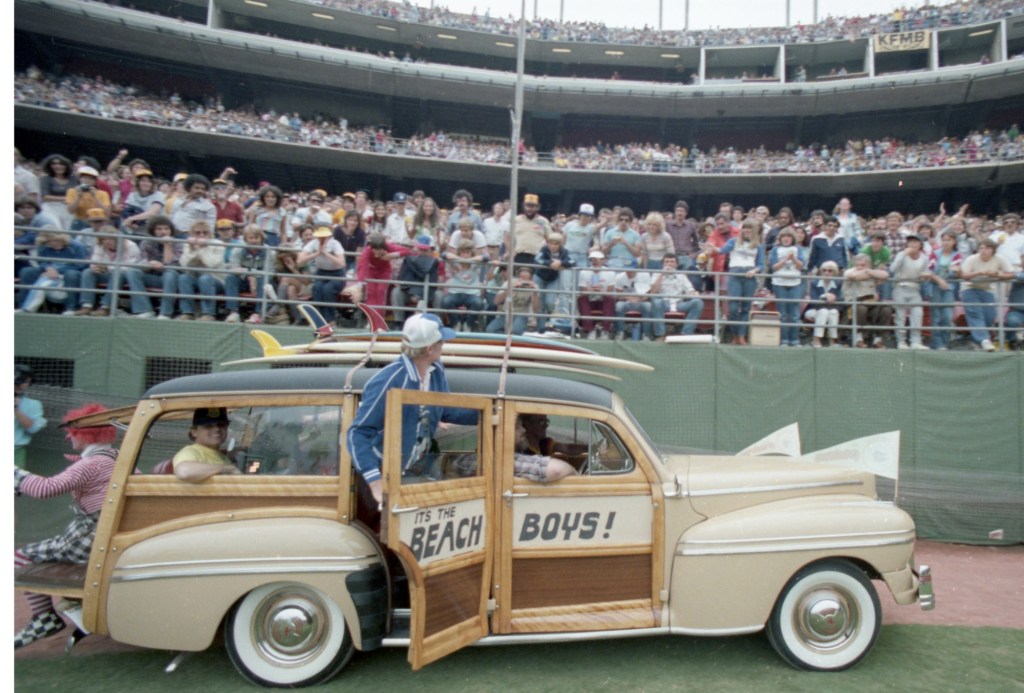
Which is how The Beach Boys ended up playing at Jack Murphy Stadium after a May 1982 game against the Philadelphia Phillies.
Then, beginning on May 8, 1983, and continuing each Mother’s Day when the Padres were home through 1987, the Wilson brothers — joined by Bruce Johnston, Al Jardine and Mike Love — brought “Good Vibrations” to “The Murph” and created a tradition that no one saw coming.
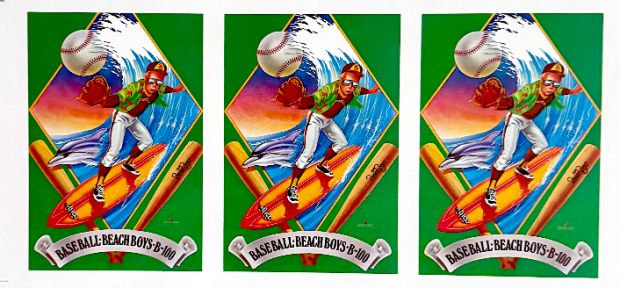 A promo for the San Diego Padres’ postgame Beach Boys concert in the 1980s. (Andy Strasberg)
I can hear music
When I worked for the Padres, our market research revealed that only about 15% of the population were baseball fans.
Those fans fell into three categories: “Devout” (they attend regardless of team performance); “Fence Sitters” (they become ticket buyers and respond to event promotions such as fireworks, giveaways, and deep discounts); and “Casual” (they will only watch or listen to Padres games on TV and radio, but not attend games).
Hoping to make my mark, I started thinking about how I could get the 85% who were not baseball fans to attend a Padres game.
For a brief moment, I considered staging a Portuguese-style bloodless bullfight after a Sunday game. Fortunately, sanity prevailed, and I landed on something more practical: a postgame concert.
The first act that came to mind was obvious — The Beach Boys.
I put together a rough pitch and presented it to Padres president Ballard Smith. He gave me the green light to make the deal, and on May 2, 1982, The Beach Boys turned “The Murph” into a day at the beach for 44,227 fans — more than double our average home crowd of 19,846. We were shut out 3-0 by the Phillies, but you never would’ve known it from the mood in the ballpark.
The concert was a financial success, and just like that, a new part of my job description was born: booking postgame entertainment.
Some acts were outside my comfort zone: Charlie Daniels, Juice Newton, Billy Ray Cyrus and Kenny Rogers.
Some performed better at the box office than others — the Doobie Brothers, The Monkees, the Temptations, Herman’s Hermits, the Grass Roots, Gary Puckett and the Union Gap, and the Village People.
One idea I seriously considered — but ultimately abandoned — was booking a stand-up comedian. Friends in the stand-up comedy business quickly pointed out that a 50,000-seat stadium isn’t exactly ideal for delivering punchlines.
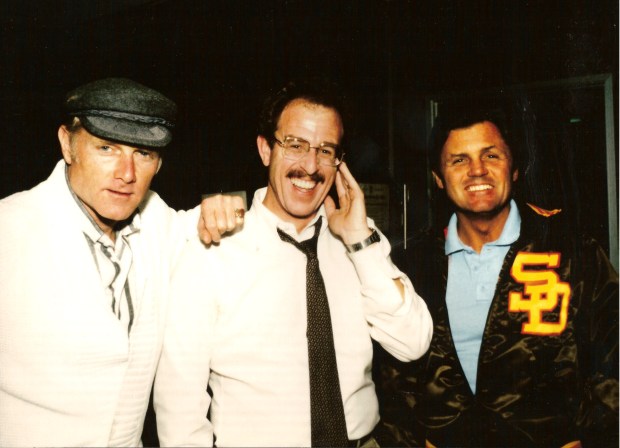 Andy Strasberg, center, poses with Mike Love and Bruce Johnston of The Beach Boys. Strasberg, a longtime San Diegan, helped arrange for The Beach Boys to play after Padres games at Jack Murphy Stadium in the 1980s and 90s. (Andy Strasberg)
Do it again
Along the way, we developed what would later be called “variable pricing,” modestly increasing ticket prices for games with postgame concerts. Reserve tickets for our first Beach Boys concert went for $6.50 and $7.50; they rose to $9 in 1984, and by 1990, they were $12.
We received little to no resistance from fans. In fact, they often paid less than they would for a standalone concert elsewhere. Season-ticket holders especially appreciated that their prices didn’t increase for those games.
Perhaps the greatest validation came when other teams began adopting the postgame concert concept.
At some point, I realized my daily responsibilities included negotiating with The Beach Boys, designing beach towel giveaways, reviewing fireworks inventory, and scheduling appearances for a man in a chicken costume.
Not exactly what I had imagined as a passionate, baseball-loving kid.
Looking back on my time with the Padres with a Friars Road address, I’m reminded of a number of short-lived traditions — some by design, others by happy accident.
There were ushers in tuxedos on opening day, team photos staged offsite, Ozzie Smith’s Fan Appreciation Day backflips, a dancing “plant” on the grounds crew during infield drag, and, of course, the ever-popular postgame concerts.
One of those traditions — The Beach Boys playing on Mother’s Day — was never planned. It simply evolved from the overlap between their touring schedule and our home games.
With changing times and my departure in 1996, these traditions have become distant memories of “Fun, Fun, Fun.”
Baseball historian and former Padres employee Andy Strasberg is a longtime San Diego resident.
Music to their ears
The Padres began hosting postgame Beach Boys concerts in 1982, starting what would become a Mother’s Day tradition. Here’s a look back:
Date/Score/Attendance/Ticket price
May 2, 1982/Phillies 3, Padres 0/44,227/$6.50-$7.50
May 8, 1983 (Mother’s Day)/ Padres 5, Cubs 3/47,500/$7.50-$8.50
May 13, 1984 (Mother’s Day)/ Phillies 8, Padres 3/42,576/$9
May 12, 1985 (Mother’s Day)/ Padres 5, Cubs 3/54,556/$9.50
May 18, 1986/Expos 8, Padres 3/54,654/$9.50
May 10, 1987 (Mother’s Day)/ Padres 14, Cubs 2/44,876/$9.50
May 22, 1988/ Padres 9, Phillies 2/48,558/$10
May 28, 1989/ Expos 10, Padres 2/54,520/$11
Sept. 9, 1990/ Padres 5, Braves 4/38,750/$12
Sept. 22, 1991/ Padres 6, Giants 3/31,129/$13
— Source: Andy Strasberg