
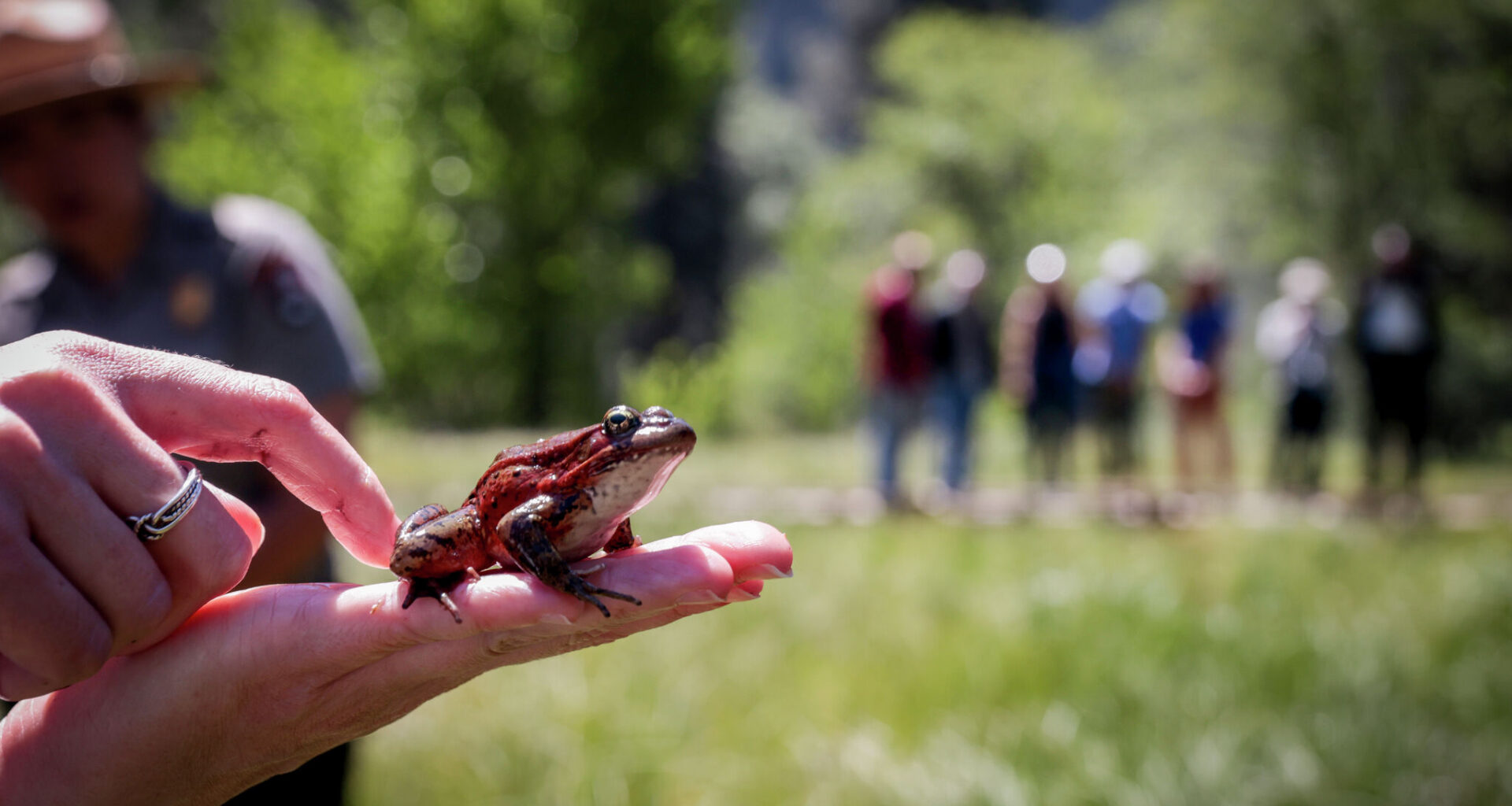
YOSEMITE VALLEY — The frog had no idea how big a splash it was making.
As it leapt from a schoolchild’s hands into a marsh along the Merced River on Thursday, the swamp jumper became the 10,000th native frog released in Yosemite National Park — a celebratory capstone to a 10-year effort to bring California red-legged frogs back to Yosemite.
Wildlife officials declared this week that the park’s once-vanished population of red-legged frogs is now self-sustaining, cementing the success of the experimental reintroduction program. Going forward, instead of regularly releasing the animals in Yosemite Valley, the area will serve as a protected stronghold for the rare, yet well-known frog, where eggs and tadpoles can be collected for building up frog numbers elsewhere in the state.
“They have proven that they can persist on the landscape,” said Rob Grasso, aquatic ecologist at Yosemite National Park, surrounded by a group of scientists and wildlife enthusiasts on the Valley floor cheering the return of the frogs. “We now have a large enough population that we can do similar actions in other areas of the Sierra.”
The California red-legged frog was once common across much of the state. Its renown was burnished with the publication of Mark Twain’s 1865 tale about a jumping frog in Calaveras County. At about that time, however, California’s largest native frog, growing to about 5 inches long, and later named the official state amphibian, began taking a turn for the worse.
Initially, settlers harvested the animal for food, while draining wetlands where it lived to plant crops. But pressure continued, with additional habitat loss, non-native predators and disease driving the red-legged frog to the brink over the following century. It was listed as threatened under the federal Endangered Species Act in 1996.
At Yosemite, the colorful frogs, with their signature reddish skin and iridescent green patches, were largely decimated by invasive bullfrogs. As the story goes, the hungry bullfrog was brought to the park around 1955 by an employee of the Ahwahnee hotel who put a few in the property’s reflection pond as a prank. Their numbers exploded.
Predatory raccoons and the emergence of a worldwide fungal epidemic also played a role in the demise of the park’s red-legged frogs. After the 1970s, lakes and meadows where thousands of frogs once lived became devoid of the native amphibian.
While the frogs have done somewhat better along the coast, between Mendocino County and northern Baja California, only a handful of red-legged frog populations have endured in the Sierra Nevada.
A coalition that includes the National Park Service, U.S. Fish and Wildlife Service, California Department of Fish and Wildlife, private landowners, the Yosemite Conservancy and the San Francisco Zoo and Gardens set out to turn things around.
Setting the stage for the reintroduction was a bullfrog eradication effort at Yosemite that had scientists wading into creeks and ponds nightly for years to kill the stubborn predator. Meanwhile, red-legged frogs across the state seemed to be developing resistance to deadly fungal infections, offering hope that the threatened frogs could be saved.
Finally, park officials, buoyed by success reintroducing the higher-elevation yellow-legged frog, gained enough confidence to hatch plans for restoring red-legged frogs.
“Anytime you’re doing species reintroduction, where you’re putting animals into an area they formerly occupied, there’s a huge amount of risk, and often it doesn’t work,” said Grasso, who led the initiative.
In 2016, Grasso and others began collecting eggs from a healthy population of frogs in Eldorado County and delivering them to the San Francisco zoo for rearing. Zoo officials had just closed a bald-eagle facility, reconfiguring it with a series of large, oblong aquariums for the captive breeding of amphibians.
Over the ensuing decade, thousands of red-legged frogs, as well as other frog species, were hatched at the zoo and brought to Yosemite. Park officials estimate the current red-legged frog population in the Valley at between 300 and 500, probably the largest of any area in the Sierra. At least a half million dollars of public and private funds supported the amphibian’s return, according to park officials.
On Thursday, Rochelle Stiles, director of field conservation at the zoo, helped lug two blue coolers of 1-year-old red-legged frogs, each with the individuals stored separately in plastic containers, down a dirt path to Cook’s Meadow along the Merced River.
“The frogs were in the tanks this morning,” she said, having picked them up at the rearing facility in San Francisco at 4 a.m. and driven them to the park.
Shortly before noon, a group of students from Yosemite Valley School joined Stiles and other scientists to begin letting the animals loose in the marshy meadow, including what was estimated to be the 10,000th captive-reared frog released at the park.
“The idea of restoring a species to its natural habitat feels like the proudest achievement you could reach in a national park,” said Schuyler Greenleaf, chief of projects for the Yosemite Conservancy, a nonprofit that supports the park. “It’s really something that warms my heart.”
While park officials expect to continue a small number of frog releases in Yosemite Valley, to help add genetic diversity to the stock, the primary work here will be transporting eggs and tadpoles to new sites to start and rebuild other frog populations.
Ackerson Meadow and Camp Mather, both near Hetch Hetchy Reservoir, are being eyed for the next frog introductions.