
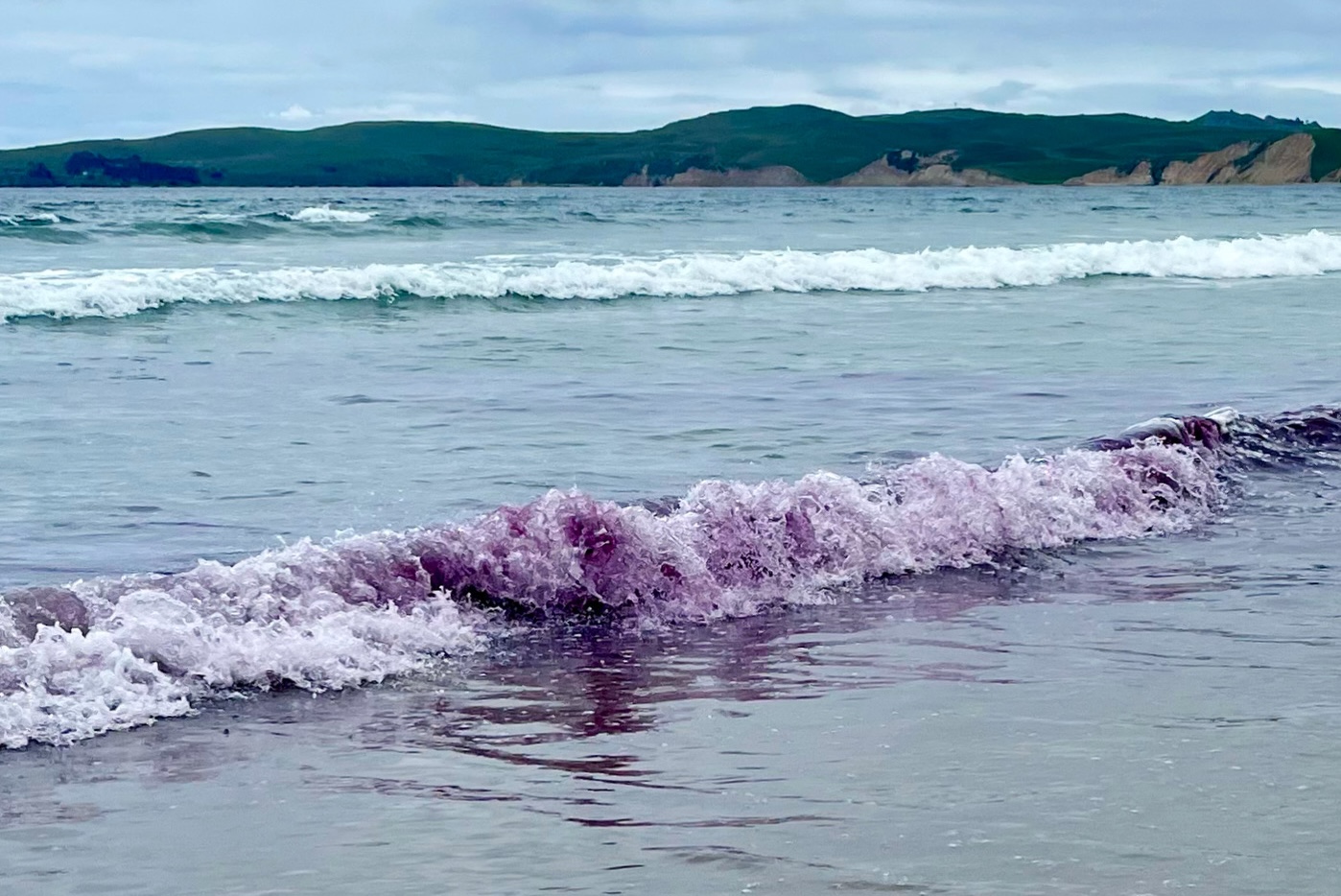
Purple-tinted waves wash ashore at Point Reyes. A UC Davis scientist said the color was likely caused by tiny gelatinous marine animals usually found farther offshore.
Marilyn Beck
The strange purple waves that rolled onto the Point Reyes coast last weekend may have a new explanation.
Eric Sanford, a professor in the Department of Evolution and Ecology at UC Davis and a researcher at Bodega Marine Laboratory, said Friday that his “best assessment” was that the organisms coloring the surf are likely doliolids — tiny gelatinous marine animals that usually live far offshore — not juvenile salps, as initially suspected.
Sanford said he and Jackie Sones, research coordinator at the UC Davis Bodega Marine Reserve, saw similar purple waves off the Sonoma Coast in 2015 and 2016 and identified the translucent animals in those waters as doliolids.
Article continues below this ad
“Although I have not had a look yet at the purple organisms washing up at Point Reyes, the photos are so similar to ours that I think doliolids is a good bet,” Sanford said in an email. “The color is pretty striking and distinctive, so (it) seems like it’s the same doliolid.”
The update adds a new twist to a coastal mystery that drew attention after the West Marin Feed posted a photo by local artist Marilyn Beck showing purple-tinted surf at Point Reyes. The account initially attributed the color to juvenile salps, a related group of gelatinous tunicates often mistaken for jellyfish.
San Francisco Chronicle Logo
Make us a Preferred Source to get more of our news when you search.
Add Preferred Source
But Sanford said a definitive identification would require a close-up photo or microscope examination of fresh samples. Because the purple surf appeared to be short-lived, that opportunity may have passed.
What makes the Point Reyes event unusual, he said, is not that doliolids exist off California, but that they appear to have reached the beach.
Article continues below this ad
“In California, the doliolid, Dolioletta gegenbauri, is typically found in warmer waters off the coast rather than close to shore like the recent sightings,” Sanford said. “So, what is unusual is seeing them close to shore.”
To his knowledge, Sanford said, this would be only the third such event on the Marin and Sonoma coasts since 2015.
Eric Sanford, a UC Davis professor and researcher at Bodega Marine Laboratory, said the purple waves seen at Point Reyes were likely caused by doliolids, tiny gelatinous marine animals that usually live far offshore.
Courtesy of Eric Sanford
The purple surf also coincides with large numbers of Velella velella, or by-the-wind sailors, washing up on local beaches. Those blue, sail-like animals also typically live far offshore, Sanford said, suggesting recent ocean conditions may have pushed offshore waters closer to the coast.
Another marine scientist who reviewed photos of the violet surf also told Bay Nature this week that the likely culprit was doliolids.
Article continues below this ad
Alejandro Damián-Serrano, a marine taxonomist in Spain who studied salps at the University of Oregon, told the publication, “That’s not salp purple.”
Doliolids, like salps, are not jellyfish and do not have stinging tentacles. They are tiny marine chordates that drift through the water, filtering out plankton and other small particles.
Their complex life cycle allows them to reproduce quickly under the right conditions, and blooms can become large enough to discolor nearshore water.
Officials urge people to avoid discolored, cloudy or foul-smelling water, especially if it looks paint-like or is accompanied by dead fish or plants — possible warning signs of a harmful algal bloom, according to the California Department of Public Health.
Article continues below this ad