
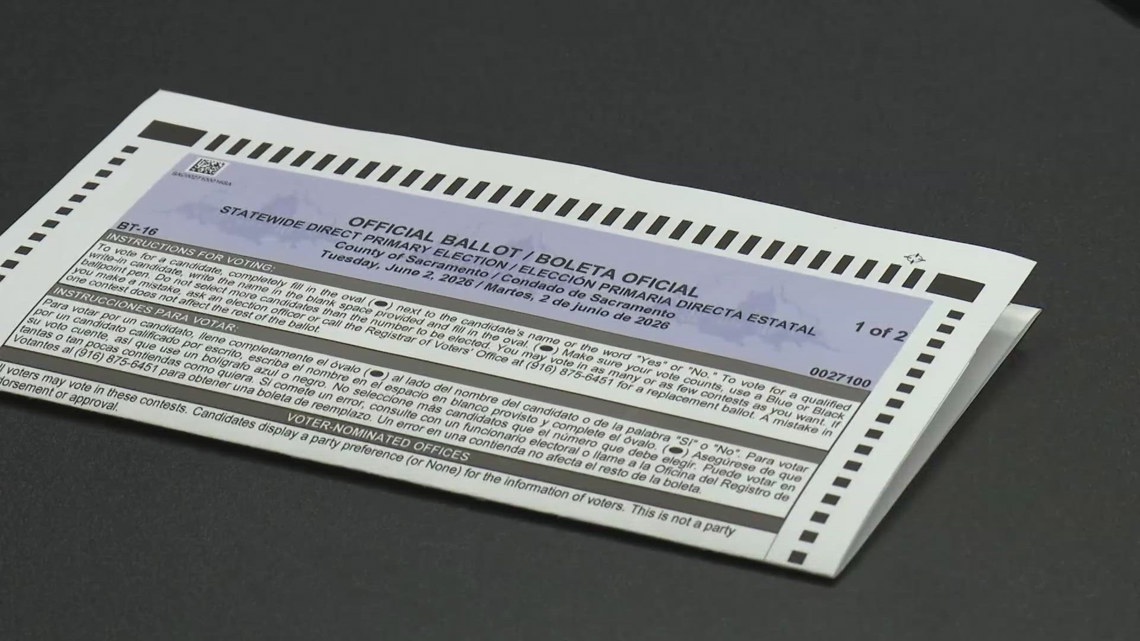
How did the Golden State’s “jungle primary” come to be, and what are its pros and cons for both parties?
SACRAMENTO, Calif. — California’s top-two primary system is once more the center of attention amid concerns Democrats could be locked out of the November gubernatorial runoff — despite the party’s dominance statewide.
The system was created through Proposition 14, approved by voters in 2010, and allows the top two vote-getters in statewide and congressional races to advance to the general election regardless of party affiliation.

This story continues below.
“They call it a jungle primary system here in California because it gets kind of crazy,” Democratic strategist Roger Salazar said.
Under the system, voters receive a single primary ballot and can vote for any candidate regardless of party registration.
“Well, the idea of an open primary is to allow voters to be able to move across party lines instead of having to wait untill November,” Republican strategist Rob Stutzman said.
Supporters of the change had said it would encourage moderation in state politics and give independent voters more influence in elections, rather than disenfranchise them from partisan primary elections. The proposal was pushed by Republicans Governor Arnold Schwarzenegger and Lieutenant Governor Abel Maldonado, despite opposition from both major political parties.
Dr. Mindy Romero of the USC Center for Inclusive Democracy said supporters hoped the system would create more competition and weaken party dominance.
“Increased level of competition would come from it. Maybe less power of the parties or dominance of the parties because it could potentially open up space for independents. More voter choice. Potentially even [boosting] turnout, recognizing that our primary turnout is always low,” Romero said.
But experts say the system has also produced unintended consequences.
Mark Baldassare, survey director of the Public Policy Institute of California, said third-party candidates are often excluded from the November ballot altogether.
“People who aren’t Democrats or Republicans aren’t reflected on the November ballot. They have someone to choose in the primary but not on the November ballot,” Baldassare said.
He also said vote splitting among candidates from the same party can create unexpected outcomes in districts dominated by one party.
“In a majority Democratic district, two Republicans [may advance as the top two] if there are many [too] Democrats who are on the ballot,” Baldassare said.
And vice versa. That’s because both Republicans and Democrats are more inclined to run in districts favoring them in party registration. And when there are multiple candidates from one party, their vote gets diluted, offering candidates from the opposing parties the chance to slip into top two.
The concern now is that a crowded Democratic field in the governor’s race could see just that — divide votes enough for Republicans Steve Hilton and Chad Bianco to advance to November instead.
“Is that fair to Democratic voters across California to not have an option? If there were two Democrats advancing to the runoff, I don’t think that would be fair to Republicans across the state of California,” said Sen. Tony Strickland, a Republican representing Huntington Beach.
Strickland opposed the proposition when it was first introduced in the Legislature.
Salazar said the system has also intensified campaigning during primary season.
“Primaries are the main battlefield. There’s more money being poured into primaries since the top two system passed,” Salazar said.
Experts interviewed for the story said proposed changes to the system could emerge after the 2026 primary.
“Let’s get those minor parties back on the ballot in November. Let’s create a reasonable path for an independent,” Stutzman said of the various possibilities, noting that any proposed change would have to go in front of voters as a constitutional amendment.
We reached out to the California Democratic and Republican parties for comment on the top-two system and its role in the governor’s race, as well as what each party feels are the successes and shortcomings of the election change.
Republicans declined to comment, and Democrats did not respond.
We also asked Governor Gavin Newsom the same questions.
A spokesperson directed us to his comments at an unrelated press conference Friday morning in which he against declined to endorse a candidate for governor.
“[The race] seems to be coming more into focus. It’s my intention not to get involved in the primary. it’s my intention to do everything that needs to be done to make sure there’s not a lockout for a Democratic choice in the general election. That’s my focus.”
More from ABC10: Prosecutors: Political motive behind ABC10 Sacramento shooting
ABC10: Watch, Download, Read










1
/
12