
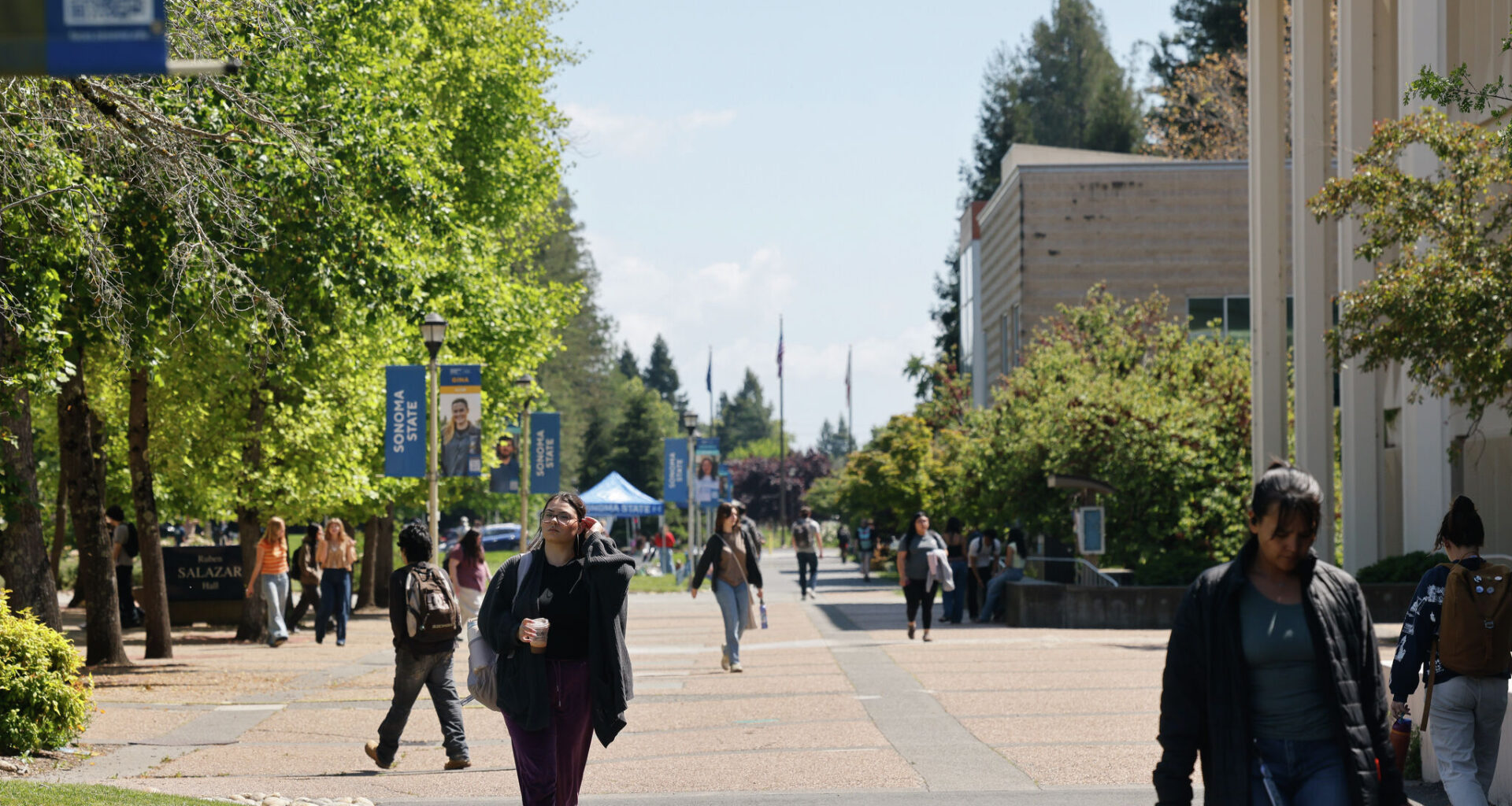
Students walk across Sonoma State University in Rohnert Park. Enrollment is down nearly 40% over the past decade, and some describe the campus as a “ghost town.”
Lea Suzuki/S.F. Chronicle
Sonoma State University President Michael Spagna, left talks with Bianca Delgado, senior coordinator for intercultural and undocumented programs.
Lea Suzuki/S.F. Chronicle
The Seawolves and paw logo on items for sale at the university bookstore.
Lea Suzuki/S.F. Chronicle
The main quad at Sonoma State University, once a near-perpetual frenzy of Hacky Sack circles, club fairs and outdoor concerts, long defined a postcard-worthy campus life. But as new president Michael Spagna strode across that emerald lawn on a recent sunny afternoon, he heard little beyond the rustle of oak trees.
“This should be busy 24/7,” he said.
At a time when less-selective state universities in the Bay Area are feeling the brunt of the region’s shrinking college applicant pipeline, no school has been harder-hit than Sonoma State. After a nearly 40% nosedive in enrollment over the previous decade plunged it into a $24 million budget deficit, this scenic Wine Country institution announced seismic cuts last year in a campus-wide email: The layoffs of a quarter of its faculty. The gutting of several historic academic programs. Even the elimination of its entire athletic department.
Article continues below this ad
Sonoma State University President Michael Spagna speaks at a reception for the Research, Scholarship and Creativity Symposium at Sonoma State Univeristy. As the school’s fifth president in five years, he faces a daunting task.
Lea Suzuki/S.F. Chronicle
Sixteen months later, Spagna now faces perhaps the most daunting job in Bay Area higher ed. With some on campus concerned about Sonoma State’s long-term viability, he must reshape the university’s identity, rebuild the community’s trust and attract new kinds of applicants — all while giving people reason to be proud of their school again.
A soccer goal stands on an empty field at Sonoma State University. The school eliminated its entire athletic department, wounding school spirit, but it is considering whether to bring programs back.
Lea Suzuki/S.F. Chronicle
In interviews with the Chronicle, more than a half-dozen current students and faculty members described life on the Rohnert Park campus as a “ghost town.” Some even find themselves wondering: Why would a recent high school or community college grad choose a school with no school spirit?
San Francisco Chronicle Logo
Make us a Preferred Source to get more of our news when you search.
Add Preferred Source
Spagna, 63, remains bullish. A tall, gray-haired educator with relentless energy, he spent much of the past three decades cultivating a reputation as a “fixer” on three other California State University campuses. Along the way, Spagna came to appreciate all Sonoma State has to offer: small class sizes, suite-style dorms, a picturesque campus and a liberal arts-style education — at a public-school price.
Article continues below this ad
“The first thing we have to do,” he said, “is show people why this is a great place to be.”
Urgency is mounting. Though a combined $55 million in assistance from the state Legislature and the CSU chancellor’s office should stabilize Sonoma State financially, Spagna knows a successful reinvention in the near-term would buoy the university’s longer-range outlook.
It would also quiet consolidation speculation. Maureen Loughran, Sonoma State’s California Faculty Association field representative, said there is “real fear” on campus that it could merge with San Francisco State and Cal State East Bay to form a “CSU Bay Area.”
Students, left to right, Alyssa Reilly, Joey Ciardella, Mike Fodor and Daniel Herriman play a game of Spike Ball on a lawn at Sonoma State University. University employees have taken measure to encourage student activity to create a more vibrant campus after a decline in enrollment.
Lea Suzuki/S.F. Chronicle
After years of pandemic-spurred declines, CSU, the largest public university system in the country, recently announced that overall enrollment had rebounded to its highest level in more than a decade. San Jose State represents the most relevant individual success story: Thanks to its proximity to Silicon Valley and emphasis on AI curriculum, it saw a 6.5% uptick in its student body between fall 2024 and 2025.
Article continues below this ad
But Sonoma State and San Francisco State are still enduring the steepest enrollment declines of the whole 22-campus system. And, even though its student headcount has steadied, Cal State East Bay projects a budget deficit of around $13 million this fiscal year.
A CSU spokesperson told the Chronicle that Sonoma State, San Francisco State and Cal State East Bay will “unequivocally” remain “three separate and distinct universities.”
Asked what a potential merger — even in the distant future — would mean for Sonoma State, Spagna mentioned Cal Maritime Academy in Vallejo, which was absorbed by Cal Poly San Luis Obispo just last year.
Students work in a light filled atrium in Stevenson Hall at Sonoma State Univeristy. The school has cut some academic programs, but Spagna spared some, like the geology program, by folding them into other departments.
Lea Suzuki/S.F. Chronicle
But unlike that tiny maritime academy, Sonoma State is a regional anchor for the entire North Bay. It supplies more than 1,000 local jobs and keeps young people close to home.
Article continues below this ad
“I don’t want Sonoma State to be absorbed,” Spagna said. “If the North Bay didn’t have a Sonoma State, it would hurt the entire economy here — maybe not immediately, but absolutely over the next decade. This place is essential.”
Lower-income and first-generation college students recognize as much. For many of them, this 269-acre school at the foot of the Sonoma Mountains might be the difference between going to college — or not.
Michael Balasek, lead recruitment coordinator at Sonoma State, inside the Welcome Center at Sonoma State Univeristy. Amid enrollment declines, recruiters are trying new tactics, including using advanced analytics software to identify which students might be most likely to enroll.
Lea Suzuki/S.F. Chronicle
That is Michael Balasek’s biggest motivation. While meeting with prospective applicants, Sonoma State’s lead recruitment coordinator makes sure to emphasize the campus’ low student-teacher ratio, hands-on instruction and abundance of academic resources.
When someone asks about the school’s sudden lack of NCAA athletics, Balasek offers a quick sentence or two about Spagna’s efforts to resuscitate them. Then he’s back discussing academics, top-rated dorms, even the on-campus duck pond.
Article continues below this ad
“I talk to so many kids who view four-year schools as a pipedream,” Balasek said. “Helping them make it a reality is extremely powerful.”
Unused tennis courts at Sonoma State, whose entire athletic department was cut last year.
Lea Suzuki/S.F. Chronicle
Spagna said he came to Sonoma State, in part, to advance that mission. A self-described “fan of the underdog,” he started his career as a middle school special education teacher in Los Angeles’ San Fernando Valley.
While Spagna was on faculty at Cal State Northridge in 1994, a massive earthquake ripped through campus, toppling buildings and causing hundreds of millions of dollars in damage. Over the next 23 years, Spagna watched the university use innovative marketing campaigns to nearly double its enrollment — from roughly 24,000 students to around 40,000.
In 2017, when he took over as provost at Cal State Dominguez Hills, he was the sixth person in eight years to hold the position. During his seven years there, Spagna helped raise both enrollment and graduation rates.
His first opportunity as a university’s top leader came in August 2024 at Cal Poly Humboldt, where his predecessor’s controversial handling of a pro-Palestinian campus protest had just triggered a faculty vote of no confidence. In Spagna’s 17 months as the school’s interim president, colleagues lauded him for providing a steadying presence and re-establishing partnerships with local tribal nations and business owners.
Such experiences help explain why Spagna was unfazed in January when he became Sonoma State’s fifth president in five years. Well-versed in turnarounds, he saw this campus as somewhere he could finish his career — he plans to work another seven years — and cement his legacy.
Scott Hornstein, a Sonoma State theater professor, sits in Ives 119 studio theater at Sonoma State Univeristy. When the school cut its theater major, Hornstein stayed to teach English classes.
Lea Suzuki/S.F. Chronicle
In Spagna’s 3½ months at Sonoma State, many faculty members said they have been impressed with his openness and creativity. He folded the geology program, which was on last year’s initial list of cuts, into the Department of Applied Human and Environmental Sciences. Although theatre arts is no longer a major, Spagna asked Professor Scott Hornstein to stay, teach English classes, and find new ways to keep the arts on campus.
Starting next school year, students can earn a certificate in theater by, among other things, acting as simulated patients for the expanding nursing program. Hornstein also hopes to put on at least one play a year.
“I’m excited about what we might be able to do,” he said. “It feels like we’re all finally able to exhale a bit.”
Still, not everyone is pleased. Charlene Tung, the last remaining professor in a women’s and gender studies program set to be cut, hasn’t seen much reason to believe Spagna will usher in a better era for the university. “He seems to be following what was sort of put into play by the previous president,” Tung said.
Faculty members were surprised to learn in a recent EdSource article that Spagna faced a discrimination claim while serving as dean of Cal State Northridge’s College of Education in 2012. According to the report, a Black faculty member alleged she was passed over for department chair despite receiving the majority support in a department vote.
The professor filed a lawsuit against the CSU system, which did not name Spagna, and was settled in 2014. A Sonoma State spokesperson told the Chronicle of the incident that Spagna “worked with the provost to achieve stability in what was a dysfunctional department, and made every attempt to support this individual, whom he later did recommend be appointed department chair.”
Any past challenges might seem minor compared to those now facing Sonoma State.
Student teams stand by their display boards during the Research, Scholarship and Creativity Symposium at Sonoma State Univeristy.
Lea Suzuki/S.F. Chronicle
For years, students from all over California chose it over more prestigious options because it offered enviable campus life and robust academics at a budget price. Current undergraduate tuition and fees per semester are roughly $3,300 to $4,750, not including housing.
But since the pandemic, Sonoma State has become more fallback option than preferred choice. Young adults have been sticking close to home, prioritizing schools with name recognition, and pursuing degrees with high-earning potential.
“Small regional schools aren’t as desirable as they once were,” said Hans Johnson, a senior fellow at the Public Policy Institute of California, a nonprofit think tank. “What often happens is they end up in a vicious cycle: The more their enrollment drops, the less appealing they become, which further hurts enrollment.”
Few schools are better-acquainted with that spiral effect than Sonoma State, which now has its fewest students — roughly 5,000 — since the late 1990s. On a breezy Tuesday in late April, the leafy campus felt suspended in a strange sort of limbo.
A Seawolves logo is in the gym floor below posters and penannts celebrating sports achievements at Sonoma State Univeristy on Thursday, May 7, 2026, in Rohnert Park, Calif.
Lea Suzuki/S.F. Chronicle
The logo of its defunct Seawolves sports teams, whose mascot was inspired by the late Sonoma County resident Jack London’s 1904 novel of the same name, provided a nagging reminder of what was lost. The closest thing to a crowd was a handful of fraternity and sorority members using stationary bikes under a Seawolves-emblazoned tent in front of the student union.
The nearby cornhole tables, set up by student employees to encourage on-campus activity and adorned with more Seawolves logos, sat unused. At the school bookstore, hundreds of blue-and-white Seawolves shirts, jackets and sweatshirts hung untouched on racks, some listed for 75% off.
Yanni Lowry, a senior and Black Student Union president, sits at the HUB, where the Black Student Union often meets, at Sonoma State University.
Lea Suzuki/S.F. Chronicle
“If you do wear a Sonoma State shirt around campus, people are going to look at you sideways,” said Yanni Lowry, a senior communications major. “It’s strange to have school spirit here now.”
Like many of her classmates, Lowry considered transferring to Sacramento State after last year’s cuts, just for more of a typical college experience. Now president of Sonoma State’s Black Student Union, she reflects on how much has changed whenever only one or two people show up to weekly meetings.
With the school’s annual “Black Prom” less than a week away, Lowry is doing whatever she can to draw a decent crowd: buying food, offering prizes, even inviting people from other CSU campuses. “It really is like a ghost town out here,” she said. “I would love to say that our college doesn’t need sports to have the college feel, but I think we do.”
They could return sooner than many had anticipated. Spagna recently hired a former two-time Division II athletic director of the year, Joan McDermott, as Sonoma State’s interim athletic director.
The Seawolves paw logo at the Sonoma State University bookstore. The school mascot is inspired by the by the late Sonoma County writer Jack London.
Lea Suzuki/S.F. Chronicle
With the help of administrators, faculty, former coaches and student-athletes, she is exploring the feasibility of bringing back — and sustaining — sports at the Division II or Division III levels. Spagna plans to decide by June 30 whether to reinstate the Seawolves’ affiliation with their conference, DII’s California Collegiate Athletic Association, for the 2027-28 academic year.
“It’s hard to know how everything’s going to shake out,” said McDermott, who retired as the University of San Francisco’s athletic director in 2022 before eventually deciding to help Spagna. “All I know is that my whole focus is on trying to make something work. It’s critical for the university’s outlook moving forward.”
On that recent Tuesday, Spagna stepped into Sonoma State’s Welcome Center, surveyed a stack of brochures and lamented about his “weekly therapy sessions” with the center’s team of recruiters. “You need to always be in a positive mindset with what we’re trying to do,” he said. “This is high-stakes work.”
That wasn’t always the case. Before the pandemic, Sonoma State’s recruitment efforts amounted to the occasional college fair stop and some mailers. Its approach evolved when enrollment started to decline. Now in crisis mode, Sonoma State’s six full-time recruiters use advanced analytics software to identify which students might be most likely to enroll.
They also visit local elementary, middle and high schools. They broker guaranteed-admission agreements for every student in certain districts. They try to sway former community college students to finally pursue a bachelor’s degree.
Leonardo Arteaga, a Sonoma State University senior, studies in the atrium at Stevenson Hall.
Lea Suzuki/S.F. Chronicle
Though Sonoma State has relied upon a hyper-local, college-age student population in recent years, Spagna knows it must broaden its scope. That means tapping back into once-fertile pockets of Southern California and even pitching out-of-staters. With no athletic department to sell, Spagna’s Welcome Center staff is also zeroing in on a demographic that probably doesn’t care too much about school spirit: older adults with full-time jobs.
Whenever recruiters drive by the Zinfandel Village student housing complex currently sitting unoccupied, they remember what’s at stake.
A pedestrian walks a dog at Sonoma State Univeristy in Rohnert Park.
Lea Suzuki/S.F. Chronicle
“You can’t have a school without students,” said Paul Edwards, Sonoma State’s chief strategic recruitment officer.
After taking a couple of visitors around campus on that recent Tuesday, Spagna was walking along yet another empty quad as he raised his arms out wide. “Come back in the fall,” he said. “It’s going to be vibrant out here.”
That’s when it dawned on him: He’d forgotten to show his guests his new favorite iPhone video. There, on the screen, was Spagna lip-syncing to “High School Musical 3” with Sonoma State students during a recent charity event.
“No one had ever seen a president do something like that before, but I embrace that,” Spagna said. “The situation here requires you to be all in.”