
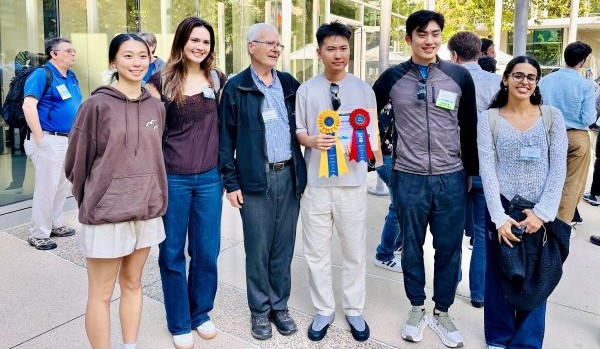
The winning team in a research competition at UC San Diego consists mostly of university undergraduates, graduate students and professors. But a much younger collaborator also is in the mix.
Sherry Huang, a sophomore at The Bishop’s School in La Jolla, was among the team recognized with a grand prize in the Jacobs School of Engineering Research Expo on April 15.
The group’s project, “Computer-navigated Surgery Using MRI and Augmented Reality,” saw the researchers develop an augmented reality-based navigation system offering needle guidance for radiation-free spinal surgery.
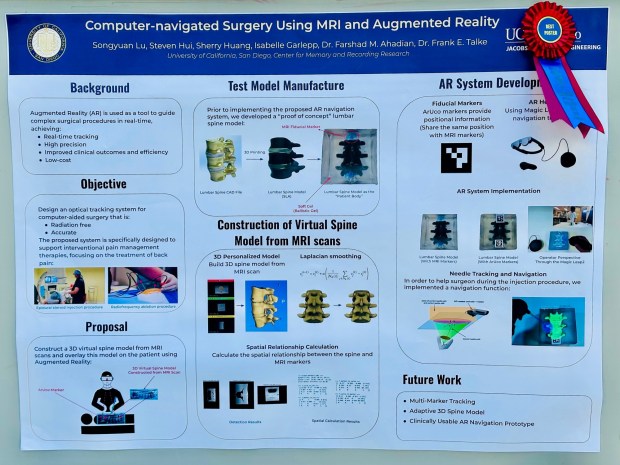 “Computer-navigated Surgery Using MRI and Augmented Reality” won a grand prize in the UC San Diego Jacobs School of Engineering Research Expo on April 15. (Hua Huang)
Sherry worked on the project along with Ph.D. student Songyuan Lu; undergraduate students Steven Hui and Isabelle Garlepp; graduate student Naina Khanna; Dr. Farshad Ahadian, a clinical professor of anesthesiology who brought the idea forward; and Frank Talke, an engineering professor whose research focuses on medical device technology and information storage.
“Computer companies … service these augmented-reality goggles and they are being used most of the time for computer games,” Talke said. “You’re using this wonderful technology for things that maybe … entertain a person but not really creating something useful.
“But using … augmented-reality goggles and overlaying that on the person and doing a medical procedure that eliminates the X-rays … is a wonderful use of AR and of all this new technology that comes out of Microsoft and Apple and Meta.”
Sherry was introduced to the project after her freshman year at Bishop’s when she was selected for UCSD’s Institute of Engineering in Medicine Outreach Program for Advancing Learning in STEM, or OPALS. Throughout the high school internship program, she and other pre-college students developed their skills through a variety of science, technology, engineering and math projects.
The UCSD team’s award-winning project is not particularly new. Five years ago, Ahadian delivered a presentation to Talke’s class about pain medicine. When students asked him what could be improved in that field, he suggested a 3D alternative to traditional X-rays.
“That would then open the door to performing a lot of these procedures in a setting that is less expensive [and] does not require extra shielding for the X-ray beams,” Ahadian told the La Jolla Light.
“And steadily, this team has exceeded my expectations,” he said. “It’s been amazing to throw out an idea … and they’ve just been going at it systematically.”
Sherry’s curiosity about the intersection of augmented reality and surgery pushed her to get involved in the effort.
“I was interested in starting research early as a high-schooler because my parents both had academic backgrounds,” she said. “That was always something that was encouraged of me and something I really wanted to pursue. As early as after my freshman year, I decided to apply and give it a shot. I got in and chose a project I really enjoy.”
Though her internship eventually came to a close, her involvement with Talke’s lab didn’t. She continued to offer her math and coding skills without formal enrollment or an internship.
“After my work last summer, they asked me if I wanted to join to work on that aspect of the project,” Sherry said. “Obviously, I said yes.
“One of the biggest things with coding is you have to have patience and be open to failure a lot, especially with debugging code. Sometimes you might get frustrated about why a code’s not working and might be tempted to immediately try to fix things. But I think taking a step back and actually analyzing what the problem is is a lot more conducive to getting the results you want.”
The lab met every Friday afternoon. Sherry said she worked particularly closely with Lu, who is listed as the research paper’s first author.
Ahadian said he was struck by how composed and confident Sherry was and how willing the undergraduate and graduate students were to get involved.
“She’s jumping on this team at a much earlier stage than a lot of the other students, and I have to say, these days kids are doing such amazing stuff,” Ahadian said. “They’re doing stuff and learning stuff that when I was in high school or college just didn’t exist.”
“That’s what makes students excited,” Talke said, “and … if you treat students in a way that they get excited, they show you the best [they] can. And that’s what we always do.”
This was the 44th year of the annual Jacobs School of Engineering Research Expo, in which some 150 graduate students from six Jacobs School departments showcased their work.
Earning recognition in the expo was a significant honor, Sherry said.
“It’s really exciting for me because I realize it’s not an opportunity that many people are able to receive,” she said. “I guess the award mostly makes me feel like I’m included and part of this group and I can make actual contributions in a university setting.” ♦