
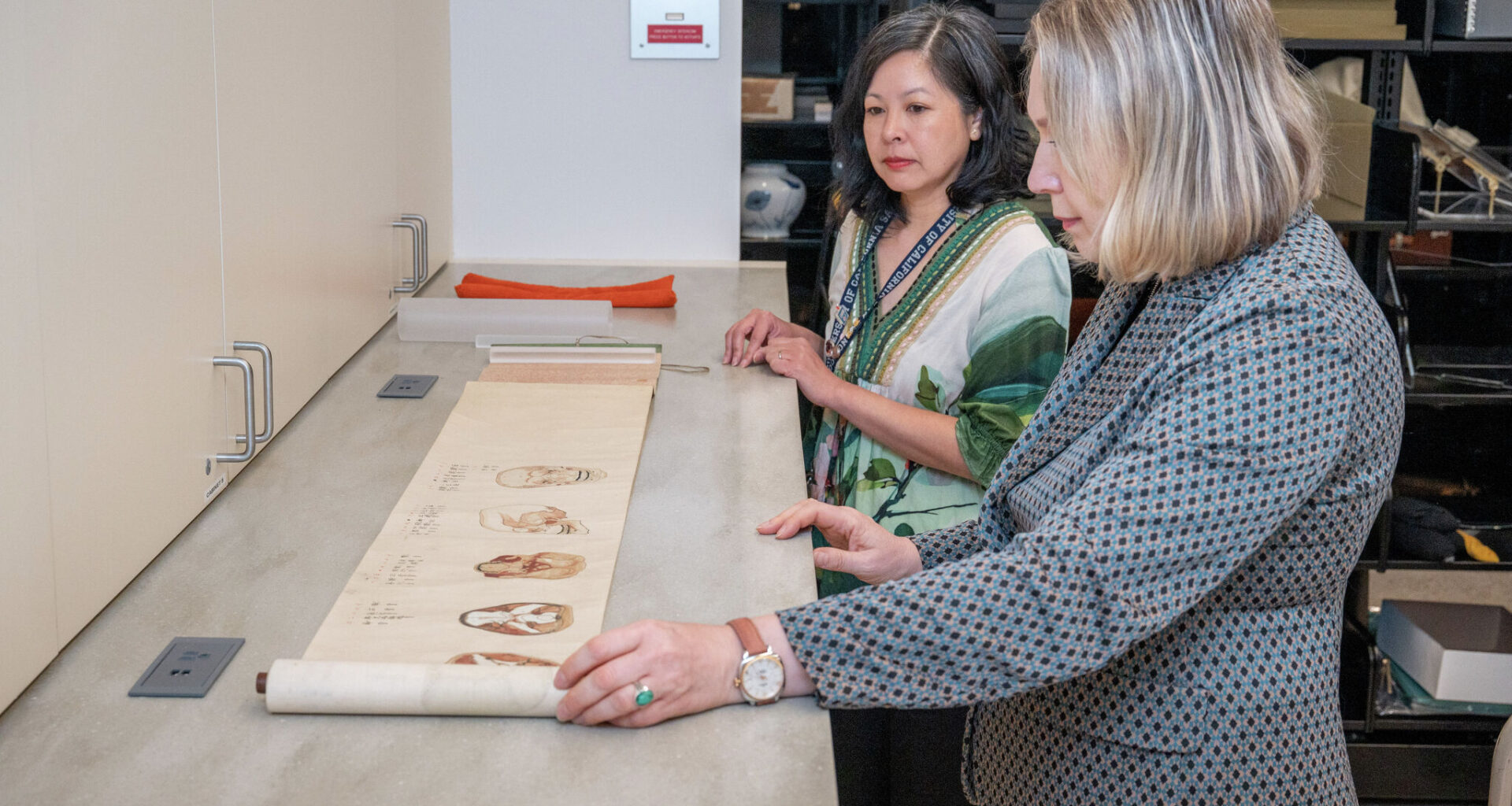
Polina Ilieva, associate university librarian for archives and special collections, right, and Lisa Nguyen, digital archivist at UCSF Archives and Special Collections, unroll an ancient hand scroll circa 1850 that illustrates anatomical diagrams of the human skeletal system at UCSF Library in San Francisco on March 19. UCSF is making public for the first time a collection of ancient medical artifacts from Japan.
Amy Osborne/For the S.F. Chronicle
Chise Saito of the Art Research Center at Ritsumeikan University in Kyoto scans pages of ancient medical textbooks for digitalization at the UCSF Library on March 19.
Amy Osborne/For the S.F. Chronicle
Librarian Polina Ilieva unrolls an ancient hand scroll that illustrates medicine plants.
Amy Osborne/For the S.F. Chronicle
Ancients texts, drawings and artifacts from Japan are stored in the UCSF Library.
Amy Osborne/For the S.F. Chronicle
Foreign women — barred from living at Dejima during Japan’s isolationist era — appear in many works from the period, including this fanciful 1862 depiction of a California port at the UCSF Library in San Francisco.
Amy Osborne/For the S.F. Chronicle
Kirari Itami of the Art Research Center at Ritsumeikan University in Kyoto scans pages of ancient medical textbooks for digitization at the UCSF Library.
Amy Osborne/For the S.F. Chronicle
Librarian Polina Ilieva unrolls an ancient hand scroll that illustrates medicine plants at the UCSF Library.
Amy Osborne/For the S.F. Chronicle
An ancient maternal health illustration, “Ten Realms Within the Body,” 1855, is seen at the UCSF Library.
Amy Osborne/For the S.F. Chronicle
An ancient textbook that illustrates medicinal plants is seen at the UCSF Library.
Amy Osborne/For the S.F. Chronicle
A medicinal pot from 1774, part of the Nakamura Sosetsu collection, is seen at the UCSF Library.
Amy Osborne/For the S.F. Chronicle
More than two centuries ago, when measles broke out in a household in Japan, the residents might hang on their door a woodblock print bearing an image of the “golden boy” – a heroic character with a baby face and muscled arms meant to warn visitors and protect those already afflicted.
When the disease had passed, the print usually would be burned. UCSF has one of the few that survived the era. It’s about the size of a modern sheet of loose-leaf paper, the character dyed red — a color meant to ward off evil — and calligraphy printed across the top.
The print is part of an East Asian medicine collection housed in UCSF’s Kalmanovitz Library that is among the largest in the world. And for the first time, librarians there are attempting to digitize the collection and make it accessible to everyone, from curious historians to scientists searching for cures that may be hidden in the past.
Article continues below this ad
An ancient hoso-e illustration of the folk hero Kintaro as a muscular baby wearing a bib marked with the first character of his name is displayed at the UCSF Library.
Amy Osborne/For the S.F. Chronicle
“Measles and vaccinations are such a topic now,” said Lisa Nguyen, a digital archivist with the library who has a background in Chinese language and literature — which can come in handy when working with the Japanese documents, some of which are written in script she can roughly translate.
It’s fascinating, Nguyen said, to visit the same topic from a few centuries ago, when woodblock prints depicted “measles as monsters and how you combat them with the spiritual. We are kind of having the same dialogue now.”
San Francisco Chronicle Logo
Make us a Preferred Source to get more of our news when you search.
Add Preferred Source
UCSF’s library is best known for its massive collection of ephemera from the AIDS epidemic of the 1980s and 1990s in San Francisco. They now have a growing collection of pieces from the city’s opioid crisis.
Article continues below this ad
Lisa Nguyen, digital archivist at UCSF Archives and Special Collections, displays an ancient medical textbook.
Amy Osborne/For the S.F. Chronicle
The East Asian collection has roughly 3,000 pieces, including books and scrolls from the early 1800s, dozens of colorful woodblock prints that were essentially public health posters from their time, and tools like mortar and pestles and copper pots that were used in herbal medicine.
The works include dramatic representations of maternal medicine, including a woodblock print so large that it would cover a coffee table, featuring women in various stages of pregnancy and detailed renderings of fetal growth over time. The women are topless, their hair arranged in different styles depending on the month of pregnancy; each has a tiny fetus visible through a window in her belly.
“We have one of the most extensive collections of Japanese woodblock print related to medicine and the health sciences anywhere in the world,” said head librarian Polina Ilieva. But she’s eager to get it all online, “because in our day and age, if it’s not online, it basically doesn’t exist.”
An 1880 maternal health illustration titled “Realize One’s Parental Love,” depicting 10 stages of fetal growth, is seen at the UCSF Library.
Amy Osborne/For the S.F. Chronicle
The UCSF collection was built almost single-handedly by Atsumi Minami, a Japanese-American librarian and curator who was given the task — and a multimillion-dollar budget — by then-Chancellor John Saunders in the 1960s. Saunders, a former UC librarian himself, had a special interest in East Asian medicine.
Article continues below this ad
Minami spent decades collecting pieces, mostly from private, small dealers, in China, Japan and other East Asian countries. Her final collection included more than 25,000 pieces; about 15 years ago the collection was split up, and non-medical pieces were sent to UC Berkeley.
The pieces that remain at UCSF are almost all from the early 19th century, a period when Japan was beginning to open to the West after 250 years of isolationism. The documents offer insight into how Japanese doctors and scientists began to merge their ancient understanding of medicine with Western discoveries, mostly around internal anatomy.
An ancient hand scroll from around 1850 illustrating anatomical diagrams of the human skeletal system is seen at the UCSF Library.
Amy Osborne/For the S.F. Chronicle
“They began opening their doors mostly to the Dutch, and that’s when we see their influences — in particular, medicine and science and how people in Japan began to see their own bodies,” said Nguyen.
According to tradition in Japan at the time, dissecting the body was not acceptable, Nguyen said. Scientists’ understanding of internal medicine came from dissections of animals and closely observing the outside body. Drawings of human dissections from the Netherlands would have been fascinating to Japanese scientists then.
Article continues below this ad
The information didn’t just travel in one direction, though. Ilieva noted that Japanese art depicting the body and medicine would end up influencing both art and knowledge in the West, including the United States.
An ancient illustration titled “Dietary Advice for a Good Sex Life,” depicting the internal workings of a woman’s body as an apparatus operated by tiny female workers, is seen at the UCSF Library.
Amy Osborne/For the S.F. Chronicle
The collection is now stored in a subterranean vault, completed just a year ago, that is climate- and light-controlled; it used to store decades of academic journals, all of which are now online.
UCSF staff are working with a team of archivists from the Art Research Center at Ritsumeikan University in Kyoto, who are doing most of the digitizing work. They were at UCSF last month, painstakingly scanning pages from fragile books and centuries-old scrolls, some of which are 20 feet long. Once the pieces are scanned, the challenging work of assigning metadata and making the collection searchable begins.
The collection is of great interest to historians, Ilieva said, but modern physicians are interested too, in particular when it comes to herbal treatments that may have been forgotten or set aside in modern times, and could be repurposed now. In 2015, in fact, a Chinese scientist won a Nobel Prize for her work using ancient medical texts to develop a modern malaria treatment.
Article continues below this ad
An ancient textbook that illustrates medicinal plants is seen at the UCSF Library.
Amy Osborne/For the S.F. Chronicle
“The knowledge we have here, especially about botanicals and herbals, may be used now, because a lot of pharmaceuticals are based on that knowledge,” Ilieva said. “So it’s not only what happened before that’s of interest, but how we can refer to this going into the future.”
The vast majority of pieces in the collection, including the more than 400 woodblock prints, are known as ukiyo-e, a genre of art from the Edo period in Japan that used drawings and carved woodblocks to produce works on social customs, nature scenes and medicine.
The books in the UCSF collection are largely text-only — dense calligraphy covers the rice-paper pages, much of it in a language that few people are able to fully translate now. Medical providers would have learned their practice in part by making painstaking copies of these books by hand, making edits and revisions to reflect their growing knowledge.
Kirari Itami of the Art Research Center at Ritsumeikan University in Kyoto scans pages of ancient medical textbooks for digitization at the UCSF Library.
Amy Osborne/For the S.F. Chronicle
When there are drawings, though, they are often richly detailed, and the colors are vibrant even after so many decades. The woodblock prints, larger than the books and scrolls, are especially bold. One print shows a geisha-like woman with a fully pregnant belly, inside which are vivid representations of deeds good and evil.
Because everything was made by hand, it’s easy to see the individual brush strokes that an artist used, to imagine the skill and steady hand it would have taken to reproduce page after page of medical text. The tools that Minami collected are especially exciting, in some ways, because they show signs of much use.
One piece is a medicine doll, made of ivory and small enough to cup in one hand. It’s a sculpture of a nude woman, and it was used by patients to point out where they were hurting, instead of touching their own body. Another piece that looks like a dagger is labeled a “doctor’s sword,” which is a mystery to Ilieva because she has no idea what a doctor’s sword would have been.
UCSF is making public for the first time a collection of ancient Japanese medical artifacts, which a team of Japanese researchers is digitizing and studying.
Amy Osborne/For the S.F. Chronicle
But Ilieva loves a mystery. She hopes that by getting all of the pieces online, they might be able to crowdsource some answers on the more mysterious parts of the collection — books that haven’t been fully translated, objects and artworks that haven’t revealed their purpose.
“We want to have these materials in conversation with modern-day materials,” said Nguyen. “We want scientists or researchers or public policymakers to know that there is a wealth and depth of materials available, and even though it might be past, it’s very relevant to today.”