
“Pedestrian scrambles” for two Coast Highway intersections are among the new items in Oceanside’s capital improvement program budget for 2026-27.
The CIP budget also includes money for several big, long-planned projects, such as replacing the crumbling Pier View Way Bridge that provides access to the city’s municipal pier and the equally old Coast Highway bridge across the San Luis Rey River. The spending plan goes to the Oceanside City Council for approval in June.
The pedestrian scrambles, to be installed one block apart at Mission Avenue and Seagaze Drive, would be a first for downtown Oceanside.
Carlsbad has two scrambles, a special style of crosswalk where traffic stops in all directions for pedestrians to cross in all directions, including diagonally. Both are on Carlsbad Boulevard, another name for Coast Highway, the historic north-south route also known as Highway 101 and by other names in other cities.
Additions such as improved sidewalks and crosswalks are being added in many places along the coastal route throughout North County to make the often-visited areas more safe and easy to access for tourists, cyclists and local residents.
The new crosswalks are not part of Oceanside’s long-planned Coast Highway Corridor Improvements Project, said Brian Thomas, Oceanside’s city engineer and acting development services director.
The corridor improvements project includes wider sidewalks and medians, fewer traffic lanes, improved landscaping, and possibly roundabouts and other changes along the Coast Highway from Harbor Drive to the Carlsbad border. That project, still in the planning stages, will receive $1.5 million in next year’s capital budget. It also will get about $7 million in developer fee revenue for construction spread over the five-year budget plan.
The scramble crosswalks have a total estimated cost of $300,000 for the design and construction of the two locations, Thomas said in an email Tuesday.
“Given that these intersections have already received relatively recent ADA-compliant ramp upgrades, the scope is expected to focus primarily on signal timing modifications, striping, and related pedestrian safety enhancements,” he said.
Oceanside’s capital improvement program budget outlines $166 million in funding for projects in fiscal 2016-27, which begins July 1.
About $38 million of the money in the budget is from the city’s miscellaneous capital funding, $36 million is from the city’s voter-approved sales tax known as Measure X, and $28 million is from the county’s voter-approved sales tax known as TransNet. Most of the rest of the money is accumulated from fees charged to developers for the parks, streets and public utilities needed for the projects that they build.
The city’s CIP budget covers the next five years. Most of the funding and details in the plan are for 2026-27. There’s less information in each successive year because of the uncertainty in planning and the various revenue sources.
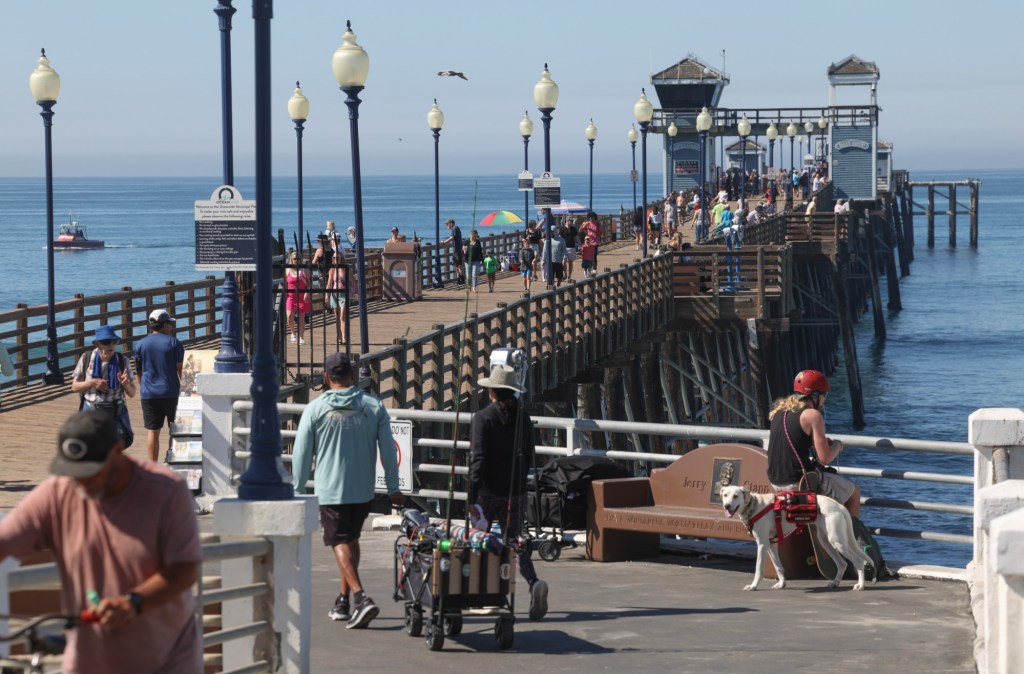
One of the biggest projects in Oceanside’s capital improvement program is the construction of a replacement for the Pier View Way Bridge, which serves as the pedestrian approach ramp to the city’s municipal pier.
The century-old, concrete-and-steel structure, which also houses the city’s lifeguard headquarters, is badly deteriorated and fails to meet present day building codes and seismic standards. Next year’s budget includes just $10,246 in funds left over from previous years to complete the design.
The Pier View Way bridge project is also in the budget for $3 million from Measure X in 2028-29 and $12 million from Measure X in ’29-30.
So far, the city has already invested more than $12 million in the project, Thomas said. Construction is expected to cost about $70 million.
“The current contract gets the project through entitlement, environmental phase, and Coastal Commission phase,” Thomas said.
“Staff anticipates taking the final design to City Council in Fall 2026,” he said. “Construction is not anticipated until 2028; (more) funding will be programmed closer to the time the final bid documents are completed and prior to the start of construction.”
Also in the CIP budget is another old and substandard bridge, the North Coast Highway span built in 1929 across the San Luis Rey River. That project will get $1.5 million next year to complete its final design.
“The existing bridge will be demolished and replaced to current applicable City, American Association of State Highway and Transportation Officials (AASHTO), and Caltrans design standards,” Thomas said.
Demolition is estimated to be about $15 million and replacement costs about $70 million, he said.
Construction is set to begin as early as the summer of 2027 and expected to be completed in two to three years. Funding is available from the federal Highway Bridge Program administered by the Federal Highway Administration through Caltrans local assistance programs, Thomas said.
A large part of the capital budget is various long-term maintenance or improvement projects such as street paving, traffic signals, street lights, storm drains, water and sewer utilities, and municipal buildings.
The Oceanside Police Department’s new Oceanside Boulevard training center, which could begin construction by the end of this year, will get $4 million in Measure X funds in the 2026-27 budget and $1 million from Measure X in ’27-28. It also will get $3 million in developer fee revenue in 2027-28 and an additional $3 million from fee revenue in each of the next three fiscal years.
Shoreline restoration efforts such as beach sand replenishment will get $550,000 in fiscal 2026-27, an amount that will increase gradually for a total of about $3.4 million over the five-year budget.