
 A rendering of Port Coronado Associate’s proposed redevelopment. Courtesy photo.
The Port of San Diego will not renew its lease with the company that operates the Coronado Ferry Landing, stalling a planned $20 million renovation of the property.
The decision ends the Port’s longstanding partnership with Port Coronado Associates (PCA), which has managed the waterfront retail center for decades and will transfer management to the Port itself.
It’s a decision that was made by the Board of Port Commissioners in closed session, a move that is not popular with some Coronado leaders.
“It’s unfortunate that the commission believes that they know what’s best for Coronado, when it’s pretty unified, from the community to the elected officials, what the city wants,” said Frank Urtasun, Coronado’s representative on the Port commission.
Coronado Mayor John Duncan also criticized the decision, saying it lacked transparency, excluded city leaders, and has unnecessarily delayed redevelopment.
“The city has had zero communication (from the Port) for years,” Duncan said. “No one has called me, no one has responded to our letters. Numerous tenants are in limbo with no lease extensions or guarantees for the future.”
Coronado sent a letter to the Port on Sept. 3, questioning its transparency regarding the Ferry Landing, but did not receive a response, Duncan said.
Now, PCA’s lease of the Ferry Landing will expire on June 30, 2026, although the port is pursuing a short-term extension of the lease to facilitate the transition, said Brianne Mundy Page, the Port’s senior public information officer.
Mundy Page did not say why the Port reached this decision, but said that the Ferry Landing will remain open, that the Port is exploring “short-, mid-, and long-term options” for the site, and that businesses within it will have opportunities to keep operating.
“It remains the Port’s goal to ensure the retail center is a vibrant and prosperous waterfront destination for residents, visitors, and the businesses that operate in it for years to come,” Mundy Page said.
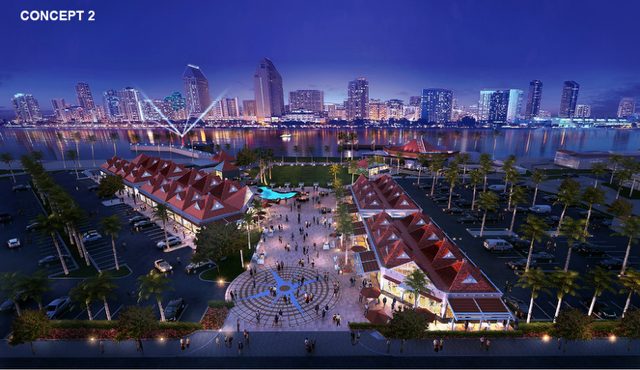 A rendering of Port Coronado Associate’s proposed redevelopment. Courtesy photo.
PCA had planned a $20 million renovation of the waterfront retail center, and has for years been seeking approval of the project and a renegotiated lease.
“We were ready to deploy $20 million in capital to turn the property into a class-A waterfront destination,” said Christian Herrera, vice president of development and operations for PCA. “Now, there’s no clear path forward for redevelopment, and it’s unclear whether the Port will invest the funds needed to maintain the property long-term.”
How Port leases work
The Port of San Diego oversees tidelands along the San Diego Bay under the California Public Trust Doctrine, which requires that waterfront land be used for purposes that benefit the public.
The Port cannot sell public trust land, and it often enters into long-term leases with private companies that promise to invest capital into development or improvement. Under this model, the Port retains ownership and regulatory control of the land, but private companies finance and operate businesses on it under lease terms that allow them to recover their investment over time.
Lease extensions or renewals are often renegotiated when tenants propose substantial reinvestment projects, a process that is governed by Board Policy 355. Under this policy, which is often referred to as BPC 355, tenants seeking lease extensions must submit packages containing the redevelopment proposal, evidence that the tenant was in good standing, and financial feasibility.
“The communication from Port staff to us was that the direction the Board of Port Commissioners gave them was to reject our proposal,” Herrera said, adding that the proposal was years in the making and had received community, city, and Port support. “When we asked what corrective action was needed on our end, they stated that the Port would not entertain any updated proposals and their intention was to take over the leasehold upon lease expiration and operate it themselves.”
Urtasun said Port staff had raised questions about PCA’s revenue projections and cost estimates for the Ferry Landing renovation. He argued that, rather than rejecting the proposal outright, staff should have continued negotiating or provided feedback to correct any deficiencies.
“If there’s a concern with this tenant,” Urtasun said, noting that to his knowledge, PCA is in good standing, “we should be negotiating a short-term agreement and be prepared to replace them if they can’t perform, not taking the property over.”
PCA said that the Port violated BPC’s timeliness clause. Under Section III, the policy states that the Port must respond to proposals in writing within 30 days of receipt, “either advancing the proposal for further review or identifying additional information needed.” If the Port took the latter option, the tenant would have 60 days to submit a revised proposal.
“Consistent with BPC 355, PCA provided detailed project feasibility studies, capital
investment plans, proformas, rent offers, security guarantees, and timelines reflecting a $20 million investment in the project,” PCA said in a press release. “Since June, the Port has refused to respond to these good-faith submissions. Finally, on Oct. 23rd, PCA was informed that its redevelopment plan was rejected.”
While the Port often leases its properties, it does manage some land. In 2018, the Port of San Diego assumed operations and management of Seaport Village, and Urtasun echoed Herrera’s belief that the Port wants to do the same with the Ferry Landing. However, Urtasun said that the two properties are not comparable. In the case of Seaport Village, he said, its tenant wanted to exit.
PCA, on the other hand, has been trying, with community input and support, to invest into the Ferry Landing for years. The company hosted a series of public input outreach events in 2021 and for years.
“We all know that is a very tired center that should have been renovated a long time ago, and it could have been,” Urtasun said, adding the the Port delayed its decision on the proposed redevelopment for years. “We could have had this renovation well underway by now, instead we’ve dragged it on.”
Mundy Page said the Port has not yet made a decision about the leasehold after PCA’s lease expires. If the Port were to manage the Ferry Landing, it would have to finance any redevelopment projects itself.
“I have a fundamental disagreement that the public sector can do things better than the private sector,” Urtasun said. “In this case, the private sector has every incentive to maximize the revenue associated with this space.”
Transparency at the Port
Beyond the lease itself, Coronado’s mayor also has raised concerns about how the Port made its decision. Duncan said that making this decision in closed session could constitute a violation of the Brown Act, which requires that legislative bodies deliberate and make decisions in public.
The Brown Act allows closed-session decisions in some cases, and real estate negotiations are excepted. However, Duncan reasons that the Port’s decision was not merely on a specific real estate negotiation, but rather, reflects a broader policy shift in how the Port handles its leaseholds, a move that would not qualify as an exemption.
“If the Port is making policy decisions about how it manages land in our city, that has to happen in public,” Duncan said.
Real estate negotiations are explicitly exempt from public discussion under the Brown Act, meaning the Port may have been within its rights to deliberate privately if the meeting focused on lease terms rather than broader policy.
Duncan’s criticism aligns with the conclusions of a 2023 San Diego County Grand Jury report, which found that the Port often makes consequential decisions in private and without meaningful input from its member cities.
The report described a governance system that carries a “lack of oversight, transparency, and accountability” out of balance with its power over land around San Diego Bay. It also raised concerns about the port district and its governing board of port commissioners, an unelected, seven-member body.
Noted in the Grand Jury report was the proposed site for the heavily opposed Cottages at the Cays development in Coronado. The now-defunct development proposed 41 small, two-bedroom, two-bath vacation rentals with off-street parking, restaurant and retail space, as well as a publicly accessible boardwalk, enhanced beach access, a playground, bathroom, and showers.
The San Diego Board of Port Commissioners in February 2023 voted 4-3 to move the project into the environmental review process. The decision came after a lengthy meeting in which more than 75 people spoke, most of them opposed to the development. In addition, hundreds of letters were sent to the board ahead of the vote and a petition against the project garnered more than 1400 signatures.
“Recent decisions by the Port District surrounding the proposed Cottages at the Cays Project on Coronado’s North Grand Caribe Isle exemplify the disconnection and disenfranchisement of the voting public and elected governmental bodies resulting from the Port District’s independence from local governmental oversight,” the Grand Jury found.
The report recommended sweeping reforms, including regular public updates to city councils, greater oversight of Port policy decisions, and potential restructuring of the Port’s governance to improve accountability.
Duncan said the Ferry Landing decision illustrates that those warnings have gone unheeded.
“What they’re doing now isn’t just bad policy; it’s eroding public trust,” he said. “The Grand Jury laid this out clearly, and the Port is continuing down the same path. They’re not transparent, and they’re not listening to the communities they’re supposed to serve.”
The future of the Ferry Landing
The Port’s spokesperson said that it is currently exploring options for the future of the Ferry Landing.
“Port staff understand the City of Coronado and the community’s vision of an improved center that retains its existing charm,” Mundy Page said.
But, Herrera countered, his company has been poised and ready to revamp the space for years.
“The Ferry Landing isn’t just a shopping village,” Herrera said. “It’s part of Coronado’s identity. It’s where families gather, where visitors get their first glimpse of our skyline, and where small local businesses give this island its unique character.”
Herrera, Duncan, and Urtasun all described the space as the “gateway to Coronado.”
“The Ferry Landing is the heartbeat of our waterfront and preserving and improving it isn’t just about buildings,” Herrera said, “it’s about protecting the spirit of Coronado.”
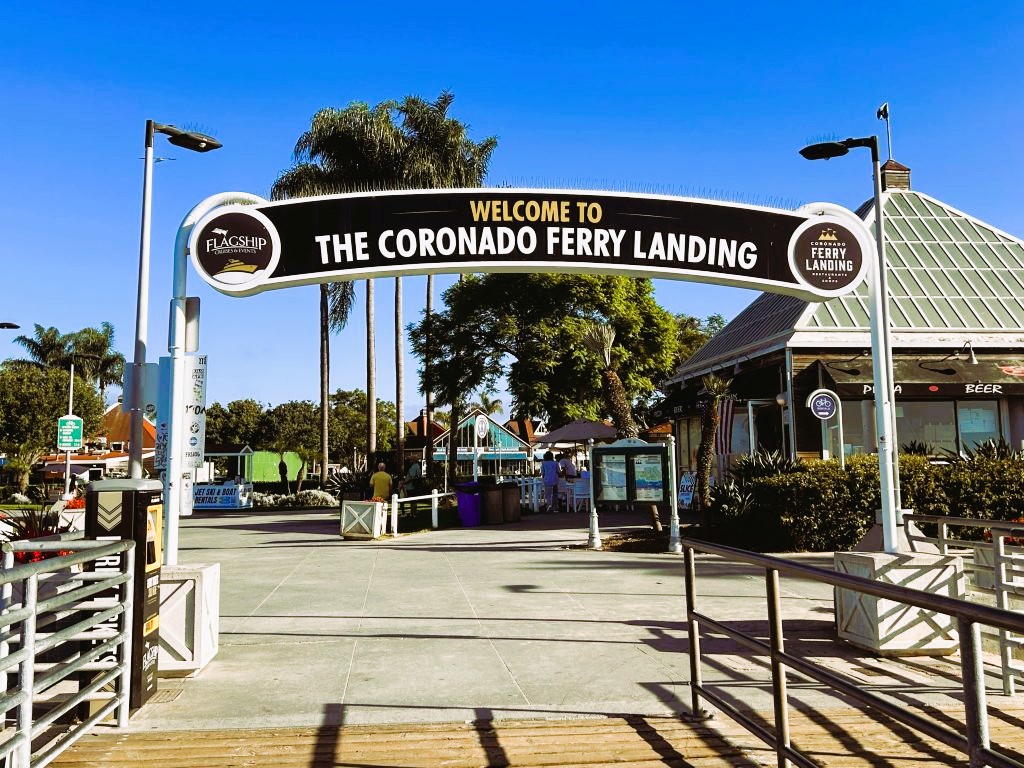 Coronado Ferry Landing, Aug. 23, 2025. (The Coronado Times)