
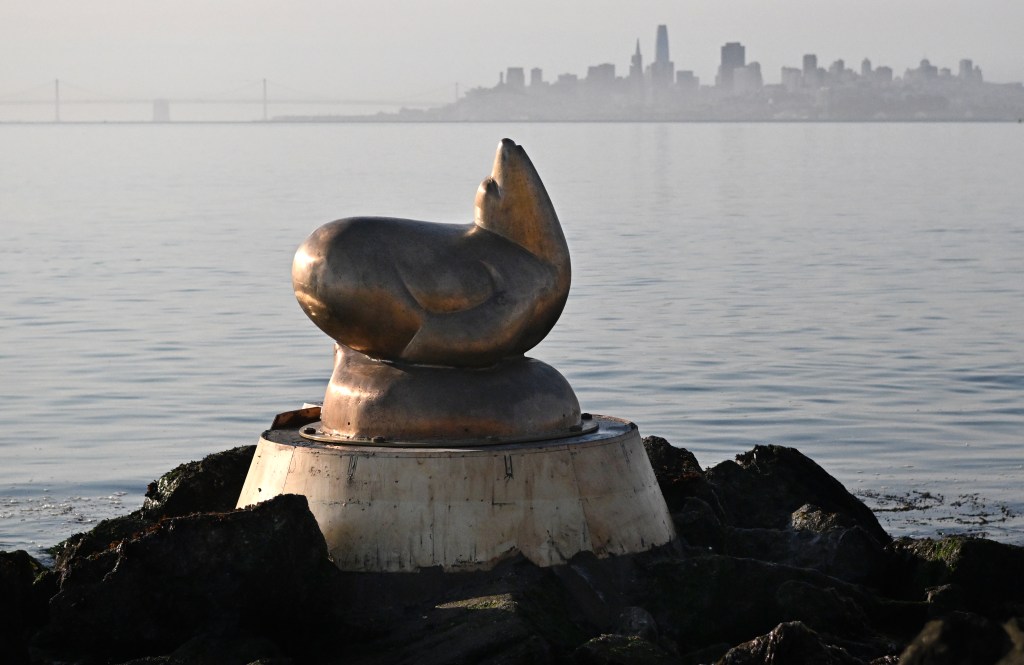
Sausalito might soon have donated art in parks and public venues.
The City Council unanimously endorsed repealing a quarter-century-old policy Tuesday that discouraged artists from placing their work in public places.
Instead, under a new process taking two months, artists or supporters would apply to the Parks and Recreation Department. The City Council would give final approval.
“The fact that we haven’t had a public art piece in Sausalito for three decades speaks to the bureaucracy associated with our current practices,” Vice Mayor Melissa Blaustein said. “And this is a really great path forward for us to start embracing, creating, supporting new public art in our community.”
“We’re eager to work with artists and donors to enhance our public spaces and add new chapters to our town’s amazing artistic history,” said Stacy Kray, chair of the Parks and Recreation Commission.
In late April, the commission unanimously recommended that a city resolution passed in 2000 that governed the acceptance, placement and stewardship of public art be repealed and replaced.
The prior process was “administratively complex,” a staff report said. In addition to applying to the parks commission, it required an advisory board of art experts to vet applications. Then the parks panel had to approve the project by a two-thirds majority. And the council had to approve the project.
“The last piece of artwork that was donated and installed on City property was the Bolinar on Bridgeway and Napa, in 1994,” the report said. “Other pieces have been restored, or donated on private property, but no new pieces were accepted in 32 years.”
The 2022 Connecting Communities Mural by Raylene Gorum, located at the underpass between Sausalito and Marin City, is outside of Sausalito’s jurisdiction.
The new process would eliminate the outside advisory board role, Kray said.
“An artist will submit an application and artist information,” she said. “They’ll submit information on funding sources, installation costs, the project, description, installation type, artwork, information on the safety and maintenance costs and the durability of the artwork. And, if they like, there is an optional portion to include letters of community support.”
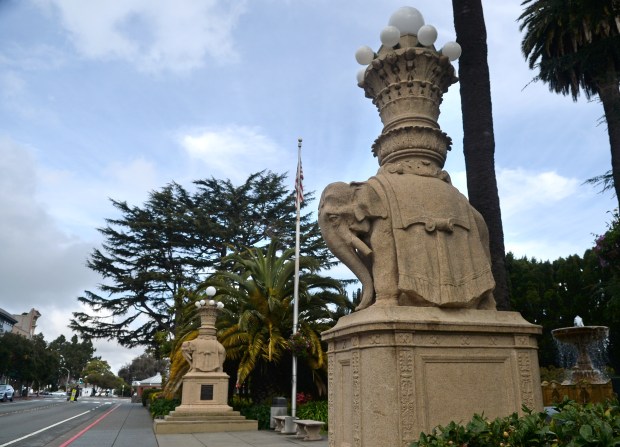 The elephant statues at Viña Del Mar Park along Bridgeway in Sausalito, Calif., on Thursday, March 8, 2018. (Alan Dep/Marin Independent Journal)
Council members welcomed the prospect of new public art in the city’s parks and venues. They had questions, however, about staff review, long-term maintenance, possibly removing art, and how offers from sponsors of artists would be handled.
“It can be very hard to remove public art once it’s been established,” Councilmember Ian Sobieski said. “Is there any kind of consideration given to the longevity of some of the pieces?”
Councilmember Jill Hoffman said she has heard from many residents who praised recent park renovations but then asked about art. She also asked about maintaining artworks and legal ownership issues.
Mayor Steven Woodside asked who would vet offers for sculptures or monuments, such as a statue honoring Joseph James, an African American musician and shipyard worker from Marin City who broke organized labor’s color barrier during World War II.
City Attorney Sergio Rudin, who drafted the new public art rules, said the council should have the final say in determining what art is suited for the city, citing First Amendment concerns. He also suggested the new policy is for long-term installations, not temporary exhibits.
“I’d certainly be willing to work with people if they wanted to float ideas,” Kray said. “And if we wanted to go to staff and find out if those things were things that were feasible.”
“There’s a lot of room for informal process,” she said. “People could come to the Parks and Recreation meetings and raise this as an item on the agenda.”