
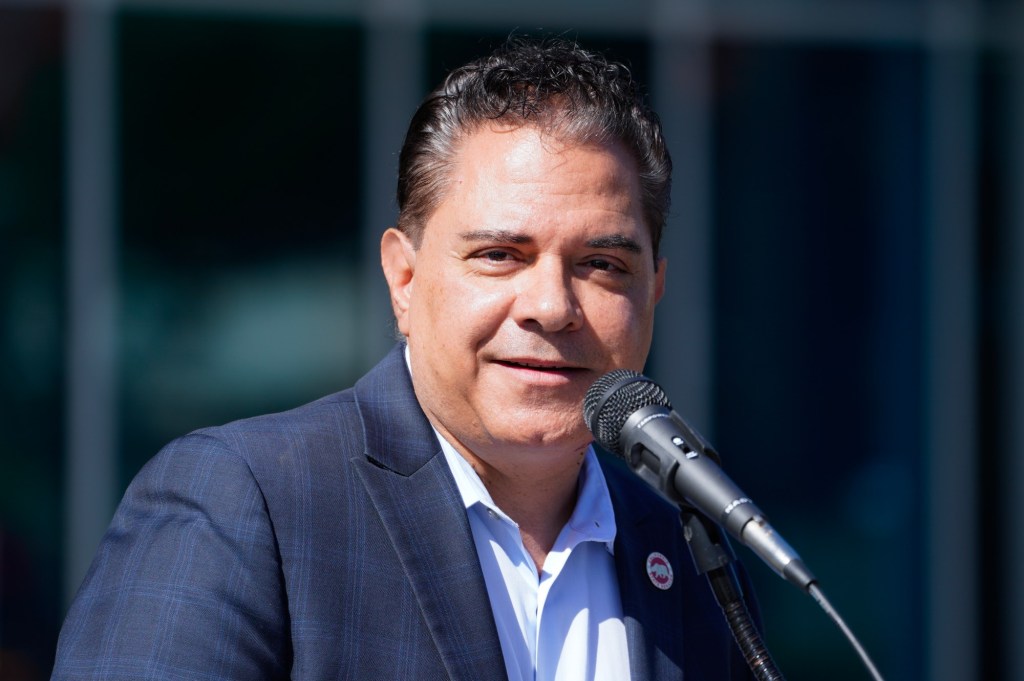
Steve Padilla, 59, a Democrat and incumbent state senator, is running for re-election to California’s 32nd Senate District representing San Diego’s South Bay region.
Padilla lives in his native Chula Vista and is seeking a third term in the state Senate.
The San Diego Union-Tribune emailed a series of questions to Padilla and other candidates to help inform voters about their positions, priorities and plans if elected.
Padilla said he did not use any AI tools in responding to the Union-Tribune’s questions.
1) Why are you running, and what makes you the best candidate? (150 words max)
South County and the working families I represent need a fighter who knows our community, gets results and fights on our side. I grew up working-class in South County. I served as a police detective. I’ve been a professional who has worked in every sector to advance equal economic opportunity and community health. I served as Chula Vista’s mayor. Now in the state Senate, I’m delivering real results: fighting for cleaner air for families near the Tijuana River, first-in-the-nation AI safeguards to protect kids and a more affordable California for the working families who built this state. I raised a daughter as a single parent — I know how hard it is to make ends meet, and I’m fighting every to bring costs down and lift South County families up.
2) What are the top 3 issues facing this district? (150 words max)Cost of living. Families across South County are getting crushed by rising costs and Trump’s tariffs. That’s why I wrote the law to stop Big Tech data centers from unfairly shifting rate increases onto struggling families.
Trump’s chaos. ICE’s violent tactics are illegal and immoral. That’s why I co-authored the bill to stop ICE agents from hiding behind masks. I’ll always stand up for hard-working immigrants and the rule of law.
Tijuana River toxic sewage. I’m tired of South County’s crisis getting ignored by Sacramento and Washington. That’s why I’m pushing for more stringent clean air standards and a federal state of emergency. Because we deserve the same clean air and water everyone else in California has.
3) What are the first 3 things you would do in office if elected? (150 words max)
I’ll keep fighting to lower costs, fix the sewage crisis and push back against Trump’s chaos and corruption. We also need to be serious about public safety. I’m a former police detective. I fully funded police in every state budget, led efforts to invest $10 billion in wildfire prevention and cracked down on untraceable ghost guns. Crime is starting to come down, but community safety must always come first.
4) What should California do to solve its shortage of affordable housing and curb homelessness? Which existing efforts do you believe are working, and which aren’t? (150 words max)
We need more homes, period. That means cutting red tape that delays construction, funding affordable units aggressively and holding cities accountable for meeting their housing goals. I get it — I was a local mayor and single dad. But supply alone won’t fix this. I authored SB 352 to create a living wage formula tied directly to regional housing costs. If workers can’t afford rent, building more units only solves half the problem. We have to address wages and housing together.
5) This district and its neighbors are vulnerable to climate change impacts like wildfires, rising seas and extreme heat, and to the health effects of climate-warming emissions. What should California do to improve climate resilience and reduce emissions and fire risk? (150 words max)
In the Capitol, I led efforts to invest $10 billion in wildfire prevention and ensure South County gets its fair share of those state dollars. I’m also fighting the insurance industry to pass comprehensive insurance claim reform so homeowners devastated by fires get compensated promptly — not drowned in bureaucratic red tape. California must continue to lead on clean energy jobs and reduce pollution to protect our safety, our health and our pocketbooks.
6) Laws enshrined in California’s Constitution that protect residents from tax increases have also painted local governments into a corner as they seek to fund basic services and have led to chronic underfunding of schools. What would you do about this? For instance, would you support changes to Proposition 13 to remove its protections for commercial properties? (150 words)
I’m a California native who remembers when we had the best public schools in America. Tax giveaways to big corporations have robbed our public schools of essential funding and the great start at a bright future every child deserves.
Proposition 13 must always be protected for homeowners — full stop, no fine print. The rigged rules that allow big corporate landowners to pay less in property taxes than you and I need to be reformed.
7) In light of those constraints, along with federal funding cuts, how should California balance its budget and fund basic services? Where would you seek new revenues or savings? (150 words)
California can’t cut its way to prosperity, and we can’t ignore fiscal reality either. The answer is a smarter combination of revenue and efficiency. Close corporate tax loopholes, ensure the wealthy pay their fair share AND root out wasteful spending, abuse and fraud.
On spending, we need honest audits of programs that aren’t delivering results. Bureaucratic overhead in housing and healthcare eats dollars that should reach people. I’m a Democrat who thinks inefficient government is a reality we need to fight and fix, not ignore.
But with Washington’s severe cuts to the safety net — Medicaid, nutrition assistance for kids and more — California will have to step up and step into the breach. That means ensuring we have the resources to support working families — and those resources are used wisely for those in real need.
8) Speaking of spending, Californians consistently rank the cost of living as a big concern. Recent jumps in the costs of fuel, food and other goods — combined with federal cuts to safety-net programs, new limits on certain federal loans and more — are further squeezing residents who were already struggling. What relief would you seek to offer, and how? (150 words max)
Working families in this district were already stretched before Trump’s trade war drove up prices and federal cuts gutted the safety net. This is a five-alarm emergency. We need insurance reform to bring down home insurance rates. I’ve authored legislation to protect ratepayers from skyrocketing electricity costs caused by massive Big Tech data centers. California needs to get serious about building more housing for the middle class — not just for the ultra-wealthy and very poor. The working families who built California should be able to afford a decent life here.
It’s also about creating more good paying jobs with decent family sustaining wages so workers’ incomes start actually going up. In the Senate, I passed the “Middle Class Pipeline Project” — and it was signed into law by the governor — to expand blue-collar apprenticeships and vocational education. We need to fight harder for good paying jobs for all of California’s working people — not just those with college degrees.
9) President Trump has made cracking down on immigration a cornerstone of his administration, ordering widespread arrests and detentions of immigrants nationwide and directing military resources to a new military zone along the U.S.-Mexico border. What impact have these actions had on this district? What are your goals on immigrants, immigration and the border, and how would you pursue them in the Legislature? What is your message to constituents who are immigrants? (150 words max)
I was a police officer and detective for years. I know how critical law enforcement is firsthand. But ICE’s chaos needs to be reined in. Trump’s mass deportation campaign has created fear, destabilized our local economy and separated families who have built their lives here. The military zone designation treats our community like a threat rather than an asset. It’s wrong.
In Sacramento, I’ve introduced legislation limiting profiteering in ICE detention facilities and will keep using every state tool available to push back on federal cruelty. My goals are clear: protect our immigrant neighbors, defend due process and ensure local law enforcement isn’t conscripted into federal immigration operations.
10) Health care costs for many Californians are rising — some because of new federal eligibility requirements, some because of Gov. Gavin Newsom’s moves to limit Medi-Cal coverage for some immigrants. How would you rein in costs? Would you vote to reverse the governor’s cuts to immigrant health care coverage? (100 words max)
Healthcare costs are rising because the Republican Congress took the money for Medi-Cal funding and Affordable Care Act credits and gave it to billionaire and millionaire tax cuts instead. We need to repeal those healthcare cuts and focus funding where it’s needed — keeping working families insured, reducing the cost of premiums and always protecting Medicare for our seniors.
I nearly died from COVID-19 during the pandemic. Protecting healthcare is personal to me. The governor made a difficult call under real fiscal pressure. I respect that, but I disagree with it. Healthcare is life and death for so many, and no one should have to decide between paying for the doctor and paying their mortgage. By cutting waste, fraud and abuse, we can ensure every Californian has access to quality, affordable healthcare.
Working with the governor, I fought for — and won — money in the state budget to prevent two rural hospitals in our district from closing. I’m fighting to keep struggling clinics open in our district, which so many underinsured and uninsured families rely on.
11) Among the many ballot measures being pursued by lawmakers and citizens for the November ballot are a handful that have drawn much attention and money. Should each of the below measures qualify for the November ballot, would you personally vote for measures that would do the following? (50 words max per measure)
After ballot measures actually qualify for the ballot and are reviewed by the Legislative Analyst’s Office, I will weigh in.