
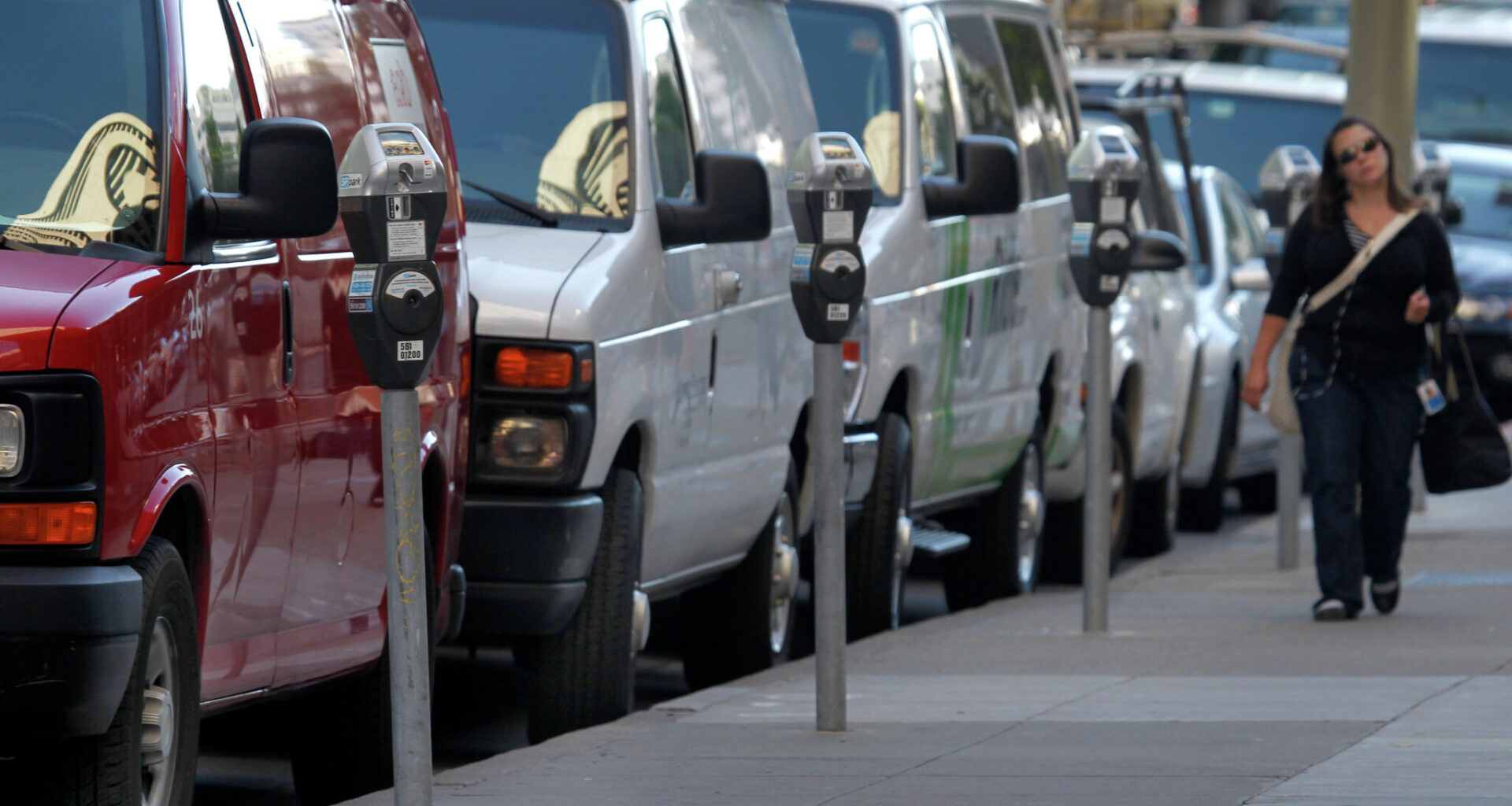
Cars and vans are parked in metered spaces on Main Street in San Francisco in 2013. The city is updating its parking app to make the practice easier, including being able to extend metered periods remotely.
Paul Chinn/S.F. Chronicle
Young drivers in San Francisco are probably baffled by tales of the old days, when people had to scrounge for quarters to pay for parking.
Today, we “feed the meter” through our phones, a payment method that makes the food analogy a little more confusing, and the process a lot more convenient. According to leaders at the San Francisco Municipal Transportation Agency, it just got even easier.
Officials at SFMTA have launched a suite of “smart” parking management tools, including online booking for garages and two new payment apps, HotSpot and ParkMobile. These innovations enable people to find and pay for curb space via their smartphones, without ever having to whip out a credit card, dig their pockets for loose change or touch a physical kiosk. If parking in a dense city had previously been a source of low-level anxiety, it’s become another illustration of a frictionless lifestyle.
Article continues below this ad
San Francisco was actually an early adopter of this technology, implementing the original pay-by-phone app in 2011. That platform will expire this month, replaced by the two new apps. ParkMobile quietly rolled out a few weeks ago, providing an advantage over its predecessor. Because ParkMobile also operates in Berkeley and Oakland, it saves motorists the trouble of downloading a separate app for San Francisco.
Hank Willson, policy manager for parking and curb management at SFMTA, ticked off the benefits of paying for parking by phone.
San Francisco Chronicle Logo
Make us a Preferred Source to get more of our news when you search.
Add Preferred Source
With the advancement of geonavigation, “you don’t have to go find the meter,” Willson said. “You don’t have to fumble with a credit card. You just pull out your phone, which people already do many times a day.”
A parking control officer patrols the metered spaces on Clement Street in San Francisco in 2011. A new parking app will allow people to pay for parking with more ease.
Paul Chinn/S.F. Chronicle
Perhaps the most practical perk is that people can extend their time remotely.
Article continues below this ad
“If after two hours you’re still having lunch, or still shopping, and you need to put more time on the meter, you can do it from wherever you are,” Willson said.
In addition to the new payment apps, San Francisco has introduced a reservation system that allows people to secure space ahead of time in any of the 22 city-owned parking structures. Staff at SFMTA began testing this mechanism last September for the performing arts-focused garages at Civic Center, eliminating some hassle for patrons at the symphony or ballet. After receiving positive feedback, the agency decided to expand, said Robert Aicardi, SFMTA’s off-street parking manager.
He and transportation director Julie Kirschbaum point out that the machinery of parking management isn’t just geared to create a better customer experience; it also promotes efficiency. With the advent of mobile payments, people no longer had to circle blocks or drive up and down ramps in a car storage facility. Cortisol levels dropped. Drivers were spared the grief of having to keep track of a paper ticket, or grovel to a parking attendant after losing it.
“If you’re not trying to figure out where to park, you get from A to B faster, and you’re not contributing to congestion or pollution,” Aicardi said. Willson cited a less-obvious outcome: Fewer cards or coins being slid into parking meters means less wear and tear or spent battery life for the equipment.
Article continues below this ad
Honestly, though, “it’s mostly about the customer,” Willson conceded. “We want parking to be a smooth process. We don’t want it to be frustrating.”