
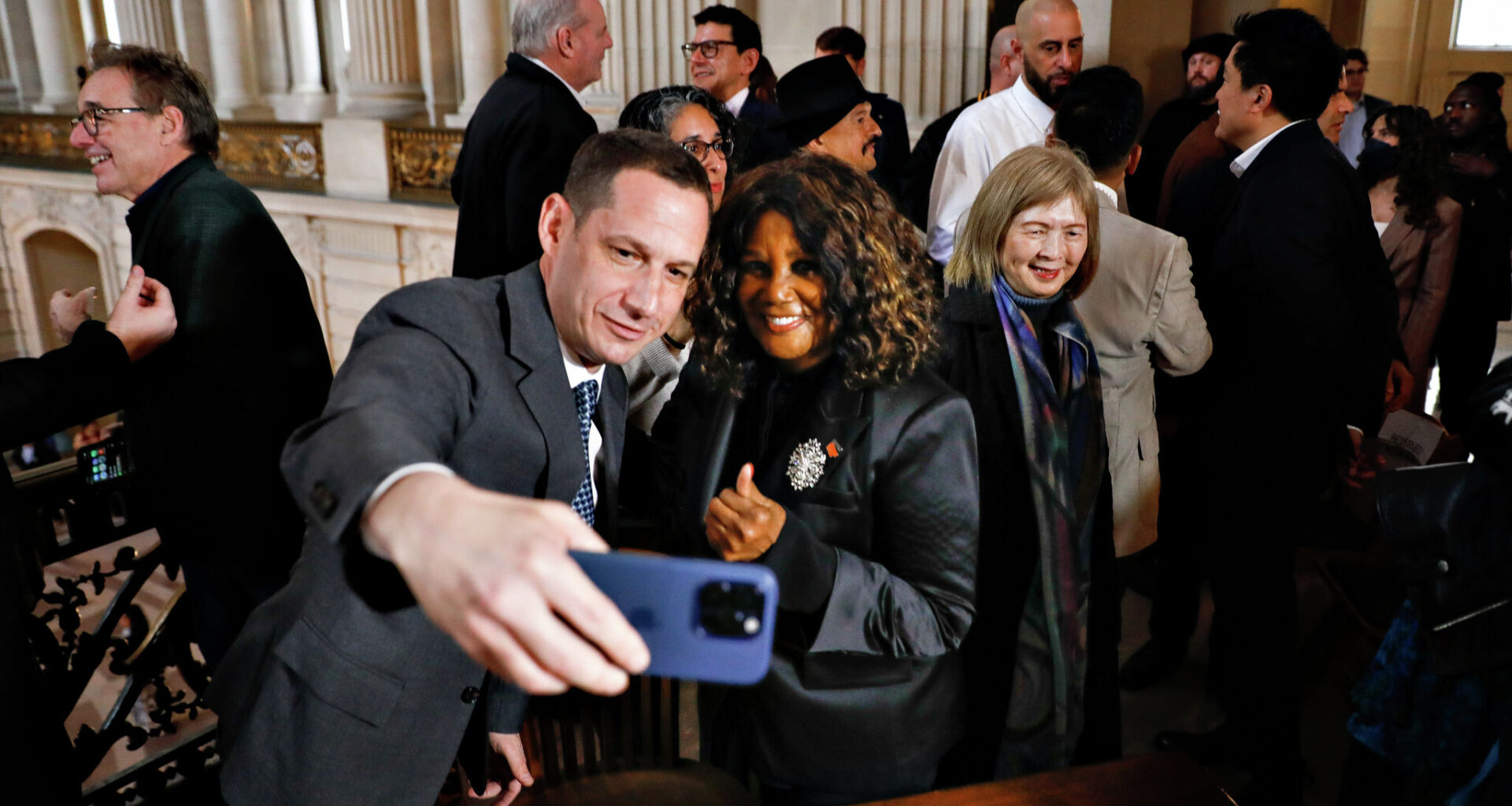
Mayor Daniel Lurie takes a selfie with Carolyn Tyler, film commissioner, in February after signing a bill expanding the city’s film rebate program.
Lea Suzuki/S.F. Chronicle
Mayor Daniel Lurie during a news conference regarding his new street safety directive.
Scott Strazzante/S.F. Chronicle
San Francisco Mayor Daniel Lurie speaks during his first state of the city address at Rossi Field.
Stephen Lam/S.F. Chronicle
Mayor Daniel Lurie has spent his time in office building a reservoir of goodwill with San Francisco voters, as shown by his remarkably high approval rating in the Chronicle’s latest poll.
In the months ahead, Lurie will try to spend some of that political capital, including by implementing fiscal belt-tightening at City Hall that’s already put him at odds with San Francisco’s leading public-sector unions.
Article continues below this ad
Then, in the fall, Lurie will tap into his popularity again when he urges voters to pass four ballot measures: one to save Muni from financial ruin and a trio to reform the city’s governance system.
Lurie will pursue those political goals while riding a wave of support from the electorate, according to the Chronicle poll. In the recent survey of more than 1,000 likely voters, 74% said they approved of Lurie’s job performance — virtually unchanged from the Chronicle’s last poll in July. On specific issues, Lurie scored best on his handling of downtown’s revival, while he received the lowest marks on the critical issues of housing and homelessness.
San Francisco Chronicle Logo
Make us a Preferred Source to get more of our news when you search.
Add Preferred Source
Still, the results show how Lurie’s popularity has endured, strengthening the mayor’s argument that San Francisco is “a city on the rise” under his leadership over the past 16 months.
In other words: Lurie’s public-relations strategy to improve the perception of San Francisco is working. And that will make it easier for him to execute the most difficult aspects of his agenda this year.
Article continues below this ad
“It emboldens him to do what he wants to do,” said David Latterman, a former San Francisco political consultant. “If he had dipped a little bit and returned to Earth, that would be one thing. But (critics might) look at these numbers and be like, ‘Aw, man, do we really want to take this guy on at the height of his popularity? ’”
The Lurie administration already issued 127 layoff notices to city workers last month, and more job cuts could be coming as the mayor prepares to submit his next budget proposal by June 1. Lurie has said he’s trying to make tough choices needed to get the city on firmer financial footing after years of recurring deficits. But unions representing City Hall workers are pushing back on both the layoffs and potential service cuts they say would unfairly harm front-line workers and vulnerable communities.
Latterman said the poll results could bolster Lurie’s position when his budget proposal is being vetted by the Board of Supervisors next month. Supervisors and labor leaders critical of Lurie’s spending proposals might feel less inclined to publicly antagonize the mayor, given his popularity, and more receptive to resolving differences behind the scenes, Latterman said.
He also predicted that Lurie could use the poll results to his advantage as he campaigns for a November parcel tax to shore up Muni’s finances. The poll results show the overwhelming majority of respondents approve of his efforts to revitalize downtown, which might inspire Lurie to lean into a message that the Muni tax is essential to continue downtown’s economic recovery, Latterman said.
A more immediate test of the limits to Lurie’s popularity will come in the June 2 primary, when two of Lurie’s allies on the board — Stephen Sherrill and Alan Wong — are facing voters for the first time. While Lurie has endorsed both Sherrill and Wong, past mayors have often found their rapport with the electorate doesn’t necessarily rub off on their handpicked candidates.
Article continues below this ad
“History is less kind than you’d think it is, but these numbers that Lurie has are somewhat unique, so that is the thing to watch for,” Latterman said. “If anyone can buck history, based on these numbers, maybe Lurie can.”
In a statement to the Chronicle, Lurie spokesperson Charles Lutvak said the mayor was delivering on his campaign promises to improve public safety and make City Hall more accountable.
“Now, we’re doubling down to drive our economic recovery and clean up the broken system so government doesn’t only work for the insiders and special interests,” Lutvak said. “Under Mayor Lurie’s leadership, San Francisco is coming back stronger than ever, and we’re going to stay relentless.”
On every specific issue included in the Chronicle survey, respondents rated Lurie higher than they did in the July poll. In addition to the overwhelming approval he got for his work downtown, Lurie fared better than he did last summer on public safety, homelessness, street cleanliness, drug overdoses and housing. The poll mirrors how voters feel about the city’s overall trajectory: 67% said the quality of life in San Francisco is excellent or good now, a 10-point increase from July and a 28-point increase from 2024.
“Voters were optimistic when Mayor Lurie took office, and they are feeling largely as though their faith is being paid off with improvements of their perception of life in San Francisco,” said Jonathan Brown, president of Sextant Strategies & Research, which conducted the Chronicle poll.
Article continues below this ad
Lurie has been laser focused on improving the public perception of San Francisco. He regularly uses his public and media appearances to promote the narrative that the city is turning around. He is highly active on Instagram, where his 245,000 followers see a deluge of videos about his policy work along with his frequent appearances at local businesses and community events across the city. “Let’s go, San Francisco!” has become his catchphrase.
Latterman questioned how much of Lurie’s continued sky-high popularity is the result of favorable media coverage that reinforces the notion that San Francisco is rebounding after its struggles during the pandemic years.
“The media narrative coming out of the city for a few years was really bad, and it got picked up on and it fed back into the city. It has now flipped,” Latterman said. “So the media coverage, both locally and nationally, has improved greatly, and that becomes its own feedback loop.”
In making his case that he is overseeing a turnaround in San Francisco, Lurie has pointed to declines in the number of reported crimes and the number of homeless tents counted on the streets. Both those figures were falling before Lurie took office, but he has cited their continued reductions as evidence that his approach to running the city is bearing fruit.
Still, San Francisco continues to face major challenges on some of its most entrenched issues. Very little new housing is being built in the city, and rent prices have surged amid an influx of workers clamoring for jobs in the booming AI sector. Public drug scenes remain common in neighborhoods such as the Tenderloin, SoMa and Mission. Drug overdose deaths plateaued last year.
Article continues below this ad
Lurie has also been buoyed by new businesses that have come to the Union Square area, even as the nearby San Francisco Centre mall closed permanently. And he’s heralded San Francisco’s successful hosting of major gatherings such as NBA All-Star Weekend in 2025 and events related to the Super Bowl this year. Overall tourism to the city is expected to grow this year but still remain well below the pre-pandemic high.
While Lurie has had little difficulty advancing his agenda so far, he does have some vocal opponents, and the poll found that about a quarter of voters did not approve of his job performance. The mayor’s detractors have pushed back on his plan to allow taller and denser housing, saying he was paving the way for the displacement of low-income residents. They have characterized his efforts to crack down on open-air drug use as an attempt to criminalize addiction. And they have described Lurie, a Levi Strauss heir who has courted private investment in public projects, as being too cozy with wealthy interests.
“Just pure class war,” former Supervisor Dean Preston wrote on social media in reference to a proposal from Lurie to cut a city tax on large real estate transactions.
Lurie’s successes have been lauded by many of the city’s influential political donors — even some who preferred other mayoral candidates in 2024. For example, billionaire Chris Larsen, who supported Lurie’s predecessor London Breed two years ago, has given generously to support Lurie’s political priorities this year. Larsen told Mission Local that Lurie is “doing a great job” and is “focused on the basics.”
Another politically active billionaire, the conservative Bill Oberndorf, has also heaped praise on Lurie, despite his concerns in 2024 about Lurie’s attacks on rival mayoral candidate Mark Farrell. Oberndorf’s moderate political group, Neighbors for a Better San Francisco, had endorsed Farrell and Lurie.
Speaking at a Wednesday summit that Neighbors co-hosted with the American Enterprise Institute, a center-right think tank, Oberndorf said “San Francisco has made significant gains in repositioning itself” since Lurie became mayor.
“It was not long ago that the doom-loop narrative prevailed,” Oberndorf said. “That clearly has changed and that is all for the good.”