
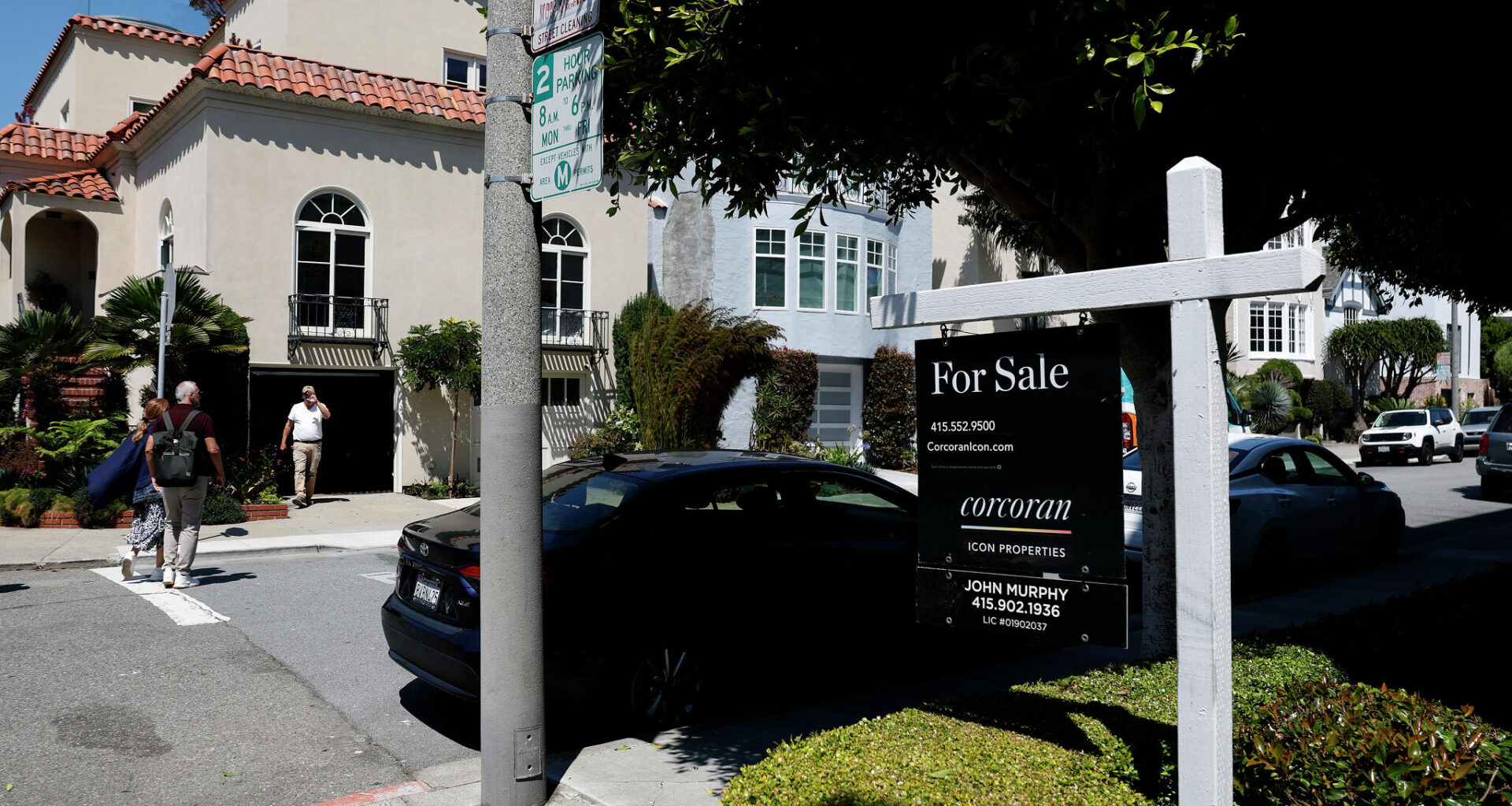
A sign is posted in front of a home for sale in San Francisco last year. Despite high mortgage rates and growing inventory, economists say today’s housing market lacks many of the conditions that led to the 2007-08 crash.
Justin Sullivan/Getty Images
Housing prices in the Bay Area have never been higher. The stock market keeps climbing to new records — mainly because of a single tech sector. Major companies have gone through multiple rounds of layoffs. The cost of living, from mortgage rates to a gallon of gas or milk, keeps going up. There’s a war in the Middle East.
The 2007 vibes are strong. That was the year the housing bubble burst, tied to the subprime mortgage crisis that triggered the Great Recession.
But do all the parallels indicate that we’re in another bubble — and that the housing market could again be poised to crash?
Article continues below this ad
Not necessarily, said Daryl Fairweather, chief economist for real estate site Redfin. She recently posted a YouTube video titled “Home prices can’t crash. Here’s the math” explaining why.
First, some numbers to set the scene.
San Francisco Chronicle Logo
Make us a Preferred Source to get more of our news when you search.
Add Preferred Source
Nationally, there are 630,000 more home sellers than buyers. That’s a lot. Even in ultra-pricey San Francisco, it’s considered a buyer’s market, according to Redfin, with 12% more sellers than buyers. In February, 7.4% of San Francisco sellers cut their price, by an average of about $143,000.
But despite that leverage, buyers face stiff headwinds. Home prices remain high — the median in San Francisco was $1.72 million in March, a 19% increase since the start of the pandemic. Mortgage rates have also stayed elevated — 6.37% late last week. Global economic and political uncertainty and a tough job market aren’t helping.
Article continues below this ad
Still, nothing in that picture puts us on track for a housing market crash, Fairweather said.
The mid-2000s housing crisis was underpinned by economic conditions that no longer exist.
So what’s really going on, and what could happen next?
She and I spoke about why she believes a crash isn’t coming, what would actually move the needle on prices, and how San Francisco’s market is more like the national one than you might think. Plus: What should hopeful first-time buyers expect in the next year?
(This Q&A has been edited for length and clarity.)
Article continues below this ad
Jessica Roy: I think there’s a perception that housing prices have gotten so high, we must be back on track for them to come crashing back down. But you say that’s not really the case, right?
Daryl Fairweather: No, I do not anticipate that prices will crash. They have come down in certain specific markets in the Sun Belt, where there was a lot of new construction during the pandemic that has resulted in more supply. And those builders of new construction were quick to correct their price expectations and mark those new builds down or offer incentives like cash at closing or lower mortgage rates to get those units sold.
But even so, it wasn’t like anything compared to what happened during the Great Recession. And more broadly, home prices are up from last year. They’re up about 2% nationally, which is slower than the pace of overall inflation. So in real terms, they’ve come down ever so slightly.
The reason why prices haven’t come down more in the face of these high mortgage rates is because existing homeowners don’t have a reason to sell. They’re not in distress. They have lots of equity. They have record-low mortgage rates that they got during the pandemic, or maybe they paid off their mortgage altogether. For them, there’s nothing to motivate them to accept a lower price than what they feel like they should get.
JR: This is not the first time people have suggested we must be on the cusp of another crash. I bought my house in June of 2020 and I had multiple people tell me everything was going to crash by August or September of that year. And then that never happened. Home values are up 50% nationally since then. Why?
Article continues below this ad
DF: In 2020, during the pandemic, I think everybody was imagining the worst possible scenarios that could happen because you were in such uncharted territory. But then what happened was that mortgage rates were low, so people wanted to buy homes. Prices kept going up until 2022, when mortgage rates increased at their fastest pace on record. But even that didn’t cause prices to come down. It just stopped prices from continuing to grow at these breakneck speeds.
JR: In your video, you said, “Crashing home prices is mathematically very difficult when homeowners have this much equity and this many reasons to stay put.” What are those reasons that they’re staying put?
DF: One reason that somebody might want to move is to get into a different home that suits them better. But most homeowners have mortgage rates far below what prevailing mortgage rates are. So if you were to give up a 3% mortgage and accept the 6.5% or 6.3% mortgage on your next home, even if the home was the same price, you would end up spending about $1,000 more per month just to move into a home that’s the same value as the home that you are in.
There are other reasons why homeowners don’t want to move, like tax incentives in California. You have Prop 13. When you start to do the math and you look at, “Well, what am I really getting out of moving besides perhaps a nicer house,” it’s way too expensive for people to sell and give that up.
• Read: California is an expensive place to live — but ‘a great place to die’
Article continues below this ad
• Read: Here’s how long Californians keep their homes — and how it compares to elsewhere
JR: If you look at home price data over the past 50-ish years, we’ve technically had eight recessions, but only the Great Recession came with that massive drop in home prices. We’ve seen little dips in prices, but nothing like that. Why are we unlikely to see that again?
DF: The housing market is what set off the financial crisis, which led to the recession, which exacerbated the problems in the house market that were already there. Those homeowners back then didn’t have equity in their homes because they were taking on these loans where there were these balloon payments, there were these teaser rates — they weren’t actually paying into the equity of their home. They were just paying interest. So when they needed to go sell their home, there wasn’t any equity cushion to make it so that they weren’t under water on their mortgages.
And that’s very different than what’s happening now. People have lots of equity. Most homeowners have more than 20% equity because they start with a 20% down payment to begin with, or they’ve owned their home long enough that their equity has gone up. Equity increased by the most on record during the pandemic. So anybody who bought during or before the pandemic, they definitely have an equity cushion. Which means they aren’t distressed, even if prices were to come down.
Right now foreclosures are increasing a little bit. But right now levels are so low. It doesn’t look like an unhealthy housing market.
JR: What percentage drop would you consider to be “a crash?” A 20% home price decrease? 50%?
DF: If there was a housing bubble anywhere in the country, it would have been Austin (Texas) during the pandemic. The Austin median home price peaked at $555,000 in April 2022, and they currently stand at $430,000. So that’s a 23% decline. If we saw something like what happened in Austin all across the country, I think we would call that a crash.
But it’s very localized to Austin. And also, home prices there are still above what they were pre-pandemic: In January of 2021, Austin median home prices were $359,000.
I think that that is a crash, but it’s a very contained crash, and not that many people were impacted because not that many people bought at the peak. You can have a localized home crash without bringing down the broader economy.
There’s a positive spin to it, which is that Austin built a ton of homes. That helped people by keeping those prices moderated, because now the first-time homebuyer in Austin is not paying what you would have had to pay back in 2022.
The 2008 foreclosure crisis was very bad for just about everyone involved. There weren’t any winners in that, versus what happened in Austin. You can definitely find a lot of winners in that story.
• Read: What a $200,000 salary can actually buy you in the Bay Area housing market
• Read: These are California’s 50 richest suburbs — a Bay Area city tops the list
JR: If we’re not on track for any sort of crash, is there any hope, particularly in California in the Bay Area, for maybe a dip? Or even a return to 2020 prices?
DF: In California that is not very likely because they have not built enough homes to get to a place where the supply is meaningful. There are more home sellers than there are homebuyers, but I think in San Francisco the margin is not very wide. (10% more sellers than buyers is considered a balanced market.) In San Francisco, there’s 12.1% more sellers than buyers; in San Jose, it’s 28.5%. In Los Angeles there’s 58.6% percent more sellers than homebuyers.
The prices have not come down in California. I think it’s because those sellers aren’t really serious sellers. Those sellers are refusing to lower their prices enough to clear the market. Also, Los Angeles is going through its own economic trouble because of how the entertainment industry has left the area, so there might be some more fundamental shift happening in the L.A. economy. You might see a longer-term price correction happening there.
But there still is a fundamental lack of homes. There are more people who would like to live in L.A. than there are homes available to them, but the owners of those homes aren’t willing to part with them unless they get really high prices. And that has to do with Prop 13, it has to do with them having record low mortgage rates. So even though there are more sellers than buyers in that market, those sellers aren’t willing to drop their prices to get those homes sold. At least not yet.
San Francisco and Los Angeles, what they have in common is that they have not been building enough homes over the last decade and a half to keep up with the number of people who would like to move to those cities. L.A.’s economy has gotten weaker, but San Francisco’s economy has gotten stronger because of the AI tech boom. We’re past the doom loop.
We’re actually seeing a lot of demand in the luxury market especially because of that, because of all the wealth that people have gotten. And it can be pretty concentrated at the top of the wealth distribution because we’re not seeing that same amount of demand for more moderately priced homes. So that makes San Francisco a bit unique.
JR: Yes, I was just looking at the Redfin luxury report on San Francisco. Median home sale price in the San Francisco metropolitan area jumped 14.4% year over year to $1.7 million. That’s the largest increase since March 2018, and the biggest gain among the top 50 U.S. metro areas. The national average was a 1% increase year over year.
But if we look at non-luxury properties here, homes in the 35th to 65th percentile, the year-over-year price change is only 0.1% in San Francisco. That suggests the city’s big-picture housing market numbers are sort of being propped up by this small group of very wealthy buyers. Does that mean that outside of that top 5% luxury market, San Francisco’s housing market is actually a lot closer to the national picture?
DF: Yes, I think that that’s an accurate portrayal. And I think if you took out that top 5% San Francisco’s housing market would look a lot more like Seattle’s. Seattle is similar, it’s a tech hub, it has supply constraints, but it doesn’t have the same amount of AI wealth that San Francisco had. Seattle’s housing market is weak, but not collapsing.
• Read: Beach homes under $400,000: This is the last affordable city on California’s coast
• Read: Bay Area condo values are still falling — except in these San Francisco neighborhoods
JR: What are we seeing from sellers who don’t get the price that they want? Do we have any numbers on how many people are pulling their house off the market?
DF: In March, 50,000 home purchase contracts fell through nationally. These deals get canceled when buyers and sellers can’t see eye to eye. Something comes up in the inspection, the buyer asks the seller for a credit, the seller refuses because they were already on the fence about selling in the first place. And then the deal falls apart.
Another thing that’s happening is price cuts. In February, a record 34% of home sellers cut their list price, which was the highest for any February on record.
And home delistings, as of the end of December, were the highest on record. Many of the people who delisted in 2025 are deciding to relist their homes in 2026. We’ll see if they go through with it or they delist again.
JR: Californians keep their homes longer than anyone else in the country, we have unique homeowner benefits like Prop 13 — do these factors mean homeowners here are less impacted by economic downturns compared to non-owners?
DF: If you are a homeowner in California, you are insulated from mortgage rates going up. That doesn’t affect you. You’re insulated from home prices being so high. That doesn’t really affect you. So for the homeowner class of California, yes, they don’t feel the shocks of the economy the same way that the renter class or their first-time homebuyer class does.
• Read: This is the real doom loop. It will change everything about life in the Bay Area
• Read: These California cities show up again and again on ‘best places to retire’ lists
JR: You talked about in your video how economically vulnerable homeowners are actually the least likely to sell right now.
DF: Right. The luxury segment of the market is doing really well, because they are not sensitive to prices being so high or interest rates being so high. They have so much money to just make those problems go away that they’re going to buy because they want to, not because of differences in mortgages.
Whereas people who are worried about losing your job because of AI or something like that, you’re probably going to hold on to that mortgage payment for as long as you can, and you’re not going to find a new mortgage at a higher rate.
JR: So homeowners here are house rich, equity secure, no financial pressure to sell. What would motivate people to sell their homes?
DF: If mortgage rates were to come down, then that gap between the mortgage rates that people have and the mortgage rate that they would get in the next home would narrow and that would encourage more home sales.
And if governments allowed for property taxes to go up with the value of homes, the way that it does in Texas or in Florida, then that would motivate people to sell when their home goes up in value, because they wouldn’t want to pay those higher property taxes. At least they’d consider it. Maybe they wouldn’t go through with it. But more people would consider it.
And if we had more housing supply, if we had better options for people who are looking to downsize and actually save some money — we could only really do that if we had a lot more of that dense affordable housing available to them.
JR: We have not been in a recession, but the economy has felt — let’s call it “recession-adjacent” since 2022. Job searches are taking a long time, the cost of gas and groceries has gone up, AI has led to a lot of wealth creation but is also getting blamed for layoffs. If we did tip into an actual recession or face protracted stagflation, what impact could that have on the housing market?
DF: Well, if we entered into a recession and the Fed actually had to cut interest rates, then mortgage rates would fall and it would actually — I mean, it would solve that problem of mortgage rates being too high, we’d probably see more home sales. The housing market would probably move anti-cyclical to a recession.
JR: If we’re not looking at a crash, but instead a multiyear period with decreased sales volume but at very high prices — how long can that kind of market last?
DF: If nothing changes, if we don’t have a recession, we will be in this place where home prices only will go up slower than wages go up, lower than inflation for the next five to 10 years. And that would mean that once you adjust for inflation, home values would get more affordable. But it would be a very slow change. It’s not going to happen with a crash.
JR: For a potential homebuyer in the Bay Area who feels priced out right now, what should their next move be? What should they be watching for over the next year?
DF: If you can afford to buy a home that you want, you should just go for it, because I don’t think the market really can change that much. And if you’re priced out, then I would — I mean, at least rents are stable right now. Hopefully, you’ll be able to save money because I don’t think home prices are going to go up a lot either.
There’s not like a lot of urgency one way or the other right now because not much is going to change.
If we did enter into a recession and rates drop, which I’m not saying is going to happen, but the possibility that were to happen, then I think we should reevaluate and look at what you can get at lower rates.