
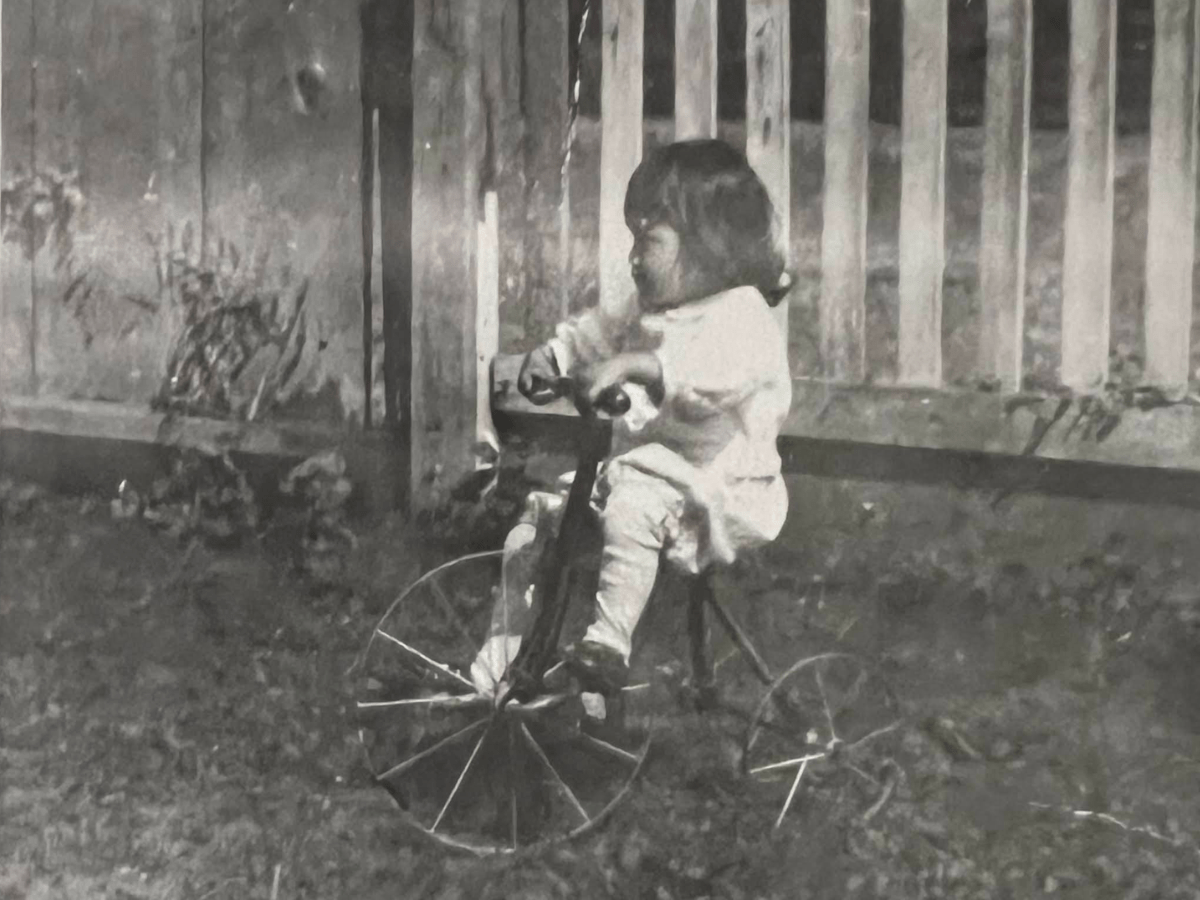
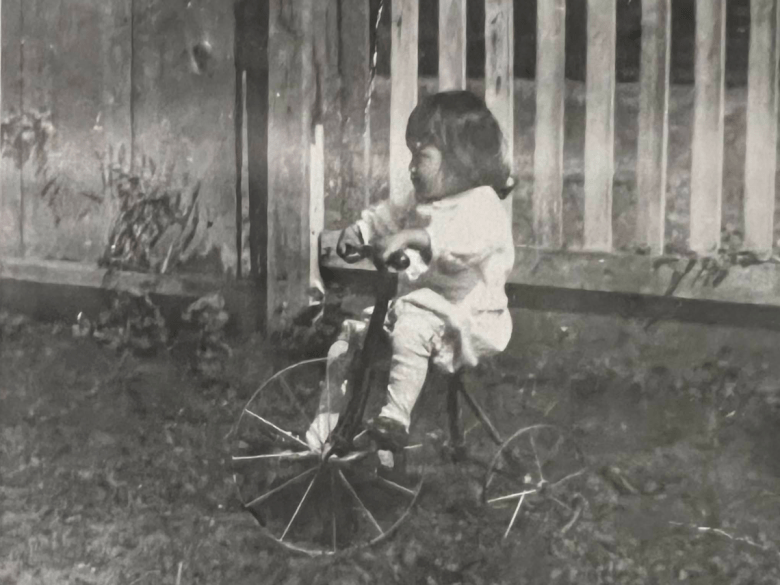
 Gyo Fujikawa, age 3, rides a tricycle in October 1912. The artist and author was born in Berkeley and became a bestselling children’s book author. Courtesy: Bonita Weavingearth and Denson Fujikawa
In Berkeley-born author and illustrator Gyo Fujikawa’s picture book “Babies,” five little kiddos with dumpling feet and chubby cheeks share a double-page spread. They do what babies do — toddle about, give hugs, clutch a clown doll. Each baby sports a tiny halo.
“Sometimes they are little angels,” Fujikawa writes.
What’s most remarkable is the babies themselves, their heads topped with black, brown, blond and red hair. The book, published in 1963, made history as one of the first mass-market children’s titles to include kids of different races together on the page.
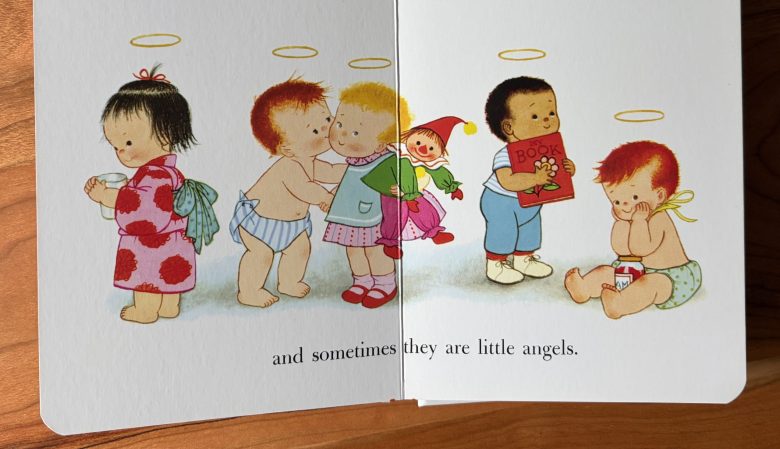 Gyo Fujikawa’s “Babies,” published in 1963, was among the first children’s books to show children of different races playing together. Credit: Sara Hayden
“Babies” and its companion book “Baby Animals” became classics. They made it on the 2001 list of Publishers Weekly’s top children’s books of all time and sold upward of 2 million copies. The Japanese American author’s books have been reprinted, sold and circulated in 22 countries and 17 languages.
And yet for many years, “Babies” has been missing from the shelves of the Berkeley Public Library. Librarian Bae Smith said this is now changing, and as of this week, copies of the board book are available for checkout. They join the library’s Fujikawa collection, which includes a copy of “Mother Goose” and a Spanish translation of “Oh, What a Busy Day!”
“Any children’s book illustrator who draws children of all backgrounds together is building on what Fujikawa called for,” Smith said. “She’s not really on people’s radar, but she’s there and had a profound influence.”
Fujikawa’s early 1900s Bay Area childhood as the daughter of Japanese immigrants
Fujikawa created a total of more than 50 children’s books in her career, but it all started in Berkeley, where she was born on Nov. 3, 1908 and spent part of her childhood, including in a home on Spruce Street. Her family also spent time in San Francisco and Southern California.
“Berkeley … is where the earliest memories of my very small childhood remain,” Fujikawa wrote in an autobiographical article.
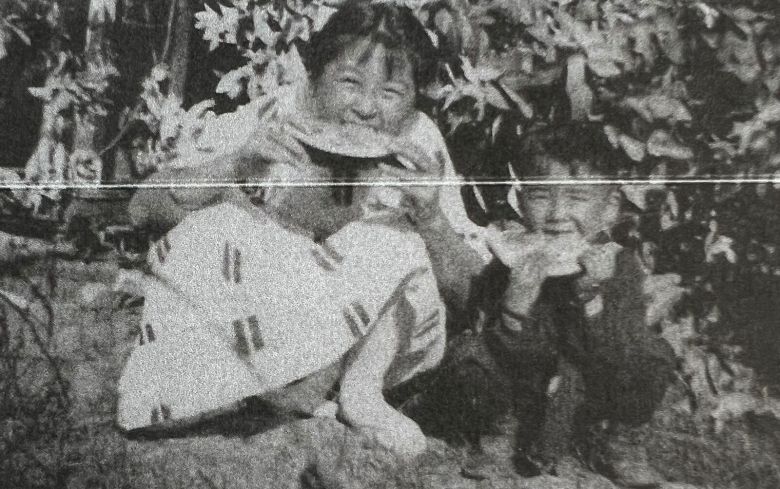 Siblings Gyo and Yoshihiko Fujikawa enjoy slices of melon as children in 1920. Courtesy: Bonita Weavingearth and Denson Fujikawa
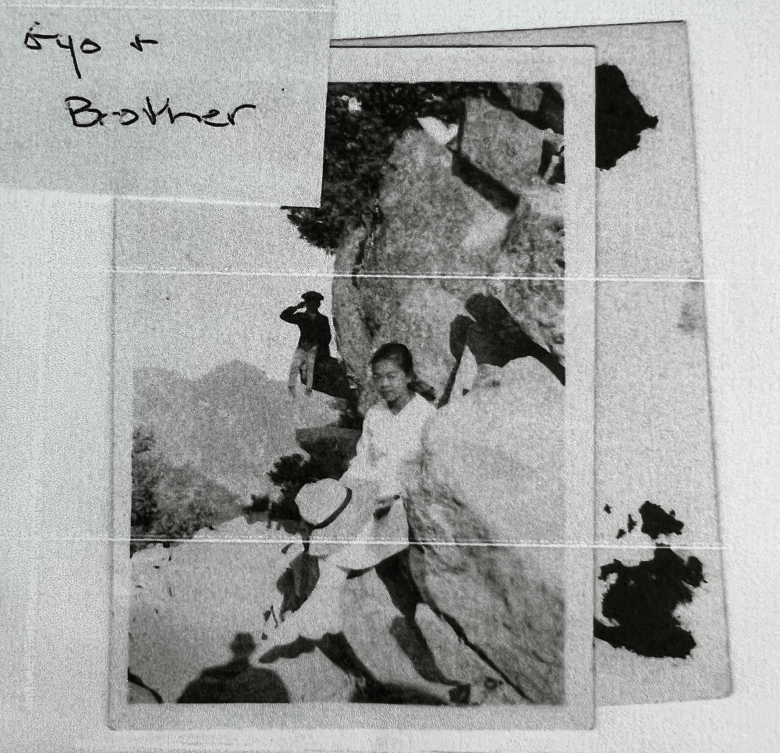 Gyo and Yoshihiko had an active childhood exploring the outdoors throughout California with their parents. Pictured here in the 1920s. Courtesy: Bonita Weavingearth and Denson Fujikawa
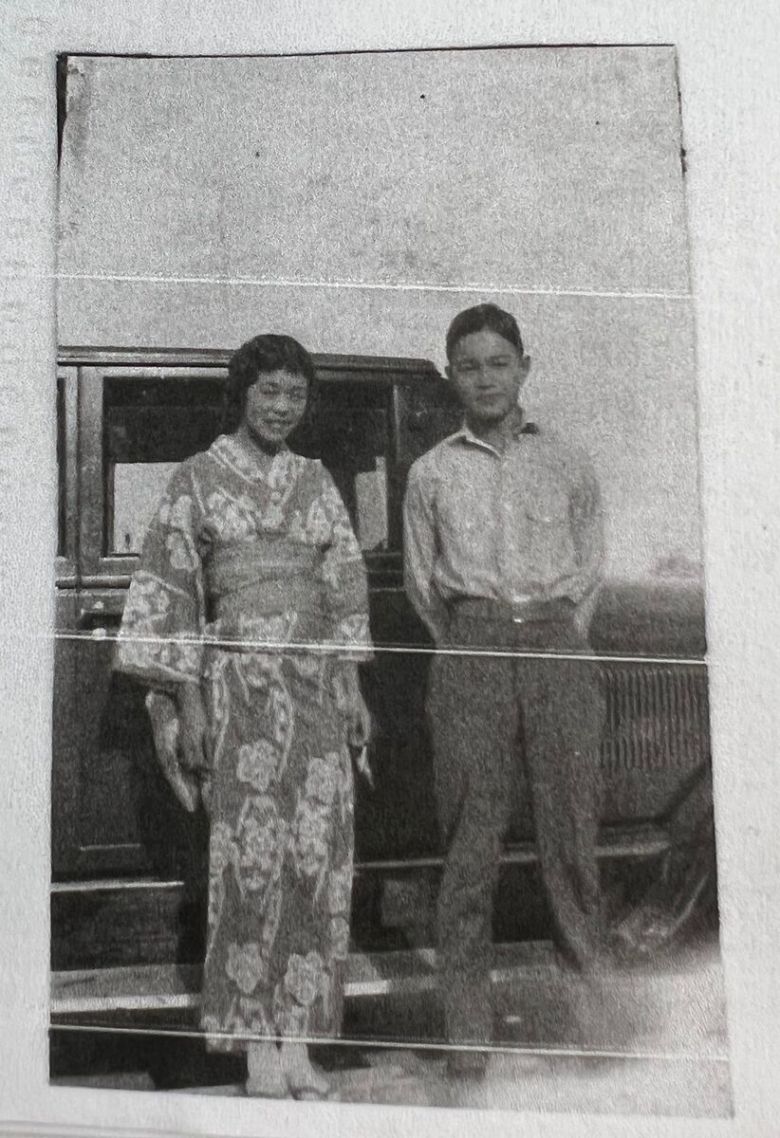 Gyo and Yoshihiko in 1925. Yoshihiko became a physician. Courtesy: Bonita Weavingearth and Denson Fujikawa
Her parents, Hikozo Fujikawa and Yu Nomura Fujikawa, were immigrants from Japan. Before World War II, they moved all around the state, seeking different opportunities. Hikozo did farm and creamery work, and also worked as a buyer, linen shop owner, grocer, interpreter and translator. Yu, an aspiring social worker, worked in a china shop, and also as an embroiderer, journalist and accountant.
The California of Fujikawa’s childhood had a significant Japanese American community, though racist attitudes and policies limited options. There were restrictions on immigration, interracial marriage, property ownership and employment. Two years before Fujikawa was born, San Francisco Unified School District established a segregated school for Asians. The California Alien Land Law, established when Fujikawa was about 5, barred Asians from owning or leasing agricultural land for more than three years.
At home, the family spoke Japanese. It wasn’t until later that Fujikawa learned English. At school, people were prejudiced against her as one of the few Japanese students.
“ I was left OUT of things a lot,” she wrote, and sometimes singled out.
“At the local elementary school, a kindergarten class asked to borrow me when I was very little for some kind of program. I believe they were going to sing about a little Japanese girl. I was put in the center of the room with a ring of American children singing and pointing their fingers at me. I began to cry and ruined the whole program.”
Fujikawa said that her little brother had it even worse. Yoshihiko wasn’t allowed to swim at his athletic club’s pool due to segregation, but she could swim at the YWCA, for example. Years later, during World War II, President Franklin D. Roosevelt’s Executive Order 9066 forced West Coast Japanese Americans including Fujikawa’s parents, her brother Yoshihiko and his wife to relocate from California to a concentration camp in Arkansas.
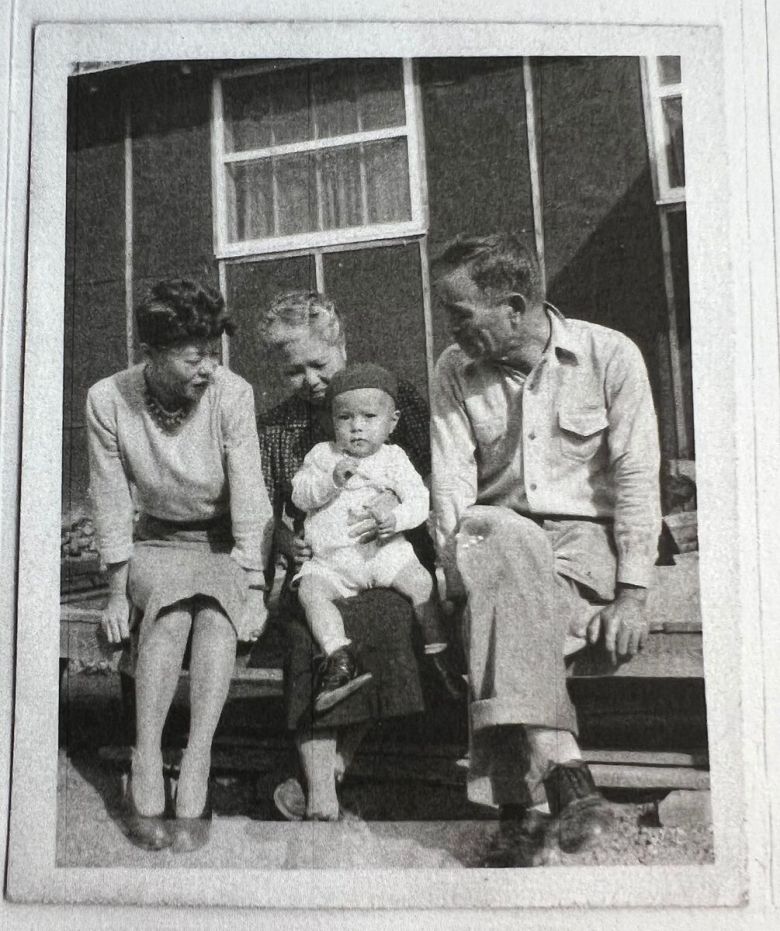 Fujikawa (far left) traveled from New York in 1942 to visit family members, including her parents, Yu Nomura and Hikozo Fujikawa, and her nephew Denson, at the Camp Jerome concentration camp in Arkansas. The Fujikawas were among the 110,000 West Coast Japanese Americans forcibly removed from their homes and incarcerated by U.S. authorities. Courtesy: Bonita Weavingearth and Denson Fujikawa
Living in New York by then, Fujikawa was exempted, but she was not immune to the cruel effects of the racist policy. She visited her family, including Denson, her nephew who was born there. Fujikawa said that her brother “didn’t want his child to grow up remembering the barbed wire and soldiers with bayonets sticking out of the end of their guns.”
How her stand to include Black babies in her books ‘changed publishing’
Fujikawa’s experiences of injustice shaped her world view, what she drew in the pages of her books and the battles she chose to fight.
“Having had her family imprisoned, I know where her political eye would have been,” said Bonita Weavingearth, the wife of Fujikawa’s nephew Denson, in an interview. “She was very self-assured and strong. … In her fight for multethnic children to be in her books, we very much know where her heart lies.”
“Babies” was published in 1963 — a year before the Civil Rights Act passed. It was the same year the Ku Klux Klan bombed a church in Birmingham, killing four Black girls, months after 1,000 Black children marched as part of the Children’s Crusade protest in support of desegregation.
When a Grosset & Dunlap sales executive told Fujikawa to remove the illustrations of Black babies lest they hurt sales in the South, Fujikawa refused. “I said I didn’t care if the books didn’t sell; the black babies must stay,” Fujikawa later wrote.
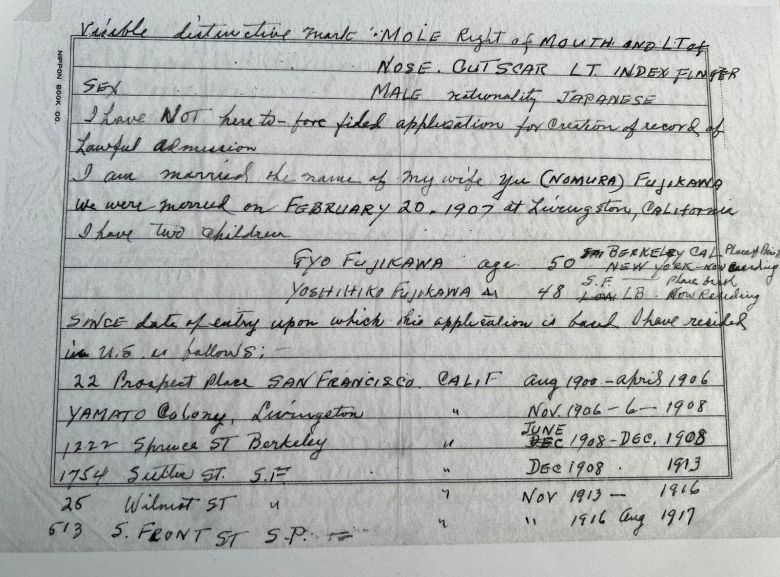 Notes from the Fujikawa family, perhaps written partly by Hikozo Fujikawa, in preparation to fill out an application to create a cecord of residence in March 1959. The Fujikawas were required to provide the addresses for every place they ever lived. This document notes that the Fujikawas lived on Spruce Street and Gyo Fujikawa was born in Berkeley. Courtesy: Bonita Weavingearth and Denson Fujikawa
Smith, the Berkeley librarian, said Fujikawa’s decision to take a stand “changed publishing.”
“As an early mainstream illustrator to reflect many races of children playing together … it wasn’t common to do that and I think it was very brave,” Smith said.
Publishers tend to publish books they deem as “marketable” — books that they think will sell. This was true in the 1950s, prior to the publication of “Babies.”
“To sell more books and ensure profits, books with white characters came to dominate the market,” global children’s literature scholar Kathy G. Short wrote.
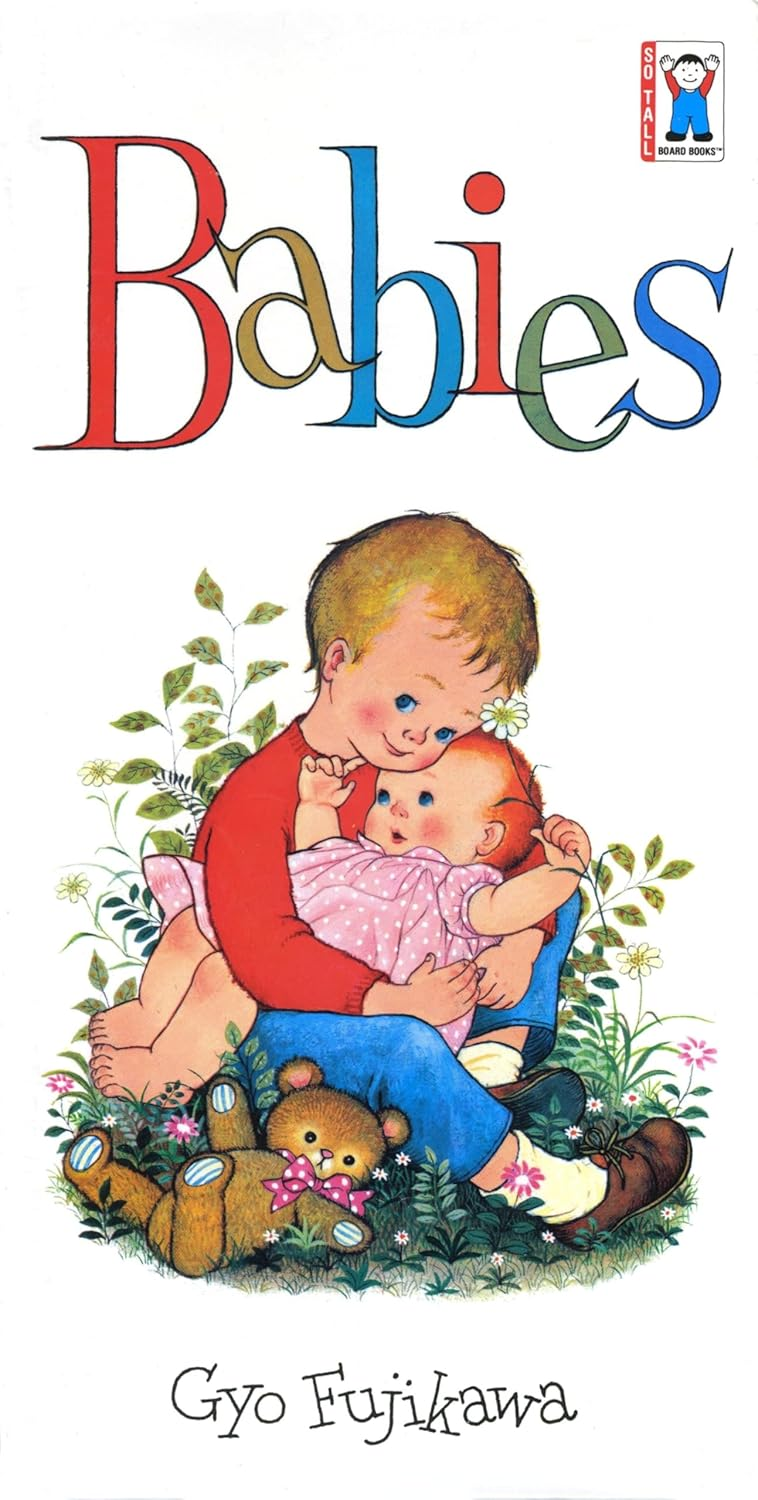 The cover of Fujikawa’s “Babies.”
By proving that there was a market for more diverse children’s books, Fujikawa created opportunities for more. For that reason, “Babies” was groundbreaking when it was published. Diverse characters and creators remain underrepresented today. Just 33% of children’s books feature a primary character of color and 38% have a creator who’s a person of color, according to a 2025 study. Fujikawa’s books were ahead of their time. Experts say that representation impacts how children feel both about the world and about themselves; representation can promote self-esteem. While Fujikawa’s own environment was implicitly and explicitly segregated, she imagined a world that wasn’t. Through her illustrations, she invented a different version of reality and helped other people see the possibility of it, too.
This gave children images they liked and it gave their grown-ups hope. After the 1970 publication of “Fairy Tales and Fables,” Publishers Weekly shared reviews about Fujikawa’s children’s books from readers:
“I am nine years old. But when I am 90 I will still like the book. The pictures are very pretty and funny and cute.”
“I got this book [‘The Night Before Christmas’]…and I love it dearly! Mostly because of the pictures. They are the most lovely pictures I have ever looked at. … I am a ten year old girl and I live in Canada.”
Revisiting Fujikawa’s books today
Fujikawa’s books have their critics. Some complain that her work is too sugary, or find the plots lacking, according to a Los Angeles Times obituary.
Her approach defies current trends. Children’s books now prioritize cultural specificity, authenticity and accuracy, often based on the author’s lived experiences. Many call for self-love in celebration of one’s unique identity. But Fujikawa’s books do something different. She doesn’t paint strictly Japanese American characters. Instead, she casts children of different races in leading roles. Her books don’t focus on self-love, so much as love of each other.
“A daughter of Japanese Americans, she was probably facing racism, sexism and her family’s internment. And yet she created books that were happy and showed all children playing happily. It’s compelling,” librarian Bae said.
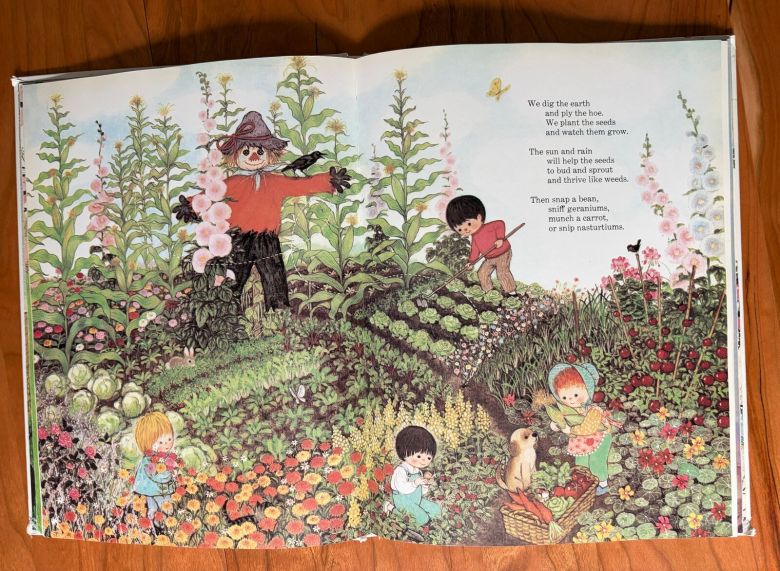 The garden in “Oh, What a Busy Day!” looks like it could grow in Berkeley. Fujikawa said she never had kids of her own, but, “Part of me, I guess, never grew up.” Credit: Sara Hayden
The 1988 book “Are You My Friend Today?” answers that pertinent titular question in a portrayal of a shouting match between two tots and their subsequent hugs.
The 1976 book “Oh, What a Busy Day!” depicts children running on green, grassy knolls under a blue sky dotted with clouds. The beach and water in the background look like they could be from the Berkeley Marina, the silhouette of the Marin Headlands in the distance.
Another poem sounds as though it was freshly picked from a local garden as children tend it together: “We plant the seeds/and watch them grow … Then snap a bean, sniff geraniums, munch a carrot, or snip nasturtiums.”
Fujikawa’s stories feel as though they could take place right here. Her detailed lists in rhyme and her fine line work in black ink give a sense of specificity. They capture the texture of a particular tree’s bark, or just the right shade of cool in the night sky. At the same time, dreamy washes of color, wandering landscapes, universal themes and relatable children’s expressions and interactions make Fujikawa’s stories feel as though they could take place anywhere, could be about anyone. This is part of Fujikawa’s magic as an artist.
“I am flattered when people ask me how I know so much about how children think and feel,” she wrote. “Although I have never had children of my own, and cannot say I had a particularly marvelous childhood, perhaps I can say I am still like a child myself. Part of me, I guess, never grew up.”
Knowing Fujikawa’s history — the prejudice she experienced as a child in school, as well as what she faced as a Japanese American woman during World War II, the Civil Rights Movement and beyond — the stories in her Four Little Friends series are especially poignant.
The Four Little Friends are a bit older than Fujikawa’s original “Babies,” perhaps preschool-aged. They have a developing sense of reason, and an ability to verbally express themselves. Most notably, they put these skills to use and demonstrate empathy and courage. They stand up for themselves and each other.
In “Welcome, Mei Su and Other Tales,” a new girl, who happens to be Asian, moves to town. The story says that she “seemed sad and timid, too,/Till she smiled and said, ‘My name’s Mei Su.’”
Patsy, a white girl, rushes to invite Mei Su to her friend group that includes Brian, a Black boy, and Sam, a white boy.
“Welcome to the neighborhood!” Patsy declares. By the second page, the children are sharing toys and playing together. The story concludes, “Smiling happily, they agree,/Four little friends are better than three!”
The book was published in 1996, two years before Fujikawa’s death at the age of 90. In it, Fujikawa gives her characters the warm welcome that she was denied — but deserved — as a child.
We know that most readers don’t get to the end of the article. But you did! To support our in-depth, rock-solid reporting, please consider making a donation to our nonprofit newsroom today. We rely on our readers — particularly the ones who read the whole story!
“*” indicates required fields