
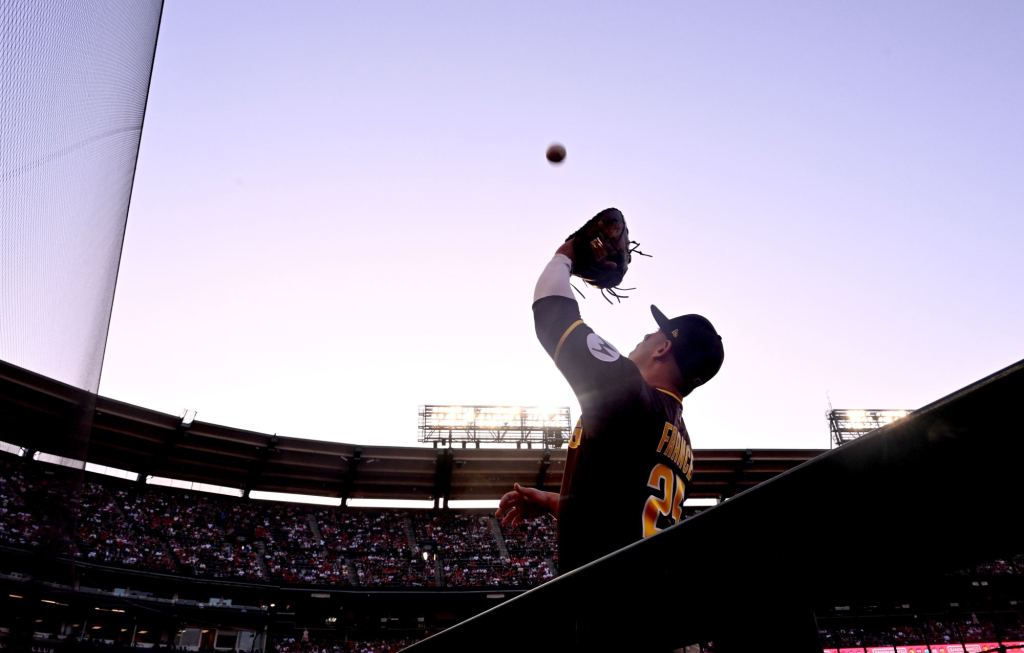
Early in the season, a batter hit a ground ball to first base.
“I had to go tackle it, basically, while trying not to die by getting run over by the runner,” said Ty France.
It’s one of many plays a first baseman makes over the course of a season — nearly doing the splits to scoop a ball, handling (sometimes errant) throws from other infielders, diving to stop a ball from sneaking down the first-base line.
Yet first base is still seen by many as a “catch-all” position, a position that “anyone can play” as long as they produce at the plate. It’s where teams send players who are getting slower, older and less agile; or where they stash someone to keep a bat in the lineup.
“People think anyone could just (play there),” France said. “I mean, can someone go stand there and catch a ball? Yeah, if it’s thrown into their chest every time.
“Do I think anybody could do it? No. Do I think most big leaguers could do it? I think they could go out there and catch a baseball, but it just turns into, you know, the willingness to want to take that next step and be able to pick balls, be able to do the footwork around the bag.
“You have teams spending almost a billion dollars on their infield. Wouldn’t you want someone that you know is gonna catch everything?”
This is an ode to first basemen, who are often underappreciated by fans and metrics (more on that later) in favor of positions that require more running, range and athleticism.
“It’s significantly harder than everybody thinks,” said Jake Cronenworth, who has played the position throughout his career. “More or less, you’re involved in every single play on the field. Whenever the ball hits the infield. Obviously, (on) ground balls, you’re covering first base. If it’s a line drive hitting the outfield and it’s a double, you’re trailing the runner in. You’re the cut-off guy for two-thirds of the outfield. You’re (there for) pick-offs. Pretty much every play.”
That involvement is crucial to the chemistry of the infield.
“They help us out all the time,” said third baseman Manny Machado.
Padres fans have seen Cronenworth make run-saving plays at first over the years, diving to stop a ball from shooting through a gap or timing a leap to snag a 100-mph liner overhead.
“I view it as: If you want to play really good first base, you play pretty far off (the bag),” Cronenworth said. “You play in challenging spots. And it’s not just a jog over to first base to get there, it’s a full sprint most of the time. So no, it’s not as easy as everybody makes it out to be.”
Nick Castellanos, a former third baseman who primarily played the outfield for the last eight seasons, anticipated a possible move to first base toward the end of 2025. He leaned on former major league first baseman Yonder Alonso to help him get acclimated to the new position.
“It was just brought up in conversation (with Alonso) during the year last year, and then I called him once the offseason started,” Castellanos said. “I always definitely viewed it as a position that deserves a lot of respect because of how much you’re going to touch the ball.”
Castellanos spent spring training getting extra work with Padres infield coaches Ryan Goins and Nick Punto, focusing on footwork, body angles and timing.
The most surprising challenge so far?
“Probably pick-offs,” Castellanos said. “Just because (the pitcher) turns around quick and flings it over. So to pick up the release point, catch the ball and tag the guy, I mean, it’s a skill.”
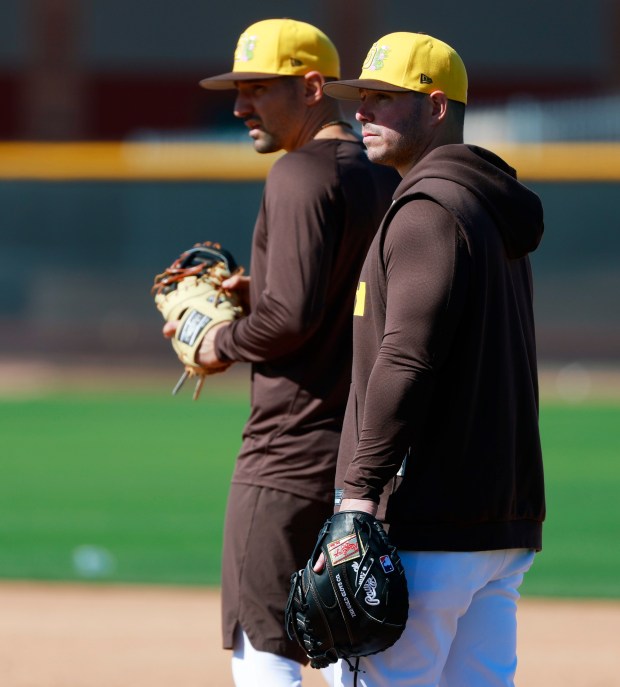 Nick Castellanos and Ty France of the San Diego Padres work out at first base during a spring training practice on February 19, 2026 in Peoria, AZ. (K.C. Alfred / The San Diego Union-Tribune)
‘He’s in charge’
The Padres’ infield is one of the strongest in the league, accounting for just four errors this season. Manny Machado is elite at hitting first basemen in the chest, even from an off-balance effort far off the third base bag.
Still, there are times when the best attempt misses the mark.
“You don’t want to bounce it,” shortstop Xander Bogaerts said. “But sometimes you will. A lot of times, actually, you will. But having (first basemen) keep it in front of them or pick it, I mean, that’s so huge for us, the other infielders.”
It’s a safety net that is central to the position.
“I think the biggest job of a first baseman — outside of our own plays — is picking up the infielders around you, making them feel confident,” said Gavin Sheets, who returned to the position this season after playing the outfield last year.
The job goes beyond routine defense. It requires learning each infielder’s tendencies — the arm angles, a rushed throw, the ones that rise or sink. A skilled first baseman can turn potential errors into outs and quietly improve the numbers of his teammates.
“It’s probably the most underrated position to have somebody that’s very talented, in my opinion,” Punto said. “Because he’s in charge. In today’s world, he’s in charge of Manny’s statistics. He’s in charge of Bogaerts’ and Cronenworth’s statistics. At the end of the day, he gets to pick balls out of the dirt and make those guys look good. If he’s bad at picking balls out of the dirt, then those guys get errors and they don’t make the plays. So there’s a lot that goes into that.
“In the old days, it used to be, ‘Yeah, just put a guy over there that can hit 30 home runs.’ But now these guys are graded, and they all look at their metrics and who they are as a player. So, it’s very important.”
The prototype of a slug-dominant first baseman has faded in modern baseball.
“At the end of the day, you got to hit; you got to bang a little bit,” Sheets said. “But there’s so many defensive metrics now that you can’t really hide at any position anymore.”
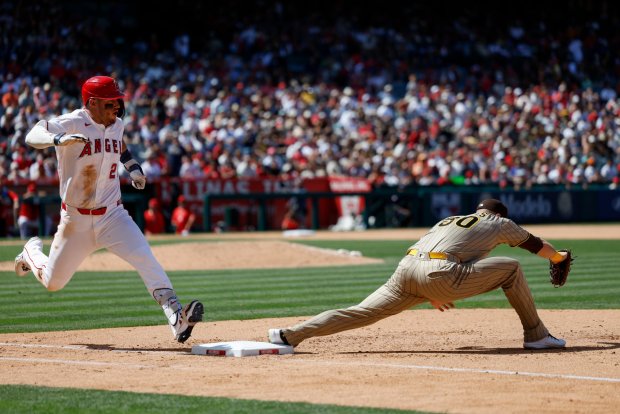 Los Angeles Angels’ Mike Trout, left, runs to first base as San Diego Padres first baseman Gavin Sheets, right, catches the ball during the sixth inning of a baseball game Sunday, April 19, 2026, in Anaheim, Calif. (AP Photo/Caroline Brehman)
‘You have to be a diverse player now’
There are so many metrics, in fact, that a disconnect has emerged — one that’s difficult to ignore when it comes to some of the game’s most cited statistics.
In 2024, Ty France was “metrically, the worst first baseman in the league,” he said.
He set out to improve his stats as well as his value to the infielders around him. Last year, France was rewarded with a Gold Glove. He was the second-best defensive first baseman in the league. He was credited with 9 defensive runs saved and his OAA — Outs Above Average — sat at 10.
Yet on FanGraphs.com, France’s DEF metric — fielding and positional adjustment combined, which measures a player’s total defensive contribution relative to a league-average player and is one of the building blocks of Wins Above Replacement (WAR) — was minus-0.7. Matt Olson, who won the Gold Glove for the National League last year with 17 defensive runs saved and nine OAA, was minus-4.2.
It raises a simple question: What, exactly, is being docked?
No one seems to have a clear answer.
“Standing out there,” France said. “I don’t have an answer for you … My best advice is, if you want to get paid based off WAR, don’t play first unless you’re gonna hit 30, 40 homers.”
Many metrics are used to evaluate player value, and each team relies on its own internal grading system. Still, the broader point remains: by most analytical models, a first baseman’s potential contribution is considered significantly lower than that of a premium defensive position such as shortstop. This hierarchy is not new to baseball. Some, however, view it as outdated, arguing that the subtleties of first base play — short-hop picks, footwork around the bag, knowing when to stretch and when to come off, turning errant throws into outs — often go unquantified or are credited elsewhere.
For example:
“If you flip the ball to the pitcher on a ground ball, you get more points than taking it yourself,” Cronenworth said. “They should just fix the system… I know I got crushed for doing that.”
First base is often treated as the easiest spot on the diamond to fill, which can diminish a player’s value in the eyes of evaluators. It’s also viewed as a “parked” position, where players are judged less on range or athleticism and more on their ability to handle errant throws.
The result is a position where doing your job perfectly can still register as not doing enough.
Picking a ball out of the dirt is unlikely to dramatically improve a player’s stats, yet it is the most important trait for Goins; one he values more than an athletic lateral movement to cut off a hard grounder.
“I don’t think it’s a position where range is a must,” said Goins. “Guys who can really pick, I think, are the best first basemen. Because if you’re good around the bag, when you pick the ball, you immediately make the whole infield better. So I don’t think you need to be, like, the rangiest. Obviously, do you want to have range? Yeah. But if you ask me, would you rather somebody who has insane range at first base or who never misses a pick, I would take the guy who never misses a pick every time.”
Goins bristled at the notion that first base is the easiest to play on the infield.
“You have to be a diverse player now,” Goins said. “It’s not just, ‘We want bats, bats, bats.’ I know you need bats. But guys make a good living being defensive players. You still gotta make plays. You can’t just go out there and be deficient. You still gotta be good.
“I think the position is way harder than people realize.”