
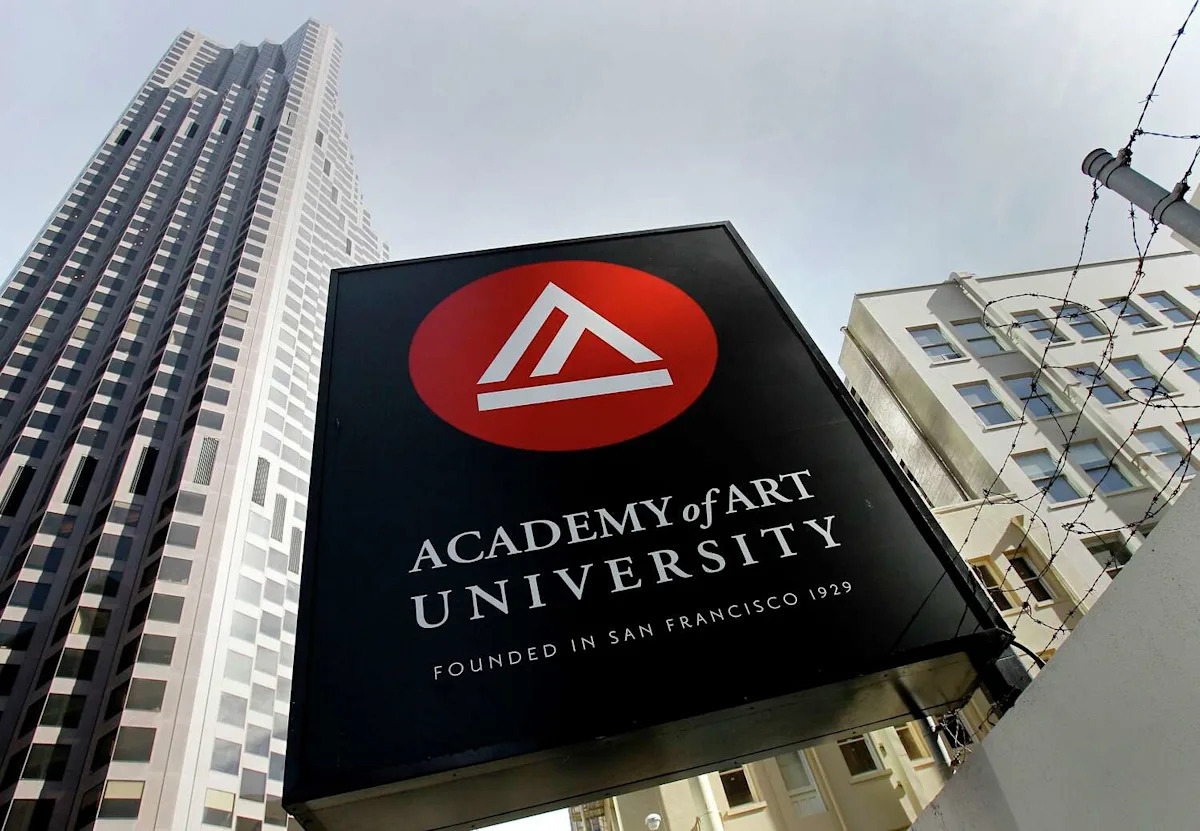
For decades, the Academy of Art University was one of San Francisco’s most voracious real estate collectors. Now, it’s become one of its busiest sellers.
The latest deal has the embattled for-profit art school selling 2300 Stockton St., a three-story office building near Fisherman’s Wharf, for $18.3 million, according to public records filed Friday. The roughly 43,400-square-foot property had long been part of the Academy’s portfolio, serving administrative and academic functions as the school expanded into one of San Francisco’s largest private landholders. Last year, preliminary plans were floated to convert the building into roughly 70 homes through an office-to-residential conversion that would add two floors to the existing structure.
The property’s sale marks the Academy’s second major property disposition in less than a month, following the sale of a century-old Russian Hill church. Both properties were included in a 10-building portfolio the university quietly put on the market last year as it deals with declining enrollment, mounting financial pressure and the lingering effects of San Francisco’s post-pandemic commercial real estate slump.
The buyer of the Stockton Street property, according to state business filings and records tied to the transaction, is an entity linked to Tony Garnicki, a San Francisco restaurateur and real estate investor best known as a co-founder of Berber, the now-shuttered North African-themed supper club and performance venue in Russian Hill.
Berber closed in early 2024 after five years in operation, a run that drew attention for its immersive dinner-theater concept but struggled with the broader headwinds facing nightlife and full-service dining in the city’s post-pandemic recovery. In interviews around the closure, Garnicki left open the possibility that elements of the concept could return in a different form.
Beyond hospitality, Garnicki has maintained a quieter but persistent presence in the city’s real estate market as the principal behind Ocean Avenue Real Estate Fund and through a series of affiliated entities tied to development and investment activity across San Francisco: Public records show a list of real estate ventures spanning residential and mixed-use properties, some of which have been subject to legal disputes and financial restructuring in recent years. One of the properties tied to Garnicki, a multi-family building at 1376 Church St., is scheduled for a public foreclosure sale next week.
Yet, the Academy’s Stockton Street office building was acquired above the asking price. According to local commercial real estate broker Charlie McCabe, who has sold property to the Academy in the past, the property was listed with an asking price of $16.4 million before selling last week for roughly $18.3 million. McCabe said that the property’s recent sale is likely a reflection of the market’s “improving economics.”
When contacted by the Chronicle team from brokerage Marcus & Millichap, who facilitated 2300 Stockton’s sale and are marketing the Academy’s larger portfolio, confirmed that four properties from the portfolio have been sold and the rest are under contract.
Garnicki, who has not responded to the Chronicle’s request for comment, has indicated that he plans to move forward with the property’s pending residential conversion, according to the brokers. The proposal was submitted in December by Thousand Architects and outlines a significant conversion project that would transform the entire building into housing. The application notes that the effort would rely on the city’s Family Zoning Plan, which, after January approval, relaxed height and density limits in select neighborhoods and created new pathways for converting underused commercial buildings into new housing.
For the Academy, the selloff marks a sharp reversal for an institution that spent decades assembling one of San Francisco’s largest, and frequently scrutinized, private property portfolios. Its rapid expansion into residential and institutional buildings repeatedly drew pushback from city officials and neighbors, including disputes over zoning compliance, unpermitted conversions and historic preservation rules. In 2016, a lawsuit filed by the San Francisco City Attorney alleged the school had illegally converted dozens of buildings for campus use, leading to a $60 million settlement. More recently, the university settled a separate fraud lawsuit in 2021 tied to its recruitment practices.
As of 2019, the academy’s campus footprint spanned over 40 buildings, about half of which were dedicated as student housing. But, in recent years, the school has parted with long-held real estate beyond the portfolio that it is currently working to offload: Last year, it sold a student dorm leased to the academy at the Commodore Hotel, for $13 million.
The Academy could not be reached for comment on the recent sale. A spokesperson told the Chronicle last year that its real estate consolidation effort comes in “response to changing student needs and the ongoing rise of remote and hybrid learning.”
The Academy has been working to retain its regional accreditation after receiving a formal warning in February from the Western Association of Schools and Colleges. The accrediting body found the university out of compliance with several core standards, including financial planning, governance and its ability to demonstrate measurable improvements in graduation outcomes.
The school remains accredited for now, but it has been placed on notice and given until February 2028 to address the deficiencies and come back into compliance.
Subscribe
There’s more to San Francisco with the Chronicle. Subscribe today for just 25¢.
This article originally published at Academy of Art sells Fisherman’s Wharf property that’s marked for housing conversion.