
A Sunday afternoon stroll along Solano Avenue in Berkeley might involve a stop at Andronico’s Community Markets for groceries. You might grab a cup of coffee at Peet’s, peruse the fiction aisle at Pegasus Books and then stop at the eclectic artisan gift shop Fern’s Garden to pick up a greeting card for a special occasion in a single trip.

In 1925, Oaks Theatre opened along the strip of road, which runs between Curtis Street to the Alameda, with a showing of the silent comedy film “Steppin’ Out.” It shuttered in 2010 and is now a climbing gym, but its vintage façade and Spanish Colonial-style building still remain. Since 1974, residents of Berkeley and neighboring Albany have gathered for community events like the Solano Avenue Stroll, which now includes music, crafters and food booths. The one- and two-story buildings have largely looked the same since the shopping district’s founding in the early 1900s.
But big changes may be coming to the charming district and two other similar low-rise commercial corridors in the city. On May 6, the Berkeley Planning Commission voted 6-2 to advance plans to upzone portions of Upper Solano, North Shattuck (north of downtown Berkeley) and Elmwood (just south of UC Berkeley) to increase the availability of housing in these wealthier areas. These plans would increase height limits from two up to seven stories and potentially result in about 1,700 new housing units across the neighborhoods. The City Council has the final say on upzoning.
Article continues below this ad
Small businesses and shops along Solano Avenue in Berkeley, Calif., on Dec. 7, 2018.
Tomsmith585/Getty Images
The potential transformation, first devised on a larger scale in the city’s 2023-31 state-mandated housing plans, is difficult for residents and local business owners to stomach. At the May 6 meeting, shouting erupted when the commission limited public comment to one minute per person due to an influx of speakers. One woman told the commission it would need to drag her out of the meeting to get her to stop talking. There were nearly 163 pages’ worth of written remarks submitted on the topic.
Save Berkeley Shops
A group of residents have gone beyond protesting. In November 2025, they started a nonprofit named Save Berkeley Shops to fight the developments. In March, they founded a political organization to raise money — nearly $76,000 as of April 30, documents show — to fund a referendum to undo any ordinance to upzone the areas.
Article continues below this ad
Make SFGATE a preferred source so your search results prioritize writing by actual people, not AI.
Add Preferred Source
“This City Council appears to have an ideological prerogative that they are going to basically turn Berkeley into Manhattan,” said the group’s president Donald Simon, who is an Elmwood resident, in a phone call with SFGATE. “There is just no concern for these shopkeepers that are Berkeley residents that support the community. We realized [that] we’re going to have to fight them politically at the ballot box.”
He’s worried his district could go the way of downtown Berkeley, where there are a number of empty, boarded storefronts after developments went on hold because of the construction costs and high interest rates. And with state density bonus laws, the buildings could theoretically be taller.
A view facing south down Solano Avenue in Berkeley, Calif., on Dec. 18, 2018.
Gado Images/Getty Images
Fern Solomon, the owner of Fern’s Garden, said her store is thriving because of its proximity to nearby businesses.
Article continues below this ad
“In retail, they call it ‘location, location, location,’” she said in a phone call with SFGATE. “People just come in to take a look, and then they remember me at Christmastime. They remember me when Aunt Harriet has her birthday.”
Save Berkeley Shops has 30 days after any local ordinance’s adoption to collect over 5,000 signatures from Berkeley voters to place the referendum on the ballot, according to city documents.
Ways to mitigate changes
Berkeley Mayor Adena Ishii acknowledged that change can be really hard.
Article continues below this ad
“These neighborhoods have been the same for a really long time,” she said in a phone call with SFGATE. “The reason why we’re even looking at corridor upzoning is because of equity. Because around the city, we have upzoned other neighborhoods, particularly in the south and the west, and so it’s important that we are also looking at neighborhoods that have not had an increase in housing.”
The idea of upzoning commercial districts is not new to Berkeley. In 2020, the City Council voted to do so on Adeline Street in South Berkeley.
“We understand our businesses and shops are so important to our Berkeley culture and neighbors, so we’re really trying to make sure our shops are protected as well,” Ishii said.
Article continues below this ad
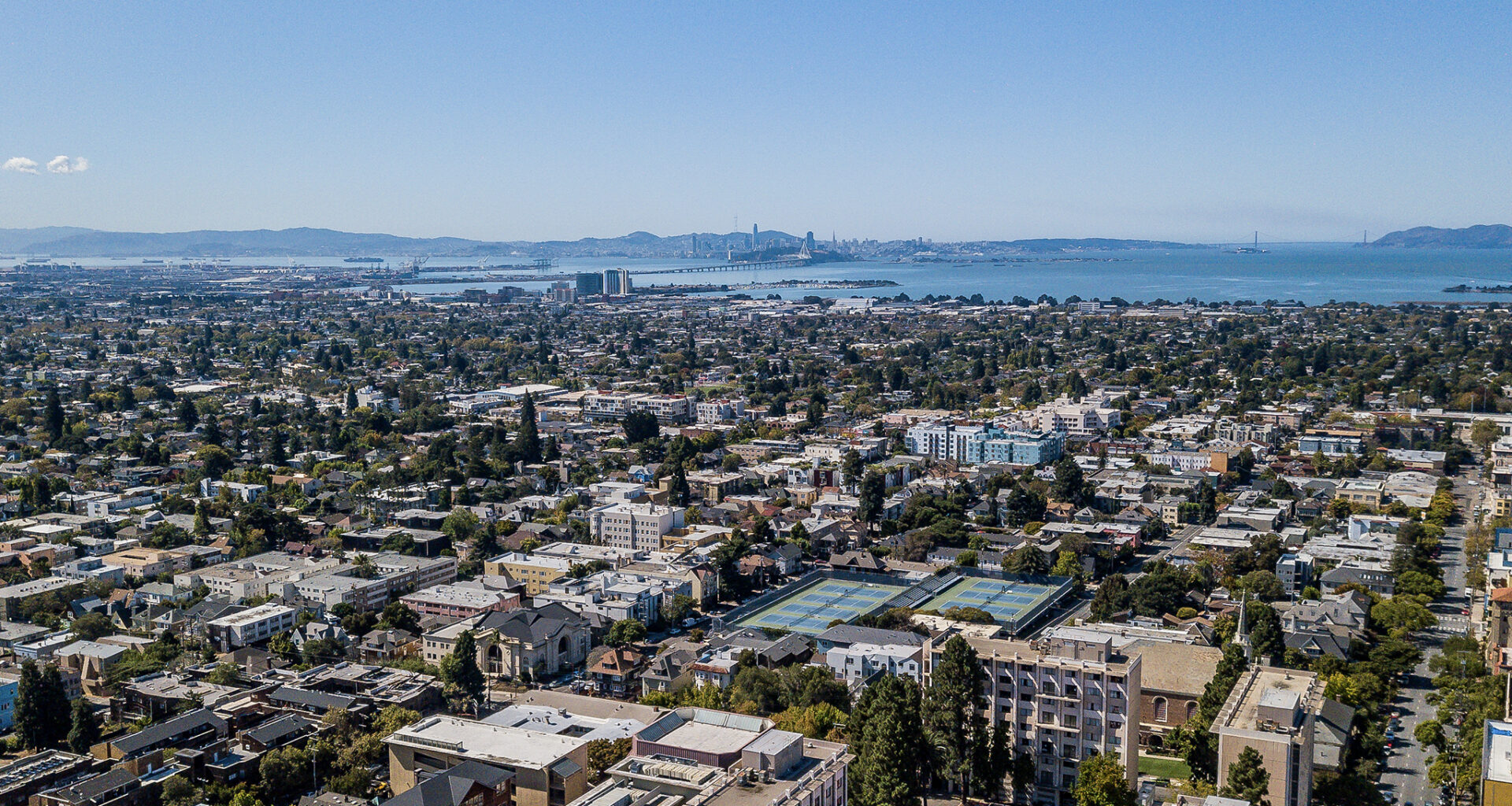
An aerial photo of a neighborhood in Berkeley, Calif., near the traffic circle called “The Circle.”
JasonDoiy/Getty Images
There are several tactics that the city may employ to mitigate the effects of construction.
One is providing business owners with so-called “warm shell” storefronts that are usable right when the initial build-out is completed. The city could also include a business license waiver for a fixed number of years for businesses forced to relocate because of housing development. To preserve anchor tenants like grocery stores, the city could require that if a building is bigger than 18,000 square feet, it will need to be replaced with at least a 10,000-square-foot space.
The commission also recommended a set of design standards to improve commercial storefronts and enhance the pedestrian environment at the ground-floor level on May 6.
Article continues below this ad
Daniel Swafford, the executive director of the North Shattuck Association, supports including design standards in the plans. He has faith that Berkeleyites can provide “creative and innovative feedback” in the spirit of the city.
Older folks living in hillside homes who want to downsize could benefit from new types of housing along the corridors, he noted.
“They don’t want to move to some weird suburb, right?” he said in a phone call with SFGATE. “They love their city, so give them a condo or something just like a first time homebuyer.”
‘They’re talking about market rate’
Solomon, the owner of Fern’s Garden, said she wants her employees to be able to live in this area but that the housing being proposed is not affordable housing.
Article continues below this ad
“They’re talking about market rate [pricing], which is crazy money,” she said.
A view down North Shattuck, the main road in the Gourmet Ghetto (North Shattuck) neighborhood of Berkeley, Calif., on Oct. 6, 2017.
Gado Images/Getty Images
Proponents argue that adding housing in general helps bring rent prices down overall. The average rent price for an apartment in Berkeley is $3,395 as of April 2026, which is about a 3% increase compared with the previous year, according to RentCafe.
Mayor Ishii noted that recent state mandates aimed at increasing housing in California have helped a lot of cities create more housing that otherwise might not have been previously built.
Article continues below this ad
“There’s still a housing crisis here [in the Bay Area],” she said. “The cost of housing is just still too high, and so it’s really important that we are continuing to build housing and especially affordable housing.”
Oakland resident Pat Schwinn wrote to the Planning Commission that adding residents above and adjacent to the corridors will help sustain small businesses. Voters spoke when they installed a pro-housing City Council, Schwinn noted.
“These are some of Berkeley’s highest-resource neighborhoods: areas with excellent schools, safe streets, good air quality, strong transit access, and abundant parks and amenities,” Schwinn said in a May 4 email to the commission. “These are precisely the enclaves that California’s Affirmatively Furthering Fair Housing law is meant to open up. For decades, exclusionary zoning pushed disadvantaged residents towards the freeway and out of Berkeley in general.”
The Berkeley flatlands have a history of redlining and housing covenants, which “reinforced racial inequalities, the effects of which persist today,” according to a report prepared by planning firm Raimi + Associates for the city of Berkeley.
Article continues below this ad
Zachary Russ, a Berkeley resident and the East Bay leader for YIMBY Action, said in an email to SFGATE that “Morally, every unit of housing that is built and occupied is a home created for people in the community. Integrating these homes with the needs of daily life, like supermarkets and third places, is how we maintain and grow a vibrant Berkeley.”
But those like Simon of Save Berkeley Shops said that the city should hit the pause button on the upzoning.
“It’s got so many projects in the pipeline,” he said. “There’s no demand from developers saying, ‘We’ve built everything, we can give us more.’ We’ve got 17 stalled projects in downtown alone.”
Article continues below this ad
Others, like Berkeley resident Carol Gross, said the city’s priority should be to end restrictive housing. “The NIMBY movement originated here — let’s end it here right now,” she wrote to the Planning Commission, referring to the “Not In My Backyard” movement.