

(TNND) — Small business optimism was flat last month, with an index that measures its level stuck below its long-term average for the second month in a row, the National Federation of Independent Business showed Tuesday.
The NFIB’s optimism index for April registered a “95.9,” a couple of points under the 52-year average of 98. The previous month’s reading was 95.8.
Ten components make up the optimism index. Three fell, and seven increased in April, though most of the movement was modest.
The outlooks for business conditions and expansion opportunities took the biggest hits.
Earning trends improved in April, but that just erased some of the big fall in that component the month before.
“Small business owners are pessimistic, and increasingly pessimistic, about expansion opportunities, business conditions,” NFIB Executive Director of Research Holly Wade said. “More think that business conditions will deteriorate in the next six months and are concerned about sales expectations.”
The NFIB’s optimism index is determined from surveys of small companies across a broad scope of industries.
Inflation pressures remain a major pain point for small business owners, with rising gas prices fueling much of that stress.
Rising gas prices are “a huge headwind for a lot of small businesses,” Wade said.
Small business owners are also having a hard time finding qualified workers, especially in trades and service sectors, Wade said. And changes to immigration policy have made finding workers even more difficult in some industries, especially construction, she said.

FILE – A worker helps construct a new home June 8, 2023, in Buckeye, Arizona. (Photo by Mario Tama/Getty Images)
Wade said small business owners are “concerned” when asked to describe their overall mood.
Capital spending plans have dropped to levels not seen since 2009, which Wade said was “quite alarming.”
While she said tax provisions in last year’s “One Big Beautiful Bill” should help small businesses that want to expand, current economic pressures are keeping expansion plans on the back burner for the time being.
Small businesses are holding onto their cash as a buffer against rising costs.
More small business owners are both increasing prices and planning to increase prices, but Wade said small business owners are worried that they’ll drive away customers if they hike prices too much or too fast.
Still, there’s only so much they can do to manage rising costs and profit pressures before turning to price increases, Wade said.
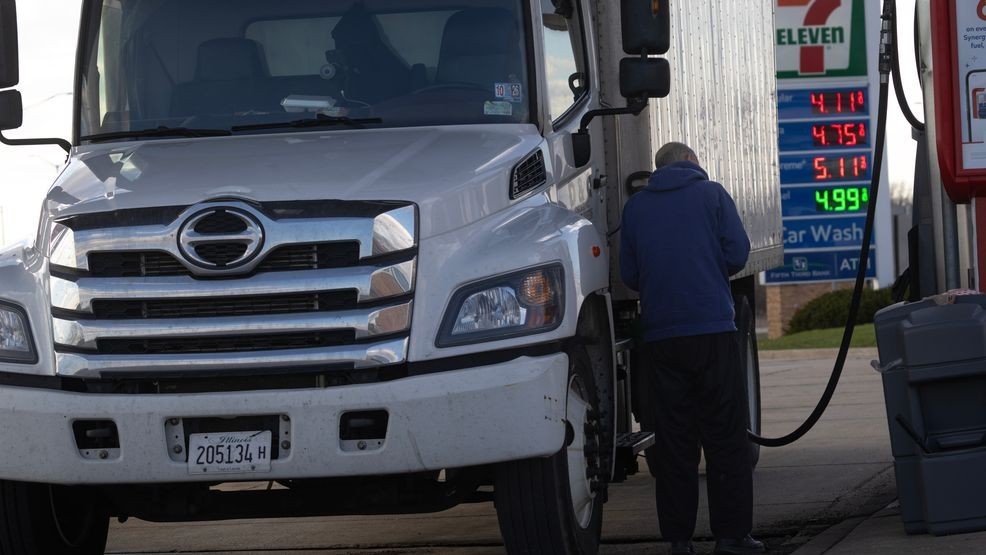
FILE – A driver buys diesel fuel for his truck at a tollway oasis on April 6, 2026, in Belvidere, Illinois. (Photo by Scott Olson/Getty Images)
Meanwhile, other surveys show consumer sentiment has also been falling. Consumer sentiment cratered to its lowest level on record in the University of Michigan’s April index.
Another NFIB index, one that captures uncertainty levels within the small business community, eased a bit in April but remained 20 points above its historical average.
In a vacuum, more certainty is good for small business owners. But Wade warned the fall seen in last month’s uncertainty index was driven by small business owners feeling increasingly sure that business conditions would get worse before they got better.
Eighteen percent of small business owners cited labor quality as their single most important problem, up 3 points from March. That ranked as the top problem for owners, followed closely by taxes and inflation.
Twelve percent of owners rated their overall business health as excellent, while 55% rated it as good. Another 29% rated their business health as fair, and 4% rated it as poor.