
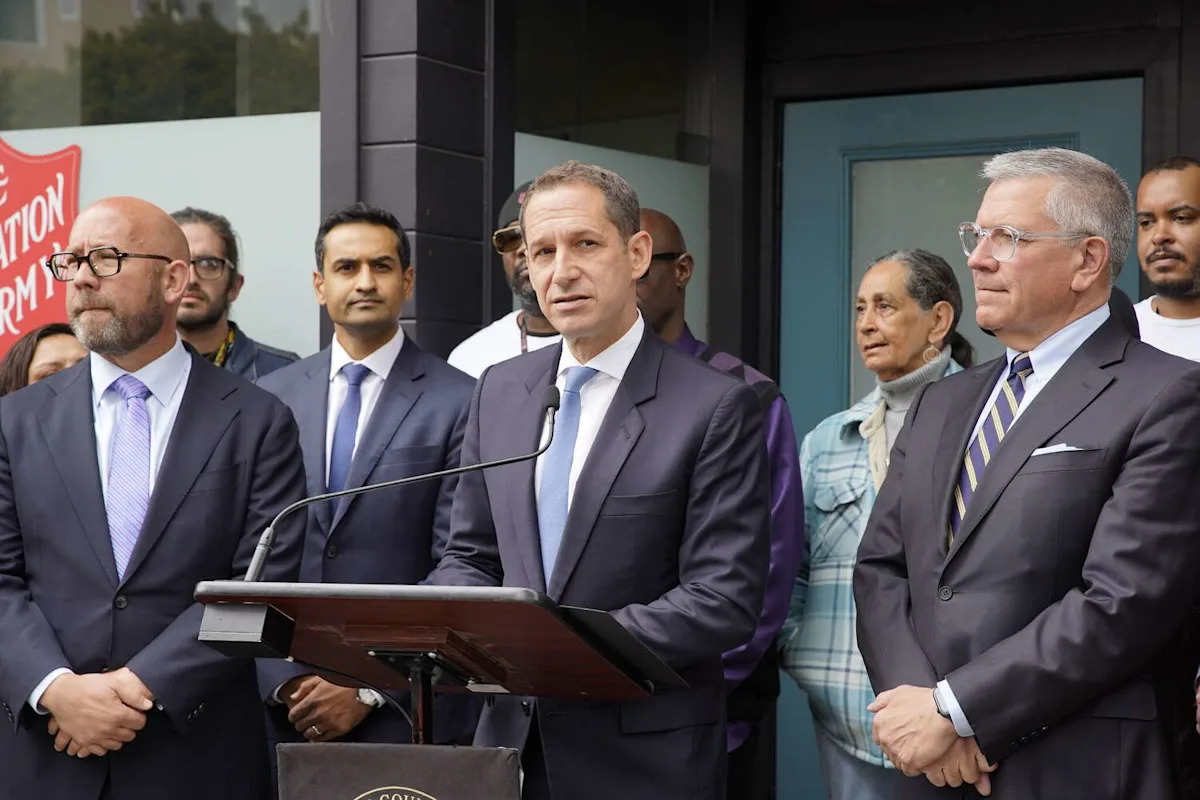
Mayor Daniel Lurie touted the latest official tally of San Francisco’s homeless population on Tuesday, arguing it shows a steep decline in the number of people living outside – but there’s a catch.
The city found that about 8,000 homeless people were on the streets and in shelters during its most recent one-night count conducted in January. That’s a 4% drop from the total homeless population identified in San Francisco’s last tally two years ago, but the city also changed the way it conducted the biennial count this year, so it’s not an apples-to-apples comparison.
Looking only at unsheltered homelessness, which excludes people staying in shelters, the decline was even more pronounced, according to the Lurie administration. The city’s point-in-time count identified about 3,400 unsheltered homeless people, which represents a 22% decrease from the 2024 tally that was conducted using a different methodology. The figures released Tuesday are preliminary; complete data is expected this summer.
One of the main changes San Francisco made to its point-in-time count this year was the timing. Historically, the event took place late at night, but this year, the city sent outreach workers out early in the morning in an effort to improve visibility and make the count safer for the people conducting it, according to city officials. Canvassers this year also sought to ask people directly about their housing status instead of relying on a visual survey to determine whether someone was homeless.
Despite the different methodology, Lurie touted the latest figures as a sign that his administration’s policies around homelessness were having an impact. Since becoming mayor in early 2025, Lurie has opened new facilities intended to help people get off the street, including the city’s first sober shelter. He has also moved to close some existing shelters, which his administration says reflects a strategy to focus on temporary housing sites that offer drug and mental health treatment.
Additionally, Lurie has reformed the city’s network of street outreach teams, passed legislation to discourage people from living in vehicles and opened a stabilization center to help people in mental health or drug crisis. Most recently, Lurie opened a sheriff-led sobering center in SoMa where law enforcement can take homeless drug users, though that facility wasn’t open when the count happened. The city has also raised about $50 million to support Lurie’s work on homelessness, a key part of his efforts to advance his agenda with help from the private sector.
The latest homeless count figures are likely to be a major point of pride for Lurie, who frequently argues that San Francisco is becoming a “city on the rise” under his leadership. A recent Chronicle poll found voters in the city are overwhelmingly satisfied with how he’s running the city, with 74% approving of his job performance.
Lurie praised what he described as “incredible progress” on homelessness in a statement Tuesday.
“When I took office, we set out to completely transform the city’s work around homelessness, drugs, and behavioral health – to get people off the street and on the path to stability,” Lurie said. “From the moment someone is experiencing homelessness to the day they enter long-term stable housing, we got to work with urgency, bringing accountability to a system that needed more of it.”
While San Francisco and other cities around the country conduct the point-in-time counts required to receive federal homeless funding, the one-night snapshots are an imperfect picture of how many unhoused people come through the city. The city previously estimated that more than 20,000 households sought homeless services in 2024.
Lurie acknowledged that his administration has “more work to do” to reduce homelessness, and he promised to “be relentless until every San Franciscan has the safe, clean streets they deserve.”
Notwithstanding his high approval rating, Lurie’s approach to homelessness has not been universally beloved. Some critics say his administration has simply pushed people around and have pointed to the persistence of open-air drug markets in the Tenderloin, SoMa and Mission as evidence that the city isn’t making enough progress. They argue the city should have better results since it spends more than $700 million a year on homelessness. Others, especially the mayor’s detractors on the left, view his emphasis on law enforcement as a sign that he’s criminalizing addiction and poverty without solving the root causes of homelessness.
San Francisco’s homeless count this year identified reductions in multiple – but not all – subsets of the total unhoused population.
Canvassers found far fewer young people and veterans residing in shelters or on the streets than they did using the old methodology in 2024. And fewer than 100 people were living in tents and makeshift structures, the city said, reflecting an 85% decline from the count two years ago when nearly 650 people identified were in tents.
But the number of homeless families in San Francisco increased, continuing a trend the city also reported in the 2024 count, when officials said the surge was being driven in part by new immigrants. This year, canvassers counted 465 homeless families in the city, a 15% increase from two years ago. Nearly three quarters were sheltered, and most of the unsheltered families were living in vehicles, officials said.
About 130 households have moved out of vehicles and into shelter or housing since San Francisco began implementing new restrictions on people living in RVs in October, according to the mayor’s office.
Mary Ellen Carroll, director of San Francisco’s emergency management department, said in a statement that the homeless count numbers released Tuesday “reflect coordinated work across city departments and a continued commitment to engage meaningfully with people experiencing homelessness.”
Lurie has sought to more closely coordinate his administration’s response to homelessness and public drug use, viewing the two crises as inextricably linked.
After overhauling San Francisco’s network of street outreach teams early in his tenure, this year he put the outreach teams under the purview of the public health department. Lurie’s office has also justified the closure of some shelters, including a 280-bed facility in Lower Nob Hill set to shutter next year, by saying that the city is shifting resources to treatment and trying to ensure that more shelters have adequate services for people struggling with addiction and mental health challenges.
Also, Lurie recently chose Mike Levine, who led the Massachusetts’ Medicaid program, to be the next director of San Francisco’s Department of Homelessness and Supportive Housing. Levine starts next month, succeeding Shireen McSpadden, who is retiring after five years running the department in charge of San Francisco’s response to homelessness.
Subscribe
There’s more to San Francisco with the Chronicle. Subscribe today for just 25¢.
This article originally published at Lurie touts big drop in S.F. homelessness. But change to the count complicates the picture.