
The government shutdown reached the one-month mark on Thursday. TSA agents and air traffic controllers missed paychecks, and there’s just days until food assistance runs out of money.
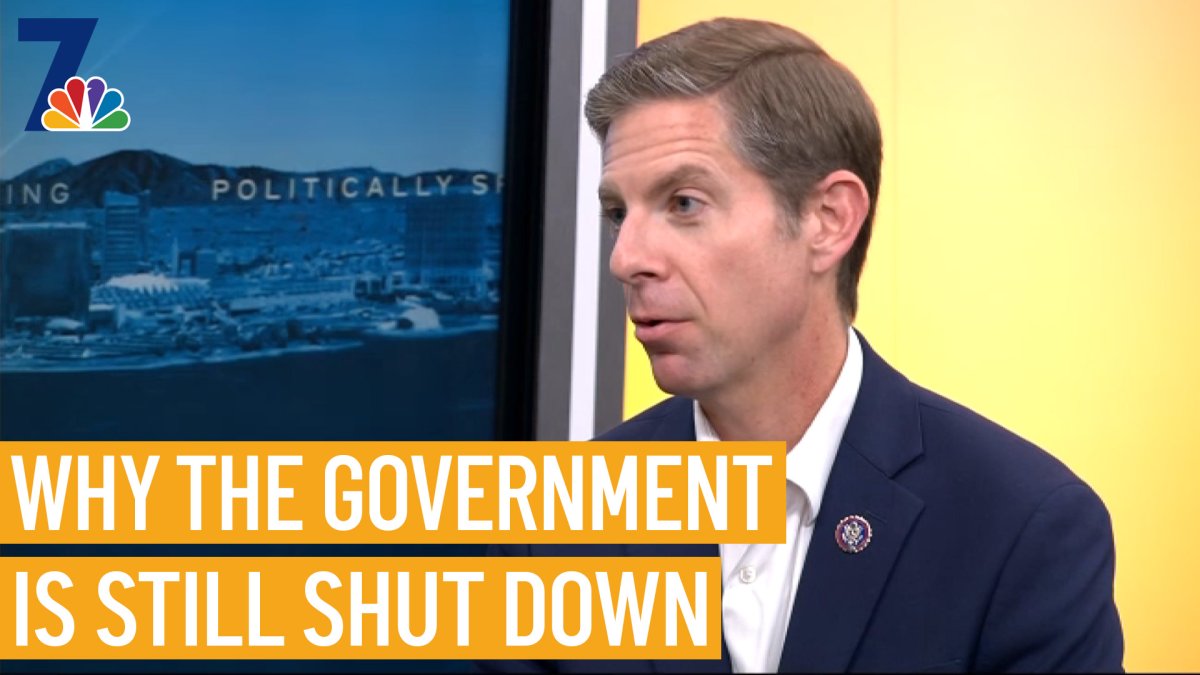
Is the government any closer to opening up, or are our elected officials still at a standstill? Rep. Mike Levin (D-CA 49) joined NBC 7’s Joey Safchik on Politically Speaking this week to discuss the shutdown that seems to have no end in sight.
A transcript of their conversation is below.
Safchik: What’s happening right now?
Levin: Not a whole lot. I got back from Washington, D.C. last night. I will tell you that in order to have any kind of negotiation, there actually have to be members of Congress present. But Mike Johnson now has kept his members home for five straight weeks, which I think is a record, certainly a record for my time in the Congress. So that means no real discussion around appropriations. I’m on the Appropriations Committee. There’s been no discussion around that. There’s been no discussion around health care and the fact that now our constituents all across the country are getting letters saying that their premiums in many cases are going to double or even triple. And the most recent thing is SNAP nutrition assistance for tens of millions of Americans is being held up unnecessarily by the Trump administration. It really is very difficult to negotiate when there’s no one there in D.C. to negotiate with. And that’s been the case now for weeks.
Safchik: I talk to you often. You seem particularly frustrated and crestfallen right now. Why is that?
Levin: Well, I’m a perennial optimist, and I’d like to think that these things could change very quickly. But I will tell you that it’s pretty bleak when you’ve got the speaker of the House of Representatives who no longer believes that the Congress of the United States is a co-equal branch of government. You had the president say that he is now both the president and the speaker. Now, of course, he said he was joking, but it’s no joke, Joey, because that’s how he’s acting. He knows that Mike Johnson will do nothing to get sideways with the administration. And so what we’re seeing is Mike Johnson unwilling or unable to do any kind of bipartisan deal with us on health care, even though there is a health care crisis happening right now. And the reason for that is I think Mike Johnson knows that if he were to do any sort of deal with Democrats, it probably would lead to the end of his speakership because he learned the lessons. Watching what happened to Kevin McCarthy when McCarthy dared work with Democrats that led to McCarthy being ousted. Johnson may be correct in this assertion that it would be the end of his speakership as well. But the paradox here is that, on the one hand, he wants so badly to be speaker that he’s willing to sacrifice virtually all of the power of the speaker’s gavel in order to hold onto power. And I think that’s pathetic, frankly.
Safchik: Both sides seem really obstinate in their positions. Does this just go on in perpetuity? What has to happen for one side or the other to capitulate?
Levin: Well, look, I think that Republicans need to just look at what is happening in their districts to their constituents. This isn’t a blue state or a red state thing. All Americans on the Affordable Care Act are getting letters if they haven’t already said that their premiums will go up on average by 30%. But for many, it is double or triple. I’ve had constituents, one woman told me that it was $104 a month that she was paying. Now, it’s $326 a month. Another woman told me that for her family of four, it is now going to be over $55,000 a year for health insurance for her family of four, up from around $23,000. And here’s the thing all Americans should be concerned about, not just those on the Affordable Care Act. Because when you have millions of Americans who can no longer afford health insurance and they decide not to renew their plans, and you’ve got millions and millions of uninsured, those costs are going to have to be absorbed by the system. When you have people with acute care needs and have no insurance, they go to the emergency room. They don’t get the preventative care that we need for all people to get. And so everybody winds up footing the higher bill for millions going uninsured. And here’s the other thing. What’s the cost of this? It’s around $30 billion a year to continue the tax credits for one more year. So this federal government has $40 billion to bail out Argentina. The president seems to be able to find $300 million or $350 million to check out his gilded ballroom, tearing down the East Wing and building. He has time for that as well. But they don’t have the time or the money so that millions of Americans can stay on health care. It’s unconscionable to me, Joey, and it’s just a direct reflection of just kind of a lack of reality of a lot of my colleagues in the House right now.
Safchik: Could the pain felt by the American people during this shutdown reach such a fever pitch that Democrats are willing to reopen the government and then have those negotiations?
Levin: Well, we are willing and ready and able to reopen the government right now, but we don’t have the gavels. The gavels belong to John Thune and Mike Johnson. They control the House. They control the Senate. They decide when we vote and what we vote on. And all we have said, we’ve been very consistent throughout this entire process, is that we need to negotiate on ACA and extend these tax credits right now, not waiting until next month, not waiting until next year. The open enrollment period begins next week. The bills will begin coming due for 2026 in December, so there’s no more time to delay here. No more time to wait. And the whole notion of “clean.” We’ve heard I’ve heard this, you know. Oh, it’s a clean bill that they’ve put on the floor. There’s nothing clean about what they’ve done, what they’ve said earlier this summer is that they care more about tax cuts for their billionaire donors. And they’re big, big corporations. Then the average American isn’t being able to afford health insurance. And most recently, the average American being able to have enough to eat for those who are most vulnerable, for seniors, for children, for veterans. We’re talking about millions of millions of Americans who are not going to have enough to eat as a result of what the administration is doing, and I just find it immoral.
Safchik: So if you were a Democratic senator, would there be a pain threshold or a line in the sand where you would ultimately vote yes on the spending bill? As it stands now to get the government back open?
Levin: Well, what I’ve said all along is we ought to pay the troops. So we ought to take that off the table. And that’s the other thing, is the pay for the troops. The first time the administration moves $6.5 billion away from R&D for the Department of Defense to be able to pay the troops for one time. That was the middle of the month, and now they’re going to move more money around another 6.5 billion from a variety of different programs. We should take that off the table entirely, and we should immediately pivot into negotiations around extension of those tax credits for health care. That needs to happen next. And the other thing underlying all of this is that the administration simply has no respect for the Congress of the United States. It is the Congress of the United States under article one that has the power of the purse. I’m on the Appropriations Committee. Congress appropriates the funds. Congress authorizes the programs, not the president of the United States. And they are violating the law and the Constitution. When they decide to freeze or cut spending outside of the empowerment process, as is very clearly laid out in the Impoundment Control Act of 1974. So when they violate the law with the deal that’s already in place, with the spending deal that Kevin McCarthy agreed to and negotiated a couple of years ago that we’re still living with today, they violate that law all the time. What assurance do we have that they’re not going to violate whatever agreement we put in place? So in addition to whatever government spending deal comes about, and I very much want to see that come about, to do so we need an agreement, a written agreement that they’re going to follow the actual law and the Constitution when it comes to the power of the purse. And if I were a Republican member, a rank and file member of Congress, I would be just as insistent on this, because it’s ultimately not just the Democratic members of Congress that this administration has no regard for. It is the Republican members. And frankly, the Republican members should wake up and they should see that this administration wants to run everything, they want a truly unilateral authority over spending, over immigration policy, over war. They want to be able to bomb anywhere they want. They really don’t care about Congress as an institution at all. Mike Johnson has done a massive disservice to the institution of the Congress by weakening his own position as speaker, by giving in, by not standing up, no oversight, no accountability. And that’s where we’re at right now. That’s what makes it so difficult. There’s no trust. Joey.
Safchik: You predicted my next question. Why don’t Democrats trust Republicans to open the government and then negotiate on health care?
Levin: Well, look, here’s the thing. John Thune seems like a nice man. He says, well, we’ll work with you to fix the Affordable Care Act. The facts are that Republicans have tried to undermine and end the Affordable Care Act. Over 70 times since the ACA was originally passed. The other fact is that right now, the ACA is more popular than ever with the American people. And look, it’s not perfect. Nothing is perfect in life. But what I know is that since 2019, when I first got to Congress, we have gone from 11 million people on the Affordable Care Act now to 24 million people, more than double in the last seven years. And I think that’s something that we should be proud of, that we’ve covered over 13 million additional Americans over the long run. If you cover people with decent, quality, affordable health insurance that brings costs down across the system for everyone in this country. And just as we ought to be advocating for more negotiations around prescription drugs to lower the cost of prescription drugs, we ought to be advocating to lower the cost of premiums, co-pays, and deductibles for the average American. The Republican lack of an alternative is the other big story here. So they’ve had again, 15 years, and they’ve never really said what would replace the ACA that they detest so much. So forgive me if there’s not a lot of trust.
Safchik: There are so many consequences of this shutdown on your constituents, particularly what causes you the greatest concern? What’s keeping you up at night?
Levin: Right now what is most concerning to me is food. Because, right now, if the administration doesn’t take action, then, November 1st is when those on call for action California, they have a, the equivalent of a debit card that they can use to purchase groceries. This is not for rich people, Joey. This is for people who are a single mom working hard, you know, with a couple of kids who just wants enough to have food on the table, to be able to live in a place like San Diego. This is the disabled veteran, whose disability doesn’t fully cover the bills. This is a senior, in need of, a little bit of extra support to be able to have enough to eat. So these are the people that we’re talking about who are going to fall off the radar. Here’s what you need to know about this, Joey. The administration is sitting on $5.5 billion right now to be used specifically in the event of an emergency.
Safchik: There is precedent there to fund SNAP during a shutdown.
Levin: There is precedent to use these types of contingency funds to, be able to make sure people have enough to eat. So it’s very, very cynical, but it appears that there are those, including Brooke Rollins, the agriculture secretary, who would rather use this moment as political leverage during a shutdown, even if it means that families, veterans, seniors will not have enough to eat. They would withhold those funds to try to score political points.
Safchik: How do you regain the trust of the American people after all of this plays out?
Levin: It’s a great question. I don’t have easy answers other than to say, we’ve got to get a resolution on health care. We’ve got to make sure that people have enough to eat, and then we’ve got to begin the process of rebuilding our trust with the American people. There are many things that I am personally working on, like banning members of Congress from being able to trade stock. That, I think, would begin that process, by the way, a bipartisan endeavor. But I’m with you. The other day, I saw a poll that Congress as a whole has a 14% approval rating, and I’m trying to find the 14%, Joey, because, when I speak to people, they’re furious about the institution as it stands right now. And I am too. And I think a lot of the blame rests squarely on the shoulders of Mike Johnson, who again, seems to care more about holding on to that gavel than the harm he’s doing in the process. Very quickly.
Safchik: While I’ve got you here, how do you think the special election is going to shake out, and will that impact what we see next year?
Levin: Well, I think that the Yes on 50 campaign has done a great job. I think that they have persuaded a lot of folks, who had questions or doubts about the initiative, that it’s one time temporary and none of us love this. I wish that we didn’t have to do any of this, but the reality is, Texas. They went forward with extreme partisan gerrymandering. And we, as California, had an opportunity to either do nothing to roll and roll over in the corner and, you know, pretend that it didn’t happen or to fight back for fair representation. And so I think on Tuesday, I think you’ll see a big showing of people who want to stand up and protect the fair, representing all Californians. And in terms of what it means for next year, you’re still going to have very competitive seats up and down the state, for Congress. And we’re going to work very hard. Obviously, in our district, and I’m sure my colleagues will as well.
Safchik: Do you think that frustration that we were just talking about, and this period of strife overall, is going to impact turnout in the midterms next year?
Levin: Well, I think it could impact turnout on Tuesday. You know, particularly when I look at a state like Virginia that has so many thousands of federal employees that are either furloughed or, you know, we’re late or they’re trying to lay off thousands of them. So I think there’s a lot of, pent up resentment right now for what the administration is doing. And I think that will help my friend Abigail Spanberger become the next governor of Virginia. I also think we’re doing very well in New Jersey. So, you know, the hope is that next Tuesday, we will have two great friends and former colleagues in Abby Spanberger and Mikie Sherrill as the governors of those two states, and that we will have a victory here in California again for fair representation.
Safchik: Thank you so much for a very thorough conversation this morning.
Levin: Thank you, Joey. Always good to be with you.