
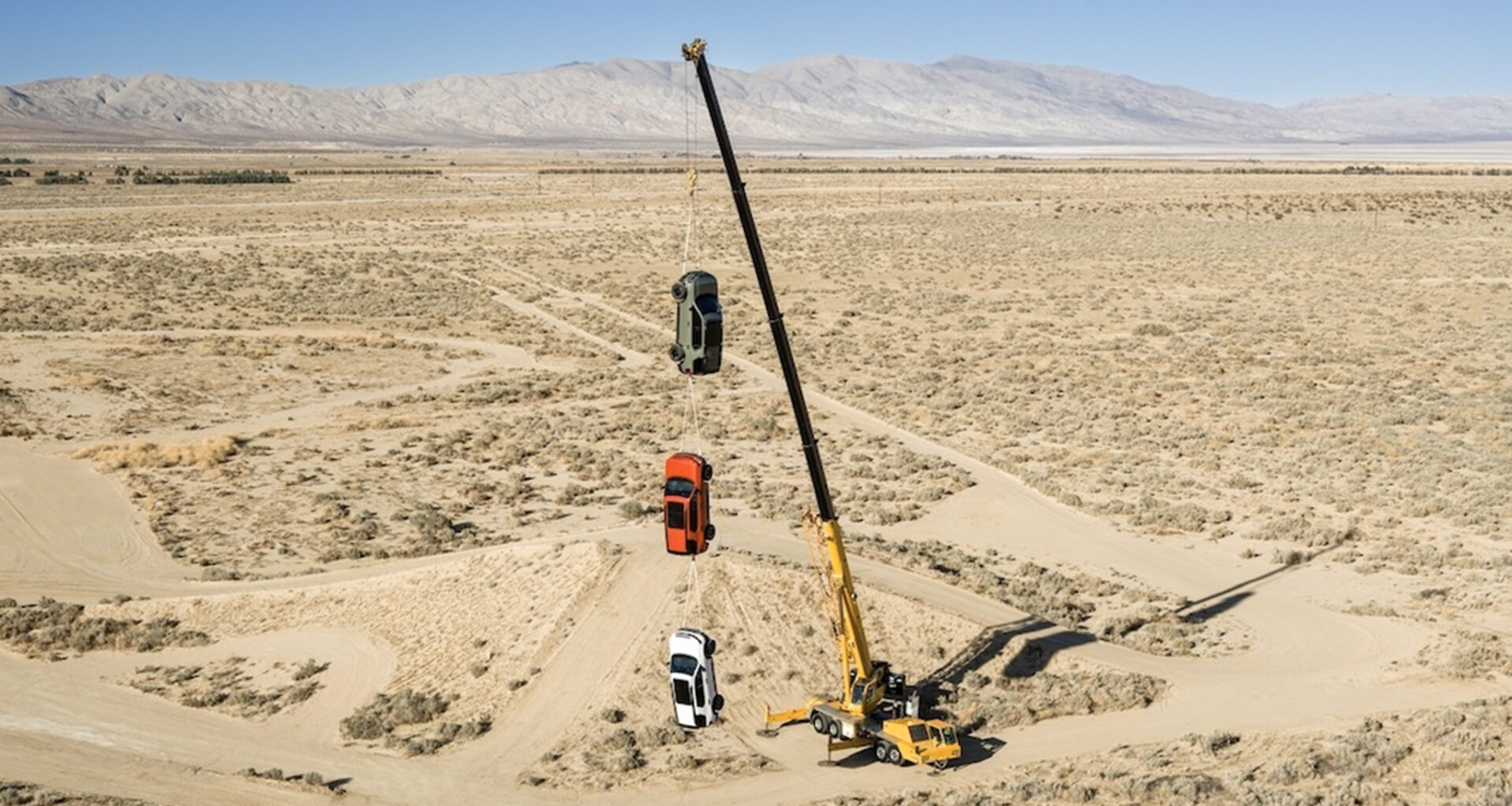
In the desert outskirts of California City, around 100 miles northeast of Los Angeles, cars wrapped in black and white camouflage sit side by side in a wide parking lot. The disguised vehicles prevent spies from detecting never-before-seen automotive shapes or cutting-edge technology, even though they’re deep within a location already chosen to prevent prying eyes.

The California desert hides plenty of secrets, from natural wonders to mysterious alien landmarks to homages to famous rock albums. Most aren’t intentionally hidden — the desert is a natural foil, given that it spans roughly 44% of the state but only holds about 4% of its residents. Still, California’s two proving grounds — Hyundai’s in California City and Honda’s in nearby Cantil — very much want to maintain secrecy.
Consumers may never even set eyes on some of the cars that will spend months driving over manmade pot holes and intentionally rough roads, or sit for hours in a simulated mud bath or high humidity chamber at these preproduction test facilities. If one of the engineers at the Hyundai California Proving Ground decides a car doesn’t meet the company’s standards, it’ll be scrapped altogether. But the millions of Californians driving these vehicles in the historically car-centric state likely have no idea about these sprawling grounds, tucked away and inaccessible to the public.
Article continues below this ad
A Honda Civic Type R at the Honda Proving Center in Cantil, Calif.
Courtesy of Honda
The carmakers have doubled down on their California facilities over the past two decades and have overcome local and environmental concerns to establish the giant complexes, contending that these locations are the best places to test and develop their automotive technology in the U.S. The Golden State isn’t exactly known as an automotive capital, but based on 2025 market share data, roughly 18% to 20% of new passenger vehicles sold in the U.S. are made by Hyundai and Honda combined, giving California more industry weight than most residents likely realize.
Why test cars in the California desert
Head west on Highway 58 once you’ve arrived at the town of Mojave, and you’ll soon hit Hyundai-Kia Boulevard and glimpse a giant entrance sign towering over a road that appears to lead to nothing. The Hyundai California Proving Ground, a 4,500-acre facility, is tightly guarded and fenced with a bright orange “no trespassing” sign that’s posted immediately after you turn onto the road. Matt Seare, the proving ground’s manager, said people will occasionally show up at its front security gates, wondering if they can have a look, but they’re swiftly turned away. This writer had to sign an NDA and surrender her phone so that workers could tape over its camera before entering. With an employee list of just around 100 people, only a small roster heads through the gates regularly.
Article continues below this ad
Make SFGATE a preferred source so your search results prioritize writing by actual people, not AI.
Add Preferred Source
Once inside the perimeter, a staid one-story office building stands as the hub of a mini city — if that city was made up of any possible road a car could drive on. A central oval track is 6.4 miles around and modeled partly after LA highways. More security gates guard each new track and section of the grounds, which are constructed to include every obstacle a car might encounter throughout the nation, from sandpits to cobblestones.
A convoy video is shot at the Hyundai California Proving Ground in California City, Calif.
Courtesy of Hyundai
There’s an artificially constructed hill (a huge paved area where drivers can test maneuvering and braking, or what is known as “vehicle dynamics”) and a section for off-roading, among other testing areas that put wear and tear on the individual car parts themselves. A series of panels is meant to speed up the effects of UV aging on different components, shining a year’s worth of sunlight in only a few months. There’s a humidity chamber that does what the dry desert can’t, and there’s even a fake driveway that Seare, who has been working there for 20 years, jokes was modeled after his mother in law’s. (It had a tight, steep turn that would leave one wheel dangling in the air.)
Article continues below this ad
The facility’s Kern County location is strategic, as it can’t be viewed by passing motorists or by air — it’s within the no-fly zone of the nearby Edwards Air Force Base. Moreover, vehicles can be tested there 24/7 and year-round, given the surrounding climate. Desert weather can be extreme, ranging from snowfall to 120-degree days.
Still, some requirements come with work in the desert, namely protecting desert species like the endangered desert tortoise and Mojave ground squirrel and plants like the Joshua trees, which dot the grounds. Before the $80 million facility opened in 2005, the U.S. Fish and Wildlife Service and the California Department of Fish and Wildlife assisted in rounding up all the desert tortoises in the area — 27 of them — which were then relocated and monitored for five years with tracking devices to ensure their safety. Environmental groups also sued over the project’s potential impacts, ultimately ending in an estimated $5 million settlement that required Hyundai to purchase and establish a roughly 3,000-acre wildlife habitat and move and protect the Barstow woolly sunflower, a rare plant only found in the Mojave desert.
An aerial view of the Honda Proving Center’s off-road testing area in Cantil, Calif.
Courtesy of Honda
That was in addition to a controversy around eminent domain, as some local residents were forced to give up their acreages for the facility’s construction. California City had been annexing adjacent land to make an area large enough for the project, ultimately deeming some of it condemned and selling it to the car giant, which resulted in lawsuits with landowners.
Article continues below this ad
Reinvesting in California
About 25 miles north, Honda’s Cantil testing hub opened in 1990 to much less environmental and public scrutiny. But after 20 years in operation, it almost abandoned the facility. In 2010, the company announced it would move its Honda Proving Center to a former ranch in Marysville, Ohio, saying the grounds would be perfect for another automaker or someone building a solar farm. “The recent closure of the facility and sale offering provides a rare chance to secure a superbly designed facility that would be cost prohibitive to duplicate today. The main site (±3,797 acres) has completed requirements for the Desert Tortoise Habitat plan, allowing a ‘fast-track’ approach to potential development/solar farm uses, should an interested party desire to change the use of the property,” a 2011 CBRE listing read.
The company was expecting somewhere between $10 million and $25 million for the property, according to a New York Times article at the time, which quoted a spokesperson for a commercial real estate broker who called it “a rare opportunity.”
An aerial view of the Hyundai California Proving Ground in California City, Calif.
Courtesy of Hyundai
But it’s hard to sell such a unique piece of real estate, and the company gave up after five years, announcing it would renovate the facility instead — for $25 million. Today, it has a roughly 7.5-mile track, a 4.5-mile road course and a 1.3 million-square-foot vehicle dynamics area, along with areas for testing its all-terrain vehicles, dirt bikes and side-by-sides (off-road vehicles).
Article continues below this ad
“As Honda evaluated its long-term mobility strategy, we recognized that a dedicated proving ground with the right scale and flexibility would be increasingly important. Reinvesting in the facility allowed us to modernize it and better support evolving needs such as electrification, safety, and advanced engineering,” a Honda spokesperson wrote to SFGATE via email.
The company originally chose the location for many of the same reasons as Hyundai: the “combination of geographic and climate conditions that are difficult to find in one place,” the spokesperson told SFGATE.
Vehicle testing at the Hyundai California Proving Ground in California City, Calif.
Courtesy of Hyundai
Plus, it’s close to Honda’s Torrance headquarters, and the 3,800 acres have the terrain, space and privacy that the company is looking for.
Article continues below this ad
Both companies have had to adapt their facilities over the years to meet the demands of new technologies, including introducing testing for electric vehicles. Swaths of solar panels now cover entire sections of Hyundai’s property, providing electricity to charge the electric vehicles on-site. These days, advanced driver‑assistance systems and autonomous driving are also on tap for testing.
For Hyundai, the proximity to its Irvine headquarters and Chino research facility was also key, as was being near customers “who are often first adopters of new mobility technologies,” Seare said.
A future in California
Today, up to 70 employees work at Honda’s proving ground, which, as at Hyundai’s, has also served as a backdrop for commercials and other promotional materials. They’re the economic drivers in these remote communities — part of the California City eminent domain controversy stemmed from allegations that the city was putting a potential $50,000 annual tax base above its residents. They employ both full-time and part-time local workers and support area businesses. Both companies allow local police and fire departments to use their facilities for training and also donate equipment to them.
Article continues below this ad
An aerial view of the Honda Proving Center’s off-road testing area in Cantil, Calif.
Courtesy of Honda
These grounds are also integral in the chain of production that puts new cars on the road: The cars driving around the Hyundai proving ground are likely a year or two out from production, Seare said, and they won’t go into manufacturing without the OK from California City.
“This location provided the right balance, reinforcing Honda’s long-term commitment to California as a hub for innovation, mobility, and environmental leadership,” a Honda spokesperson told SFGATE in an email.
But concealed within the desert, far away from major metropolitan areas, these proving grounds are mostly just more secrets of the desert.
Article continues below this ad
Vehicle testing at the Hyundai California Proving Ground in California City, Calif.
Courtesy of Hyundai
“It’s an amazing place and no one really knows about it,” Seare said of the Hyundai location.
Most importantly, Seare, said, “It’s a safe place to be unsafe.”