
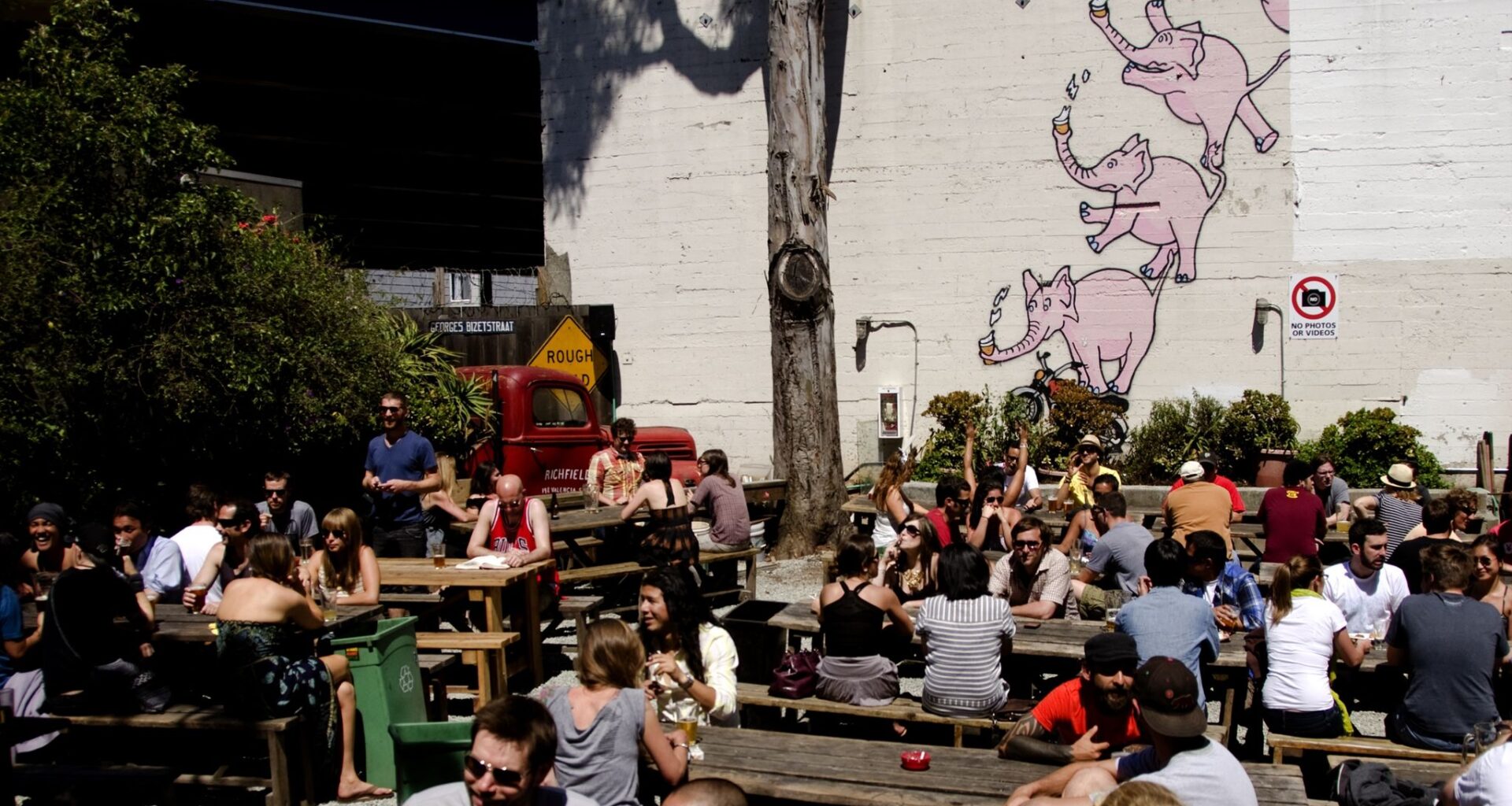
The outdoor beer garden at Zeitgeist in San Francisco, which has nonsmoking and smoking sections.
Scott Borstad
San Francisco has outlawed smoking from almost every corner of civic life in ordinance after ordinance, including at bus stops, ball parks and even when waiting in line outside for a movie or concert. Now, owners of some of the city’s most prominent nightlife spots are decrying an effort to eliminate smoking from outdoor bar patios, one of the last remaining bastions of public smoking and, many bar owners say, an essential part of doing business.
The owners of the longtime Mission District bars Zeitgeist and El Rio recently started a petition against a proposed city ordinance that would prohibit smoking in outdoor bar spaces like Zeitgeist’s large beer garden on Valencia Street or the patio at San Francisco Eagle Bar in SoMa.
“If they take away our ability to have smokers, it would be detrimental and really damaging for our operation,” said Lex Montiel, owner of San Francisco Eagle Bar, who spoke out against the proposed ordinance at a recent Small Business Commission meeting. “We cannot experiment on how this is going to impact us.”
Article continues below this ad
On Valencia Street since 1977, Zeitgeist’s patio has “a very clear nonsmoking section and a smoking section, and we enforce that,” said Lara Burmeister, Zeitgeist co-owner and author of the petition. “Our patrons have the right to make decisions on which environments they want to participate in. I don’t see why the city needs to regulate those places,” she said.
Smoking has not been allowed inside restaurants statewide since 1995 and in bars since 1998; it is not allowed on restaurant patios. While California law allows smoking on bar patios, San Jose, Oakland and more than 50 other Bay Area cities have banned it, according to the authors of the proposed San Francisco legislation.
San Francisco Chronicle Logo
Make us a Preferred Source to get more of our news when you search.
Add Preferred Source
San Francisco Supervisor Myrna Melgar introduced the proposed legislation in April at the urging of advocates, including the San Francisco Marin Medical Society, a professional association of physicians who argue that secondhand smoke poses a risk to nearby residents, employees and other patrons, especially in patios that are hemmed in by tall buildings. According to the proposed ordinance, UCSF researchers who took air quality measurements at nine San Francisco bar patios in 2022 found that six of them had peak readings in the EPA “unhealthy” air quality range or higher; one patio, with cigar smokers, registered in the “hazardous” range.
Advocates of the ban point to statistics showing that cigarette smoking among California adults dropped considerably after previous ones were implemented, from around 17% in 2001 to 5.5% in 2023, according to California Health Surveys. Rates of lung and bronchial cancer, as well as mortality, dropped over a similar period, according to the California Cancer Registry. Proponents also expressed concern about the specific vulnerability of California’s LGBTQ+ community when it comes to smoking, including a peer-reviewed study showing that people in the community are exposed to second-hand smoke more than the general population.
Article continues below this ad
“All medical evidence says that secondhand smoke is a serious public health issue,” Melgar said. “Beyond the issue of saving lives, it’s also an issue of consent. People who have their jobs or who happen to have a rent-controlled apartment above the patio — it’s not like they have a choice.”
From left, longtime regulars, Megan Sullivan, Will Jimerson, Kelly Gordon and Jasmine Blocker smoke and have drinks on the patio at the bar Lucky 13 in San Francisco.
Leah Millis/The Chronicle
Advocates for the ban estimate it would impact 50 to 60 businesses in total. The city does not know how many of San Francisco’s 409 bars have patios that allow smoking, according to a member of Melgar’s staff. Opponents have identified around a dozen establishments that do, including several large LGBTQ+ event venues, such as El Rio, San Francisco Eagle Bar and the Stud Collective. The Stud Collective is one of 14 businesses and organizations that sponsored the petition, which has gathered close to 2,000 signatures.
Critics said that the proposed ordinance would add another layer of prohibition to a regulation-heavy city during difficult economic times for bars. Members of the Small Business Commission, who according to an opposition letter “commented that the nightlife industry is still recovering from the COVID-19 pandemic and that this legislation could have a large negative impact on neighborhood bars and taverns,” voted unanimously against supporting the ordinance in April.
Breweries, wineries and bars have also struggled financially amid declining rates of alcohol consumption. Around the country, LGBTQ+ venues in particular have had difficulty keeping their doors open; the Bay Area has lost a number of other prominent gay bars recently, such as Ginger’s in the Financial District. The Stud Collective, one of the petitioners and a legacy queer bar, shut down during the pandemic and reopened in a new South of Market location in 2024. San Francisco Eagle Bar, whose sales were already down 13% year over year in March, frequently hosts cigar events that Montiel said are central to the leather scene. “We provide an environment that they can be as they want to be.”
Article continues below this ad
On Tuesday afternoon, San Francisco resident Paul Paulauskas sat on the edge of the patio at Zeitgeist, once a hotspot for punk shows, lit cigarette in hand. He has been a regular at the bar for more than 10 years. He and about seven of his friends have signed the petition against the ban, which he first heard about from staff at Zeitgeist. “When it’s consenting adults, bars should be the ones that make the rules. If (a bar) wants to ban smoking on its own, that’s fine,” he said. “But I feel like the ban is overreaching, especially when businesses like this are still recovering from the pandemic.”
If the ban does go through, Paulauskas and bar owners suggested that it would only push smokers out to more public spaces. “It’s a self-consenting space here,” he said. “It’s a much better use of space than concentrating 20 people that would be smoking outside on the sidewalk.”
Rachel Ryan, co-owner and general manager of the Stud Collective, said that “if we take away people’s dedicated smoking places, they will just go out and smoke in spaces that put them at risk with traffic or impact the neighbors with noise.”
El Rio, pictured above in 2021, is one of the businesses pushing back against a proposed ordinance to ban smoking in outdoor bar patios.
Yalonda M. James/The Chronicle
Smoking on bar patios is a “release valve” for smokers since smoking was banned from bars in the 1990s, said Montiel of San Francisco Eagle. “Right now the patios are the only spaces that smokers can socialize,” he said. “You cannot smoke in a park. You cannot smoke in plazas. You have to smoke 15 feet from businesses.”
Article continues below this ad
Enforcement of the ban would also largely fall on bar employees, which “will inevitably cause further friction between our staff and our customers and lead to negative reviews,” the petition reads.
Montiel argued in a letter to the city’s Small Business Commission that advocates didn’t provide enough evidence to show the risk of secondhand smoke in bar patios, especially given San Francisco’s notoriously windy weather. A public plaza next to San Francisco Eagle Bar, part of San Francisco’s Leather and LGBTQ Cultural District, frequently gets so windy that Montiel has to lower its huge leather pride flag to protect it from damage, he said.
The ordinance would also make a few other changes to the city’s health code where it conflicts with California law on smoking. For example, the city long ago gave Nob Hill’s 32-year-old Occidental Cigar Club permission to allow indoor smoking because it is owner-operated and has no employees; that particular exemption would go away under the proposed ordinance. The ban would also get rid of another exemption to state law that currently allows San Francisco hotels to allow smoking in up to 25% of their rooms.
If the ordinance passes through the Land Use and Transportation Committee next week, the Board of Supervisors will vote on it in late May or June.
Article continues below this ad
“I do think it’s the right thing to do,” Melgar said. When San Francisco first introduced a ban on smoking in restaurants in the 1990s, many people feared that restaurants and nightlife in San Francisco would disappear, which didn’t prove to be true, she said. And people’s thoughts around smoking are now different, just as they are around drinking, she said. “Our society’s acceptance evolves and changes over time,” Melgar said.
Mario Cortez contributed reporting to this story.