
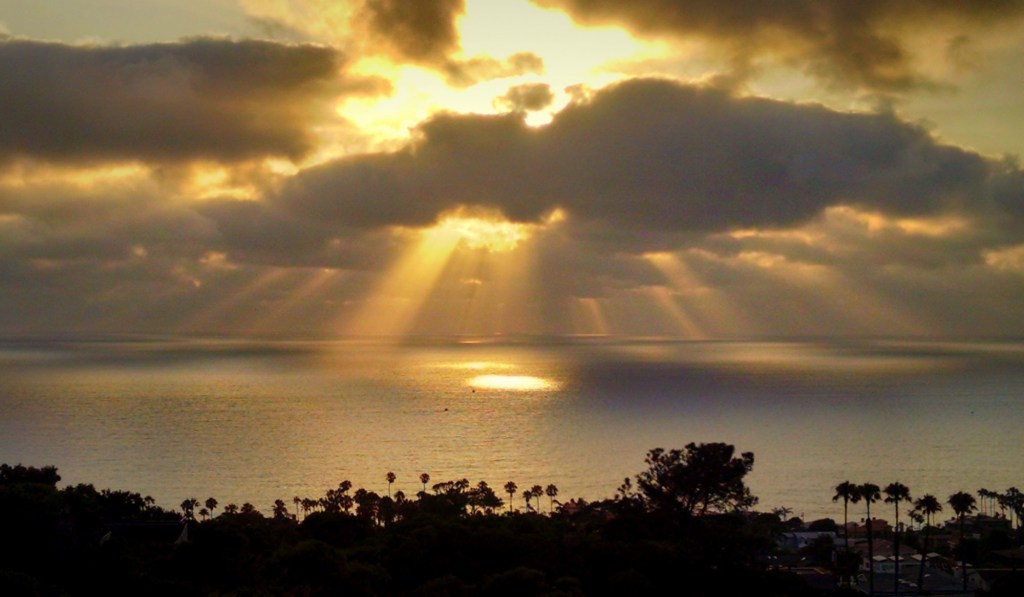
Last month in this column, we learned that more than 50 acres of mostly vacant lots on a hillside above Sunset Cliffs had once provided a hundred-acre-wood-like experience for some early 1960s suburban schoolkids.
A Page from History: Blue View — The very mid-20th-century story of Azure Vista
Planned in 1927 as a desirable residential neighborhood, the tract had instead lain fallow for almost 15 years. Following Uncle Sam’s entry into the Second World War, the mostly vacant subdivision was appropriated by the Defense Homes Corp. to become one of housing-challenged San Diego’s 25 federal housing projects.
Life in Azure Vista
In less than a year, a new community appeared. Ocean Beach suddenly had a suburb. While the idea of “complete communities” has become a 2020s buzz phrase for community-strangling over-densification and social engineering, the Azure Vista of the 1940s was a genuinely complete little community.
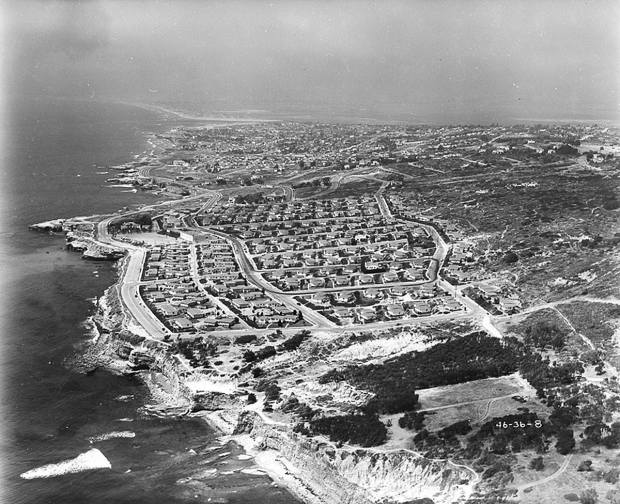 The Azure Vista federal housing project as it appeared around 1946. (Howard Rozelle)
Today there is scant physical evidence that along the west side of Cordova Street there was once a community center as well as a grocery store, a barber shop/hair salon and, according to some unverified reports, a hamburger joint. And although you certainly can’t prove it by San Diego Unified, the southwest corner of Monaco and Cordova streets was once home to Azure Vista Elementary School.
Long before the Snapchatting sunseteers discovered that the sun sets nightly at Sunset Cliffs, before Luscomb’s Point had a name, before the Padres abandoned Lane Field for Westgate Park, before John Glenn flew a few loops around the planet, before the British Invasion, before Mr. Ed ever talked to Wilbur on television, and before Needle’s Eye fell into the sea, people lived and laughed and loved and an entire generation grew up in Azure Vista.
Nice place to live, particularly for federal housing, but the project’s populace was on borrowed time from the outset. Theirs was truly a tenuous tenancy.
Defense industry workers who made up the bulk of Azure Vista’s new population faced a 6-mile-minimum commute to work, and private autos were not the norm. The south end of the “O” bus line through Ocean Beach was at Del Mar Avenue and Sunset Cliffs Boulevard, 12 to 15 blocks north of Azure Vista.
In June 1943, the San Diego Electric Railway Corp. acted to remedy that predicament.
“New bus line carries workers to Azure Vista,” declared the San Diego Union.
“Bus service from the new Azure Vista federal housing project to the terminus of the Ocean Beach bus line … has relieved a major transportation problem for hundreds of war workers,” reported SDER Vice President and General Manager Sam Mason. “Until Monday (June 7), war workers either had to walk the mile and a quarter from the Ocean Beach bus terminus to their homes or hitchhike the distance.”
The new neighbors got busy with it and quickly became part of the greater Ocean Beach community. On Oct. 21, 1943, the Evening Tribune reported that the Azure Vista nursery and extended day child care center had opened the previous day “with an enrollment of 16 children at 905 Cordova St. under the direction of Mrs. Valeria Friedell.”
That brought the total number of nursery and day care centers in the city to 28.
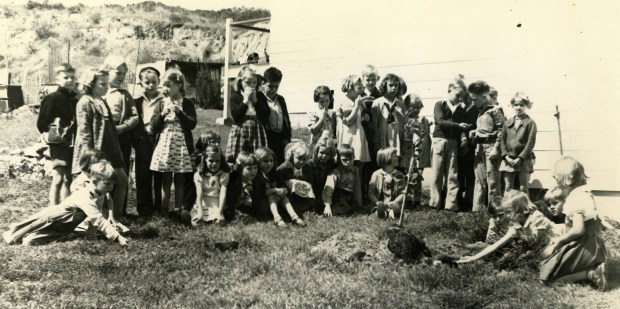 Children of Azure Vista gather in the mid-1940s. (Provided by Bob Smith)
“Azure Vista Center will serve the housing project there as well as the Sunset Cliffs and Roseville areas. A larger playground will be set aside by the housing authorities if the attendance warrants it.”
Fees were “based on a sliding scale” and were “commensurate with family earnings.” The centers were open from 5 a.m. to 6 p.m. every day except Sundays.
“Aug. 11 [1945] is the big day for the dolls of Azure Vista,” proclaimed the Ocean Beach News. “So fix dolly up in her very best and join the crowd on its way to the community building at 2 o’clock. The prettiest doll, the most unusual, the largest, the smallest, the oldest, the youngest and the best-dressed will all draw prizes for their owners.”
The craft class for schoolgirls — including how to fabricate doll furniture — would be continued Tuesday and Thursday afternoons for the duration of the summer.
Jeri Lynne Swank, born Jeri Lynne Bessie, spent her first six years on the sunny side of Brindisi Street in Azure Vista. Jeri Lynne’s Army veteran dad, Dan, worked in the aircraft industry and her mom, Mary, raised Russell blue terriers. Before too long, twin baby brothers Pat and Mike joined the family. The other side of their duplex was rented by a Marine and his wife.
One of Jeri Lynn’s favorite memories of Azure Vista was visiting the grocery store at the bottom of Brindisi on Cordova Street and getting a wonderful dill pickle from the butcher.
“It seems like he wrapped it in some kind of paper before handing it to us. It might have cost a nickel,” she recalled. “I think he just reached his big hand into that great big pickle jar and grabbed a pickle! Nowadays I don’t think I would have eaten it, but then I didn’t seem to mind. I loved pickles, and those were so good!”
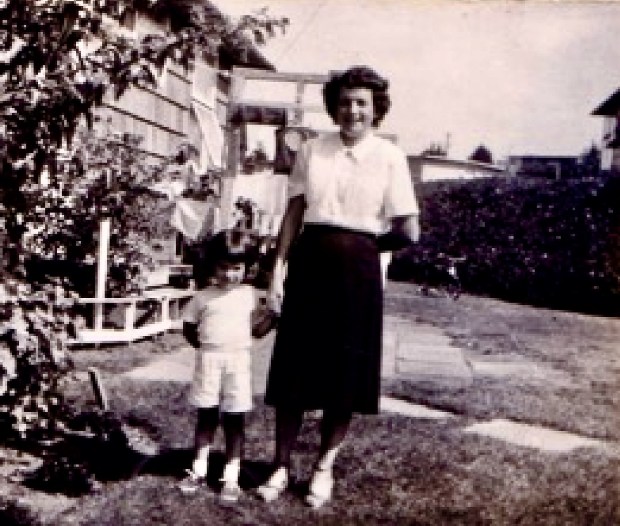 Jeri Lynne Bessie and her mom, Mary, stand in their Brindisi Street backyard in Azure Vista in 1951. (Provided by Jeri Lynne and Bill Swank)
Dan Bessie spent some of his free time working on his “jalopy,” which Jeri Lynne recalls as possibly being an aged Ford, but she won’t swear to that. Dan was often “assisted” by some of the neighborhood teenage boys.
When the family moved to La Mesa in 1954, Dan bequeathed that jalopy to those teenagers, hoping they would get it running. He later learned that the boys had rolled that old buggy down Hill Street and off the cliff. Hi ho. Such was life in Azure Vista.
Azure Vista School
While we would certainly enjoy telling you about dandy little Azure Vista School, the details, regrettably, are hard to come by.
The school opened in 1942 and closed in 1954. The student body seems to have ranged from 150 to 350 in kindergarten through sixth grade. Azure Vista was initially a federal school, which was not uncommon in WWII San Diego. George Dewey and Bayview Terrace were a couple of others.
In 1942, the Defense Homes Corp. morphed into the Federal Public Housing Authority (later the Public Housing Administration). In September 1950, as reported in the Tribune, the PHA was “asked to include the Bayview Terrace and Azure Vista schools in a ‘package deal’ whereby the San Diego city school system” was to get “13 war-built schools at no cost.”
The successful proposal, put together by Congressman Clinton McKinnon and San Diego City Schools Superintendent Will Crawford, “put an end to a PHA-city schools squabble over rental on the structures.”
By mid-century, Azure Vista School had become part of San Diego City Schools, yet San Diego Unified today seems to have no record of it.
The little school was there all right. On Dec. 20, 1946, the Ocean Beach News reported that the Azure Vista Community Center had been the scene of “the annual Christmas party, sponsored by the Azure Vista PTA, the Civic Council and the Recreational Department office. A pageant, ‘Peace on Earth, Good Will Toward Men,’ was presented by the children of the Azure Vista School. Mr. and Mrs. Kenneth D. Lyons portrayed Mr. and Mrs. Santa Claus and distributed treats to the children.”
“Contestants await Quizdown with confidence,” read a Tribune-Sun headline on Friday, April 4, 1947. A team of fourth-, fifth- and sixth-graders from Azure Vista School was to compete in the popular weekly quiz show live from the Spreckels Theater and broadcast on radio station KGB.
Meet the Emersons
At any one time, roughly 2% of the Azure Vista student body was made up of the big happy Emerson family. With 10 kids in a 12-year window, the Emersons of Azure Vista were a force for good in the community. Mom Jane was profiled in the Evening Tribune’s Outstanding Women column in June 1951. At that time, there was “one Emerson in every grade but second at the Azure Vista School.”
Reporter Jerry Fitz-Gerald cracked that not only did Mrs. Emerson knock the Old Woman in the Shoe right out of the nursery rhyme, “she has clean, healthy, well-fed and well-behaved children. She is a room mother at Azure Vista School, is active in the PTA, is a Girl Scout co-leader, helps with the Girl Scout Day Camp, takes part in local politics (she was a member of the League of Women Voters), folk dancing and a Tuesday night art group.”
It goes without saying, but it seems evident that Jane did reserve at least some time for Mr. Emerson. Sure, he seems to have been a busy fellow himself. William Emerson, known to his friends as Bill, was a popular English teacher at Point Loma High. Mr. Emerson had become what would now be characterized as a community activist. He was big, well-spoken and found himself as an advocate and spokesman for the residents of Azure Vista.
“Four hundred families in U.S. housing project concerned over status,” read a subhead in the Ocean Beach News on Feb. 28, 1947. Ocean Beach Chamber of Commerce organizers had “arranged for William Emerson, Point Loma High School faculty member, to speak on the problem of these 1,500 residents of the Azure Vista section.”
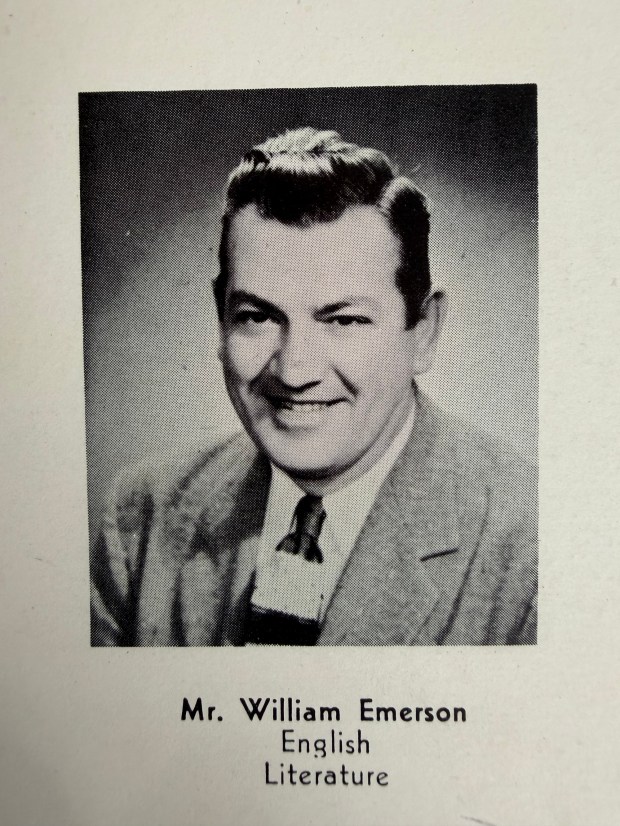
“Mr. Emerson, who has been a resident of the project for nearly three years, conferred Wednesday with officers of the Chamber of Commerce. He said that what the project folks are really concerned about is that Uncle Sam will declare the 400 homes there war surplus before the residents have had an opportunity to rent or buy homes.”
Mr. Emerson emphasized that “the vast majority of the 400 Azure Vista families” were trading in Ocean Beach and that “every local merchant” should be interested. They heard him loud and clear.
At a March 4 meeting, the Woman’s Club clubhouse was packed. Mr. Emerson suggested that the best solution to the Azure Vista question might be the establishment of a local housing authority such as 33 other cities in California had already done, as reported in the March 7 edition of the Ocean Beach News.
San Diego was “the only city of its size in California that does not have a local housing authority,” Emerson said. He warned that if the project homes in Azure Vista were declared surplus, the 400 families there “will not know what to do or where to go in view of the acute housing shortage which already exists here’ and which, he said, ‘would remain acute for several years to come, based on the present record of home construction in this area.”
Mr. Emerson “stated his belief that a large majority of the Azure Vista families, none of which is paying a higher rent than $30 a month, cannot afford to pay the high rents now being asked in San Diego, nor can they afford to buy or build a two-bedroom ordinary residence at the average prevailing price of $10,000.”
“He said he understood that a private investor had offered to buy the project from the government at 25 cents on the dollar, which disposition of the project he felt would be a decided mistake. A better plan, he believed, would be to work out some practical form of mutual homeownership plan.”
Mission Bay Chamber of Commerce President Steven Young suggested that Azure Vista residents were “whistling in the cemetery” if they thought they would be able to continue paying anything close to the rental they were paying at the time.
“Present high costs of construction,” Young said, “would not allow landlords to rent new houses at any such low rental.”
“B.B. Hollobaugh, local businessman, who said he was one of the first residents of the Azure Vista project when it was first established, said he also hoped that some workable solution of the problem could be decided on as he, like the others there, greatly hoped they would be able to continue living [there].”
The Chamber of Commerce directors voted “to take the matter under advisement” to see what “could be done toward a satisfactory solution.”
John Arvin, Federal Housing Administration district housing project manager for the Southern California area, said he had a previous engagement in the Imperial Valley and couldn’t make the meeting at the Woman’s Club.
The meeting closed with the showing of an official Navy sound film on the atomic tests at Bikini island in the Pacific the previous summer. Robert Horn of Ocean Beach operated the projector. True story.
So what happened? It appears that all 400 of Azure Vista’s demountable units got demounted, right? Exacto. The Azure project was closed, but it didn’t happen overnight. In fact, the process took the better part of the next decade to complete.
Remember, Azure Vista represented less than 2% of some 20,500 federally funded war housing units in San Diego. Just a month following the above meeting, the PHA outlined the process for the disposition of 9,000 permanent and semi-permanent demountable units, such as those in Azure Vista. Temporary units, like most of Frontier housing, were eventually torn down, but the feds were in no real rush to do it.
We will spare you most of the details, but the high points included that occupants would have first priority when the units were sold. Units not purchased by occupants would be made available to veterans, and if any were left, they would be put on the public market.
Of course, these provisions applied only to the units themselves, not to the real property. If you wanted to buy your duplex, for example, you needed to relocate it … somewhere. What if both families occupying a duplex wanted to buy it? It could be complicated.
In no case would there be any wholesale eviction of tenants, and speculation was actively discouraged.
Azure Vista School remained in operation for six more years until it was replaced by the new Sunset View School on March 1, 1954, which happened to be a Wednesday. Some 340 Azure Vista School kids went to Azure Vista on Tuesday and the next morning walked up the hill to begin their sojourn at Sunset View.
New Principal Lois Chatterly welcomed 260 kids from Silver Gate School who were now in the Sunset View attendance district.
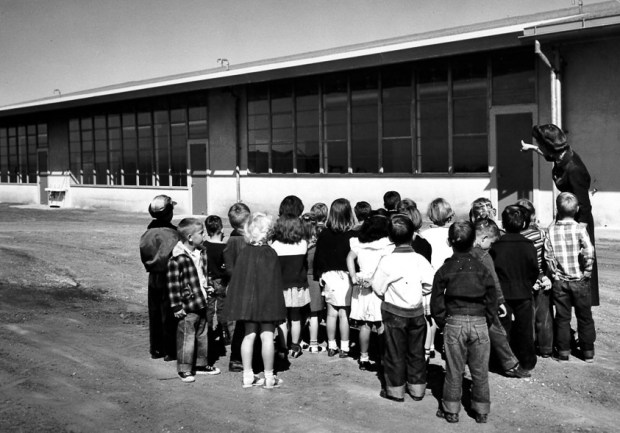 Azure Vista Elementary School students take a field trip to their newly built school, Sunset View Elementary, in 1954. (San Diego Unified School District)
The only Azure Vista School artifact retained at Sunset View is a 1953 Azure Vista School yearbook, which is really just a collection of class photos, with no text. Azure Vista’s final principal goes unnamed. For the record, he was Owen B. Handley, later a very distinguished San Diego educator who was then in the early part of his career.
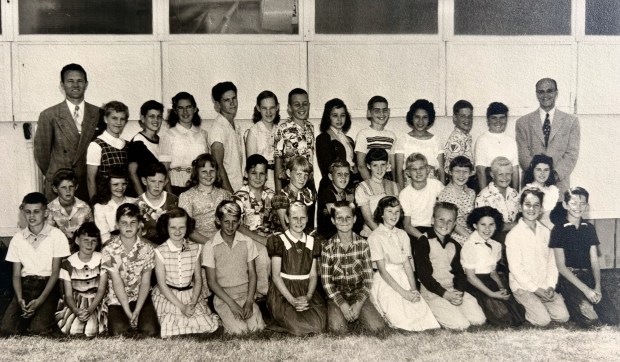 The last sixth-grade class at Azure Vista Elementary School is pictured in 1953. Principal Owen B. Handley is at far left. (Sunset View Elementary School archives)
The Ocean Beach News on Aug. 16, 1956, carried the news that the California Public Utilities Commission had granted an application from San Diego Transit to abandon bus service on that part of the “O” line from the three-way intersection of Froude Street, Leon Street and Devonshire Drive to the route’s terminus at the intersection of Cordova and Carmelo streets. It was reported that “only seven private dwellings remain in the area served by that route.”
The application was granted “because of poor patronage due to the closing of the Azure Vista housing project.”
Most of the original Azure Vista subdivision had been sold by the PHA by the end of 1957, although the last block south, between Casitas and Ladera streets, was not sold until January 1961 in what seemed to have been a completely separate transaction.
Note: There is a local legend that once upon a time at Sunset View there was an excellent Azure Vista School scrapbook. Its current whereabouts are unknown. You are encouraged to come forward if you have any information on the subject. There might be a burrito in it for you.
Eric DuVall is president of the Ocean Beach Historical Society. Membership in OBHS, a 501(c)(3) nonprofit, is $25 annually. Visit obhistory.org.