
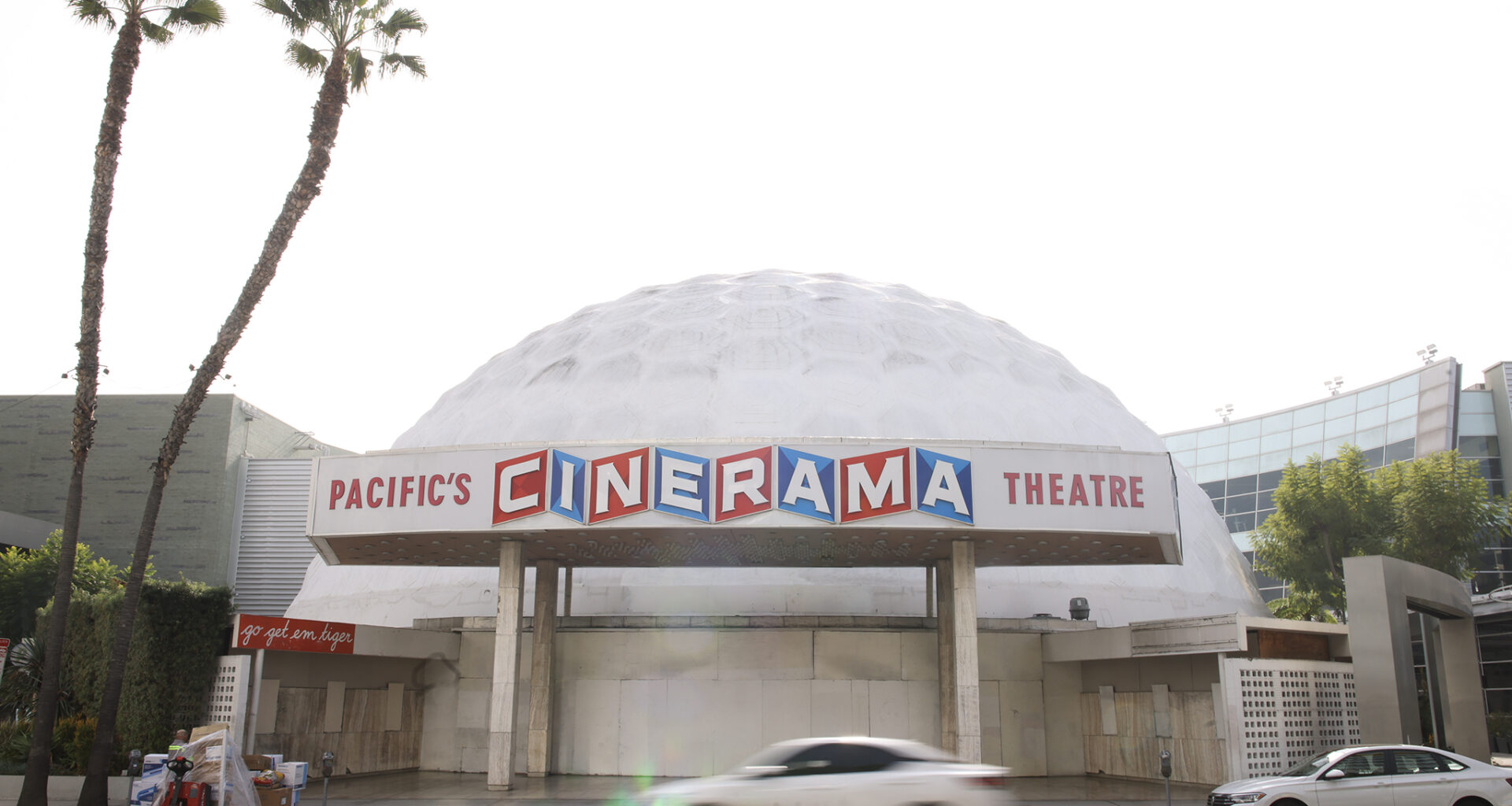
On Tuesday morning, the Los Angeles City Planning Department held a tense virtual public hearing for an ordinarily benign topic: a new conditional use permit, or CUP, application that would allow a property owner to sell alcohol consumed on-site. Dozens of Angelenos, including many people working in the film industry, turned out to voice their frustration concerning the high-profile project: the long-shuttered Cinerama Dome, a towering icon of ’60s-era Hollywood and beloved theater, that has lain empty for six years with no concrete reopening date in sight.

“It feels like when the Cinerama Dome is closed, it actually feels like Hollywood is dead,” one resident said on the call. “I believe the entire area is suffering because the Cinerama Dome is closed.”
The historic Cinerama Dome was home to many a movie premiere and night out in the Hollywood neighborhood, until the pandemic forced the theater to close in 2020. Since then, Decurion Corp., the privately held company that owns the Cinerama Dome site, has remained mum about its specific plans involving the beloved complex — even as local pressure to explain the theater’s long absence has ticked up.
Article continues below this ad
Thus, this week’s CUP hearing became a rare public forum for cinephiles and neighborhood residents to press Decurion’s representative, the land use consultant Elizabeth Peterson-Gower, about what those potential reopening plans for the dome might involve.
“Are they opening it again as a movie theater? When are they opening it? Why have they kept it closed?” asked a local journalist, Allen Salkin, on the call. “Is this just a strategy to let it rot so they can just get building violations and tear it down and build condos? There’s a lot of fear about what’s going to happen with this thing that people feel attached to. And to not answer questions about it over all this time has frankly been offensive.”
The dome of the Cinerama theater in Hollywood was built specifically to showcase wide screen movies, shown in Los Angeles in February 2010.
Kirkikis/iStock via Getty
Attendees took particular issue with the application’s request for a CUP “in perpetuity,” meaning the owners would not need to reapply for the occupancy permit that formally allows business to operate publicly. Those permits typically expire after a set period of time, allowing room for more public input — or at least a new look from the permitting department. But for the dome, a timeline for reopening has yet to materialize. “I think it does smell of a way to no longer be accountable to citizens,” said LA resident Danielle von Zerneck in the public hearing, adding that Peterson-Gower had not included information about the property’s restoration in relation to the CUP. “The vagueness of that is deeply concerning.”
Article continues below this ad
‘An instantaneous icon’
The Cinerama Dome has been a recognizable Los Angeles icon since it first opened in 1963, with the premiere of the Long Beach-shot “It’s a Mad, Mad, Mad, Mad World.” Built by the local firm Welton Becket & Associates, the same architect behind LAX’s Theme Building and the Capitol Records Building, the theater’s geodesic dome design made it immediately stand out in Hollywood, said LA Conservancy President and CEO Adrian Scott Fine.
While other geodesic domes were built in that era, “what makes this one especially unique is the world’s first all-concrete geodesic dome, whereas others were of metal or other types of material,” Fine said. “It really hit all of the boxes in terms of making this an instantaneous icon because it was so unusual and so very different from anywhere else.”
Article continues below this ad
Originally intended as a prototype for other theaters to showcase Cinerama widescreen technology, the dome proved cost-prohibitive to build on such a scale. In the late 1990s, the LA Conservancy helped lead a successful local advocacy effort to preserve the theater’s historic facets — threatened by new construction that would obscure the dome at the street level and take out the theater’s signature curved screen. Today, the Cinerama Dome is a designated historic-cultural monument.
Diana Jacobs, an administrative assistant with Pacific Theatres, holds an artist’s rendition of an improved Cinerama Dome complex during a press conference in Los Angeles on Dec. 8, 1998.
Luis Sinco/Los Angeles Times/Getty Images
For decades, the Cinerama Dome was a local favorite for filmgoers, offering various dining and drink options and reserved seating inside the theaters. The pandemic spurred its closure, but even as the world has reopened — with other big projects opening, like Blue Note Jazz Club’s Los Angeles outpost that’s housed in the same complex — the Cinerama Dome continues to gather dust.
Five years ago, a film student and filmmaker named Ben Steinberg started a petition to reopen the theater, which has garnered over 30,000 signatures. Since then, he’s taken to sharing dome resources on social media through his account Save Your Cinema. “Having it sitting abandoned and literally falling apart represents the overall picture of Los Angeles,” he told SFGATE. “It’s just been very frustrating to the people of LA that the owners of the complex are extremely secretive about it, and they don’t issue any PR statements or respond to emails.”
Article continues below this ad
Earlier this year, Steinberg hired a projectionist to beam an image of the property’s owners, the Formans, onto the defunct theater, urging them to “reopen the dome.” Steinberg said the Forman family called the police and that authorities warned him that the projection was a form of “escalation and harassment.” Steinberg has since stopped projecting images onto the dome but continues to post frequently online about its status, including Tuesday’s public hearing.
‘We want to know this area’s alive’
Many of the public questions and comments at the forum concerned whether the property would, in fact, reopen as a public movie theater anytime in the future. Reading off a question from someone watching the hearing, Associate Zoning Administrator Tim Fargo asked Peterson-Gower: “Is there any intention to remove any of the movie theaters, either now or in the future?”
Article continues below this ad
“I don’t have a direct answer for that,” Peterson-Gower said. “The Cinerama Dome, obviously, it’s a historic property. It’s not going to be removed.”
“But just to confirm, for the sake of everyone on the call, this proposal does not include any attempt to remove any of the movie theaters, correct?” Fargo replied.
“That is correct,” Peterson-Gower said.
A view of parking lot behind the landmark Cinerama Dome building near Vine Street and Sunset Boulevard, which was shot on slide film in March 1981.
trekandshoot/iStock via Getty
In an interview with SFGATE before the hearing, Peterson-Gower stated that the owners have “every intention” of it going back up. “They are really committed to Hollywood and making sure that all the steps are taken and that it opens and thrives,” she said. When I asked Peterson-Gower to clarify if the complex will specifically reopen as a theater, instead of being redeveloped into something else, Peterson-Gower said: “We’ve spent a lot of time, and they’ve spent money, making sure that this property stays with the theaters and all that.”
Article continues below this ad
The LA Conservancy has been part of discussions with the owners, Fine said, and he believes that “the intent is to reopen it.” The dome’s “continued use as a theater space is part and parcel of its story,” he continued. “We look at adaptive reuse all the time, but for a building like this, it really needs to be a theater to experience it as it was always intended to be.”
Various critics have questioned whether the aging property has remained empty so it can be written off as a tax loss. The Forman family also owns the Hollywood Pacific Theatre, which closed and never reopened as a theater after the building sustained damage during the 1994 Northridge earthquake.
In the public hearing, various Angelenos worried that the conditional use permit’s “in perpetuity” clause suggested that the dome might remain shuttered indefinitely. Many urged for its approval, with the caveat that the company would provide a timeline for its reopening. (In the meeting, Peterson-Gower said that she herself didn’t “have a schedule yet, but when I do, I’ll convey it to you.”)
Eddie Navarrette, the chief consultant of FE Design and Consulting, said that the LA City Planning Department, likely in an attempt to streamline processes, stopped putting time-restrictive terms on grants such as CUP applications during the pandemic. “It became kind of normal for these things to go on in perpetuity,” he said. That said, while it may not be that unusual for a business in LA to apply for a CUP in perpetuity, “the more flexible the grant is, the farther that can can be kicked,” Navarrette said.
Article continues below this ad
It will take some time for the CUP to go through. Yet during the meeting, Fargo stated: “It seems like there’s universal support for it reopening, so with that, I am inclined to approve.”
The Cinerama Dome in Los Angeles on Dec. 22, 2025.
Jessie Alcheh/SFGATE
For Angelenos who grew up seeing movies at the Cinerama Dome, its closure and the half-decade holdup in its hopeful reopening have hit hard at a time when the city has been struggling to recover from the pandemic, wildfires and Hollywood’s ongoing woes — at once in a macro sense and with the beleaguered neighborhood that shares its name.
The dome’s continued absence is pushing Angelenos to seek out cinematic magic elsewhere around town. One filmmaker on the call, Xan Aranda, told a story about frequenting the dome back in the day, attending premieres and gathering huge groups of friends to hang out there. Since the dome’s closure, Aranda explained that she’s been going to smaller spaces like Vidiots instead, the arthouse theater/VHS store in Eagle Rock.
Article continues below this ad
“I really miss the Cinerama,” Aranda said. “I hope that this is tied to a plan to reopen. If it’s not, I don’t see the point. The conditional use permit needs to be tied to a timeline, and I don’t think it should be in perpetuity. We want to spend money, we want to gather, we want to have a good time. We want to know this area’s alive.”