
Day of the Dead reminds us that our legacy is more than objects: its stories, rituals, and the love we shared. The altars and offerings transform mourning into celebration and remind us of our mortality. This celebration of life is a good time to reflect on whether we are prepared for the end of our journey. Planning for the end of life can be a final act of love.
According to the Centers for Disease Control and Prevention, the average age of death in the United States is 78.4 years. The global average age of death is a few years lower, at 71 years for men and 75.8 years for women. Monaco takes first place with the highest life expectancy, where men live an average of 84.8 years and women 88.6 years.
Without a Will or Trust: What Happens to Your Assets When You Don’t Prepare
If you die without leaving a will or a trust, your assets will be distributed according to intestate succession laws. This can lead to a lengthy and expensive legal process known as probate. In this case, a court will determine who your heirs are and how your estate will be divided.
As a result, your personal wishes may not be fulfilled, and the final distribution of your assets may not be what you would have chosen. How do we protect what we’ve worked so hard for? Planning is essential. In the following story, Sergio Flores explains how to prepare for death and what happens to your assets if you don’t.
How do we protect what we’ve worked so hard for? Planning is essential. Sergio Flores explains how to prepare for death and what happens to your assets if you don’t.
Sergio Flores, from NBC7 Responds, spoke with a lawyer who explained the steps we should take to prepare for death.
When the end arrives, it can be very costly. According to the National Funeral Directors Association, in the United States, the average cost of a funeral with a wake and burial is $8,300, while the average cost of a funeral with cremation was just over $6,280.
Death Abroad: The Complex Process of Repatriating a Body from the U.S. or Mexico
Saying goodbye is never easy, but when it involves navigating international borders, the process becomes a heartbreaking logistical tangle. Here we analyze the challenges of dying on the other side of the border.
Cecilia Treviño investigates the process to follow if a loved one dies while traveling across the border.
Did you know you can buy a casket at your favorite shopping center?
That’s right! You can buy a casket or urn at Costco, Walmart, or even Amazon. You can have it shipped directly to the funeral home of your choice. If you plan to do this, you should know that throughout the United States, it is illegal for funeral homes to charge a “casket handling” fee or any other additional charge for using a casket or urn purchased from a third-party vendor.
In fact, in California, there are laws that prohibit funeral homes from charging a fee for a casket built by the family. The only requirement is that the casket meets the standards of the cemetery or crematorium where it will be used. If a funeral home tries to charge you a handling fee or refuses to accept a casket you purchased elsewhere, you can file a complaint with the California Department of Consumer Affairs’ Office of Cemeteries and Funerals at the number shown on screen.
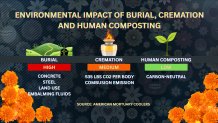
Can you imagine becoming fertile soil after you die? It may sound strange, but it’s real. Human composting is a new option that’s transforming the funeral industry in the United States.
Besides cremation and burial, there is human composting
Human composting, also called terramation or natural organic reduction, is a process by which human remains are transformed into fertile soil over a period of 30 to 60 days. The body is placed in a container along with organic materials such as wood chips, alfalfa, and straw, where microorganisms naturally decompose it.
Human composting is legal in 13 U.S. states. Although it became legalized in California in 2022, it won’t be available until 2027. Ana Cristina Sánchez explains the process of this new alternative to traditional burial.
The end result is nutrient-rich compost that the family can use to plant a tree or create a memorial garden. Human composting is legal in 13 states, and in California, it was legalized in 2022 but will not be available until 2027.
What happens to your digital treasures when you die?
Today, our presence isn’t limited to a framed photograph. Many of us have extensive digital lives, with profiles, photos, and data that continue to exist after we’re gone. This leads us to wonder: what happens to our digital legacy when we’re no longer here? We spoke with a cybersecurity expert who gave us recommendations on how our families can find and access our digital treasures when the time comes.
Nikolas Behar, a cybersecurity expert, explains the steps that should be taken so that when death comes, our loved ones can access bank accounts and other digital assets.
Differences Between Term Life Insurance and Permanent Life Insurance
Choosing life insurance can seem like a complicated task, especially when it comes to understanding the difference between term life insurance and permanent life insurance. Both offer financial protection for your loved ones, but they work very differently.
While the former provides coverage for a specific period and is usually more affordable, the latter accompanies you for life and can accumulate cash value. Understanding how each one works will help you decide which one best suits your needs and financial goals. In the following story, Sergio Flores answers the most common questions about life insurance.
Sergio Flores, from NBC7 Responds, explains the difference between term life insurance and permanent life insurance.
How has the meaning of the Day of the Dead altar evolved?
The meaning of the Day of the Dead altar has evolved over the centuries, merging Indigenous and Catholic traditions to become the celebration we know today. Originally, the Indigenous peoples of Mesoamerica made offerings to honor and communicate with their ancestors, using elements such as food, flowers, and fire as symbols of life and renewal.
After Spanish colonization, these rituals blended with the Catholic festivities of All Saints’ Day and All Souls’ Day, giving rise to the modern altar: a colorful space that reflects both spiritual devotion and cultural identity, celebrating life, memory, and the connection between the worlds. Catholic priest Bernardo Lara explains how the meaning of the altar has evolved.
Father Bernardo Lara with the Catholic Diocese of San Diego explains how the meaning of the Day of the Dead altar has evolved over the centuries.