
Occupancy at four of Long Beach’s shelters for homeless people has increased significantly in the past month, according to city officials, after a new nonprofit service provider took over operations at the locations.
In late March, Long Beach’s Department of Health and Human Services announced that it had made an abrupt decision to cut all ties with First to Serve, a nonprofit it had contracted with to manage four homeless shelters since 2022.
The decision was the result of an investigation by the city auditor’s office that identified multiple “contract compliance issues” with First to Serve. The details of the issues with First to Serve’s operation of city-run homeless shelters has not been fully released at this time, as the auditor’s investigation is still ongoing.
First to Serve, though, said in a previous statement that it is fully cooperating with the investigation, noting that it was aware of “accusations made against a former employee.”
The initial findings by the auditor created a problem for Long Beach’s health department — one that needed to be fixed quickly. Once Long Beach had officially cut ties with First to Serve, the city needed to find a new contractor to take over shelter management immediately.
So People Assisting The Homeless, otherwise known as PATH — a nonprofit homeless services organization serving four regions, including Los Angeles, Orange, Santa Clara and San Diego counties — was quickly brought on to manage the four city shelter sites previously under First to Serve’s management.
Those include two Project Homekey shelters, 5950 and 1725 Long Beach Blvd., alongside the Atlantic Bridge Community and the city’s year-round shelter, 702 W. Anaheim St.
Typically, when the city is looking for a contractor for any service, there is a relatively lengthy bidding process, Homeless Services Bureau Manager Paul Duncan said in a Monday, May 11, interview at the 5950 Long Beach Blvd. shelter.
“Typically, within our shelters, we’re going through a procurement every three years or so. In that procurement time, there’s an opportunity for nonprofits to bid on contracts, which we try to get out as far ahead of time as possible, anywhere from six to eight months before we’re looking for the new contract to start,” Duncan said. “Then, we’re making selections three to four months ahead of that contract starting, (and) that gives them enough time to prepare.”
But with First to Serve let go so abruptly, Long Beach approached PATH about coming on board as the city’s new shelter operator just about a month and a half before the contract was expected to start, Duncan said.
PATH was an obvious choice for the job, Duncan said, since Long Beach had worked with that nonprofit in other capacities for years. Most recently, the organization was hired to oversee operations of the Colonial Motel, which is being used as a shelter as part of the city’s efforts to bolster homeless encampment resolution.
“That was happening at about the same time that we were looking for a new provider to take over,” Duncan said. “Since (PATH was) selected for that, we reached out to them, being a similar procurement and said, ‘Hey, we just selected you for this. Would you by chance also be open to taking over our other four shelters, as we are looking for a provider to come in quickly.’”

Long Beach Homeless Services Bureau Manager Paul Duncan describes the future for Project Homekey at 5950 Long Beach Blvd. in Long Beach on Monday, May 11, 2026. (Photo by Drew A. Kelley, Press-Telegram/SCNG)

Project Homekey at 5950 Long Beach Blvd. in Long Beach on Monday, May 11, 2026. (Photo by Drew A. Kelley, Press-Telegram/SCNG)
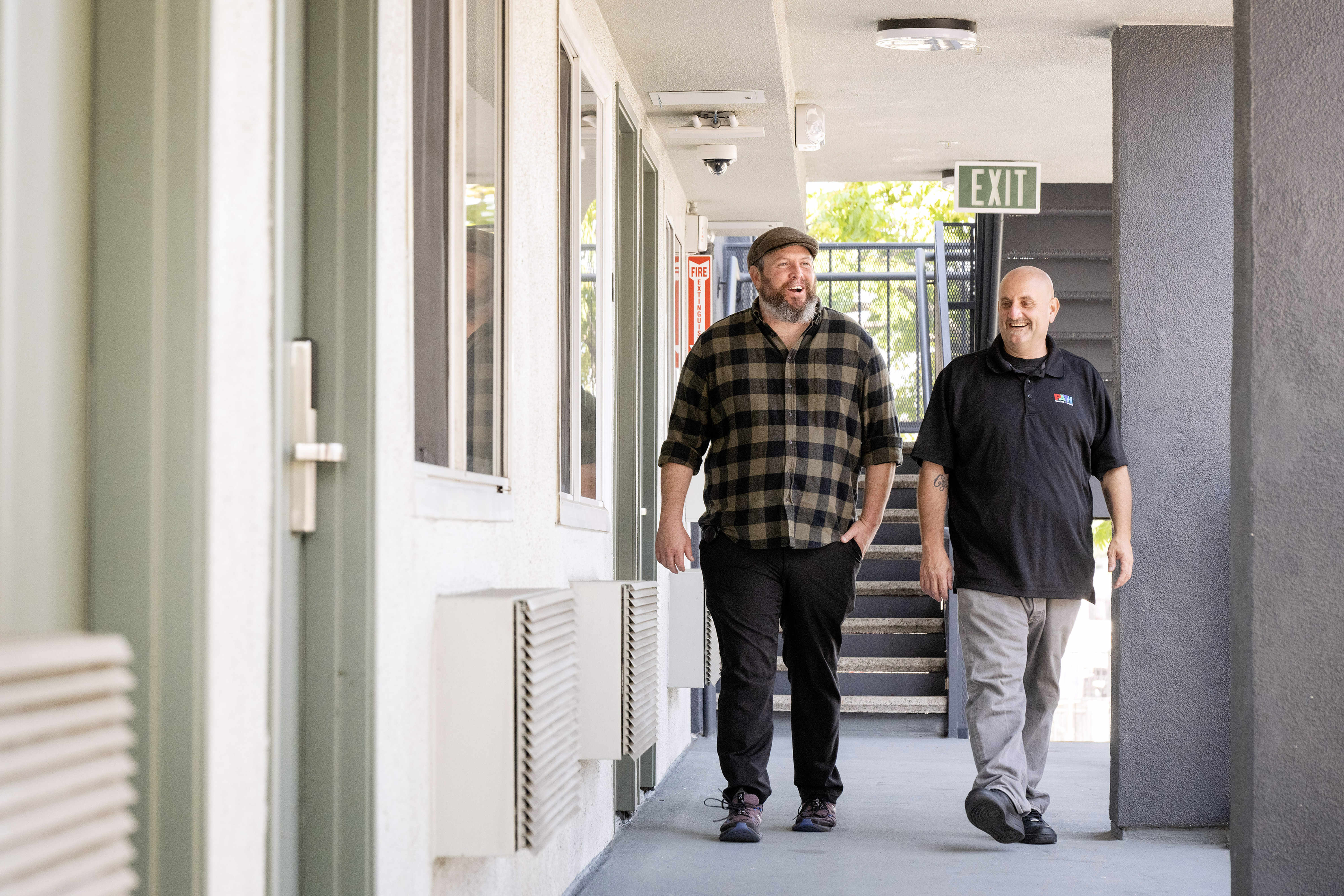
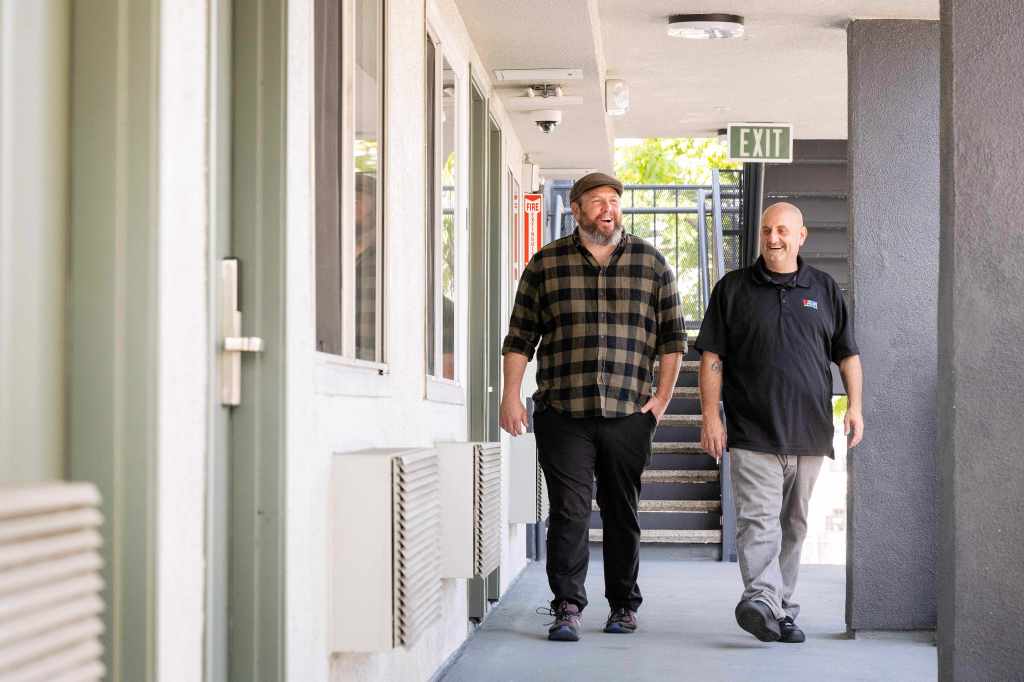
From left, Long Beach Homeless Services Bureau Manager Paul Duncan and PATH Associate Director of Interim Housing Tim Huxford pose for a photograph in Long Beach on Monday, May 11, 2026. (Photo by Drew A. Kelley, Press-Telegram/SCNG)
Show Caption
1 of 3
Long Beach Homeless Services Bureau Manager Paul Duncan describes the future for Project Homekey at 5950 Long Beach Blvd. in Long Beach on Monday, May 11, 2026. (Photo by Drew A. Kelley, Press-Telegram/SCNG)
PATH was up for the challenge, said Tim Huxford, the organization’s associate director of interim housing.
“I just think the positivity of the new adventure and a new relationship with the city of Long Beach (was exciting),” Huxford said on Monday. “We’ve worked together recently with that other site, and I think we work well together.”
But getting the contract in place with PATH was just a small part of the transition.
“It’s not an easy feat to change one shelter, let alone four shelters at the same time,” Duncan said. “From the city side, we’re grateful for the thoughtfulness and the effort that PATH has put into coming in and taking over the participants on site, and the willingness for PATH to jump in and take over four shelters in a pretty quick time manner.”
Once PATH officially came on board, it was tasked with transitioning all four shelter locations into its operations systems. That included, Huxford said, relocating staff from PATH’s other Los Angeles County locations to work at the Long Beach shelters, hiring temporary workers, getting security in place, and putting in place new administrative and data collection systems.
“We pulled staff from all of our sites all over LA County to be able to make this happen in such a short time,” Huxford said. “All the security, all the food vendors, all that in place. Most of our staff right now are from a temp agency until we can hire on full time.”
Another key aspect of the transition, Huxford said, has been ensuring the clientele who currently live at the four city shelter sites were informed about the transition — so PATH’s workers, case managers and other staff could start the process of building relationships with them.
First to Serve, Duncan added, didn’t give shelter residents much of a notice that anything was going to change.
“We had given First to Serve notice. However, their notice to participants was very late within that changeover process and that transition,” Duncan said, noting that while First to Serve did meet with PATH to help smooth the handoff process, First to Serve didn’t inform people living in the shelters of the incoming change until about a week before PATH came on board. “It was probably, for them, a little abrupt and kind of shocking — I don’t know if in some ways that made it easier, in some ways more difficult.”
Huxford, though, said PATH made — and will continue to make — concerted efforts to ensure that the people the nonprofit serves in shelters have their concerns heard and needs met. To that end, the organization hosted community meetings with shelter residents to get feedback and begin the trust-building process.
“I think, speaking with most of the participants, they’ve been happy with the changes that have come. We like to treat people like adults and like human beings, and we’re very person centered,” Huxford said. “And all the feedback we’ve gotten mostly is positive.”
PATH has made some changes to how the shelters run, Huxford said, to account for what works for their residents.
“They were having curfews and stuff here before, but we believe people are allowed to work, they’re allowed to go to school, they’re allowed to do stuff like that,” Huxford said. “So we relaxed that kind of stuff. There were some structural things that we do differently than they (First to Serve) do, and participants seem to like that, that they’re treated fairly.”
At all four shelter sites, Duncan and Huxford added, First to Serve had labeled the offices home to case managers as “restricted areas” just for personnel, effectively barring shelter residents from accessing their case managers when needed.
“At all of our sites, the case management had a restricted access site,” Huxford said, “but that should be an area where participants are comfortable coming in to talk to the people that are there to help them.”
So PATH covered up the restricted area signs with ones that instead read: “Welcome please come in!”

Project Homekey at 5950 Long Beach Blvd. in Long Beach on Monday, May 11, 2026. (Photo by Drew A. Kelley, Press-Telegram/SCNG)
Show Caption
1 of 1
Project Homekey at 5950 Long Beach Blvd. in Long Beach on Monday, May 11, 2026. (Photo by Drew A. Kelley, Press-Telegram/SCNG)
Besides working to get all four shelter sites transitioned to PATH’s operations, the nonprofit has also been focused on another key goal: making sure each site is full.
Under First to Serve’s management, there were unoccupied beds at all four shelters sites, according to data provided by the city’s health department.
The Atlantic Bridge Community, for example, is home to 125 beds. Before PATH took over, as of March 30, 78% of available beds at that site were occupied.
Just a couple of months later, as of Monday and with PATH operating ABC, occupancy had risen to 93%, with 116 beds occupied.
The trend is the same at the three other locations. At 702 W. Anaheim, occupancy has risen from 88% in March to 98%, with 79 of 81 beds taken, as of Monday.
And at 1725 Long Beach Blvd., occupancy has risen from 83% in March to 88% in May. The numbers haven’t increased as much at that location because 35 beds are currently offline while rooms undergo maintenance, which is expected to be completed in the coming weeks.
The former Luxury Inn site, 5950 Long Beach Blvd. is nearly at complete capacity as of Monday, according to the data, with 90% of total beds occupied — up from just 15% in March. There are also currently nine beds unavailable at this location because of ongoing maintenance.
Since the PATH transition completed, occupancy across Long Beach shelters has risen from just 68% in March to 96% occupancy of the currently available beds as of Monday.
At 5950 Long Beach Blvd., Duncan said, there were about 50 available rooms that were unoccupied when PATH took over.
“There was a fair amount of conjecture around the site, as well as an interview from the previous site manager with First to Serve,” Duncan said. “Not to get deeply into what occurred, but there were efforts to try to avoid taking referrals and getting it filled, and retaining people on site.”
So once PATH was in charge, getting those 50 rooms filled, along with increasing occupancy at the other shelter sites, was a key priority.
“We did 50 intakes the first week we opened here (at 5950 Long Beach Blvd.),” Huxford said. “The outreach team goes out and does outreach. They put in the referrals, and they have a list there that will submit the referrals to us, and we usually try to do the intakes as soon as we get the referrals.”
Now that occupancy is up across the four shelter sites, PATH is working on additional projects, including getting a substance abuse program up and running for shelter residents, Huxford said.
“We’re creating an MOU (memorandum of understanding) with a medical provider that we’re going to have come weekly,” Huxford said. PATH will also have “mental health outreach teams that connect people with housing as needed,” and are working to help shelter residents collect their documents for housing.
“We believe that everybody deserves to have a home,”Huxford said, “and we would like to get as many people indoors as possible so they can get the help that they want or need.”
Since the contract with PATH is temporary and was done much faster than it would have been under normal circumstances, Long Beach will work on issuing a request for proposals sometime in late summer or early fall to select longer-term providers for the four shelter locations, Duncan said.
“We also are committed to being a good steward of the public money that we have, and when it’s not being spent in the way that we want to see, those are the difficult decisions that need to be made,” Duncan said, referencing the decision to cut ties with First to Serve. “Our contract with PATH is for a year, renewable by three months, and that’s to give time to get out a competitive process to award the four sites.”
Doing a new RFP process, Duncan said, will allow Long Beach to ensure there is a competitive and fair method for how government money is awarded.
“Obviously, we hope that PATH considers putting in proposals,” Duncan said. “We’ll also look at other proposals that come in, but (we’re) wanting to make sure that we are operating an open and competitive process, (since) this is not normally how we’d go about it.”
As for whether PATH will apply for those, Huxford said he hopes it will.
“We’re excited for the challenge and grateful for the opportunity,” Huxford said, “(And that) the city of Long Beach trusted us.”