
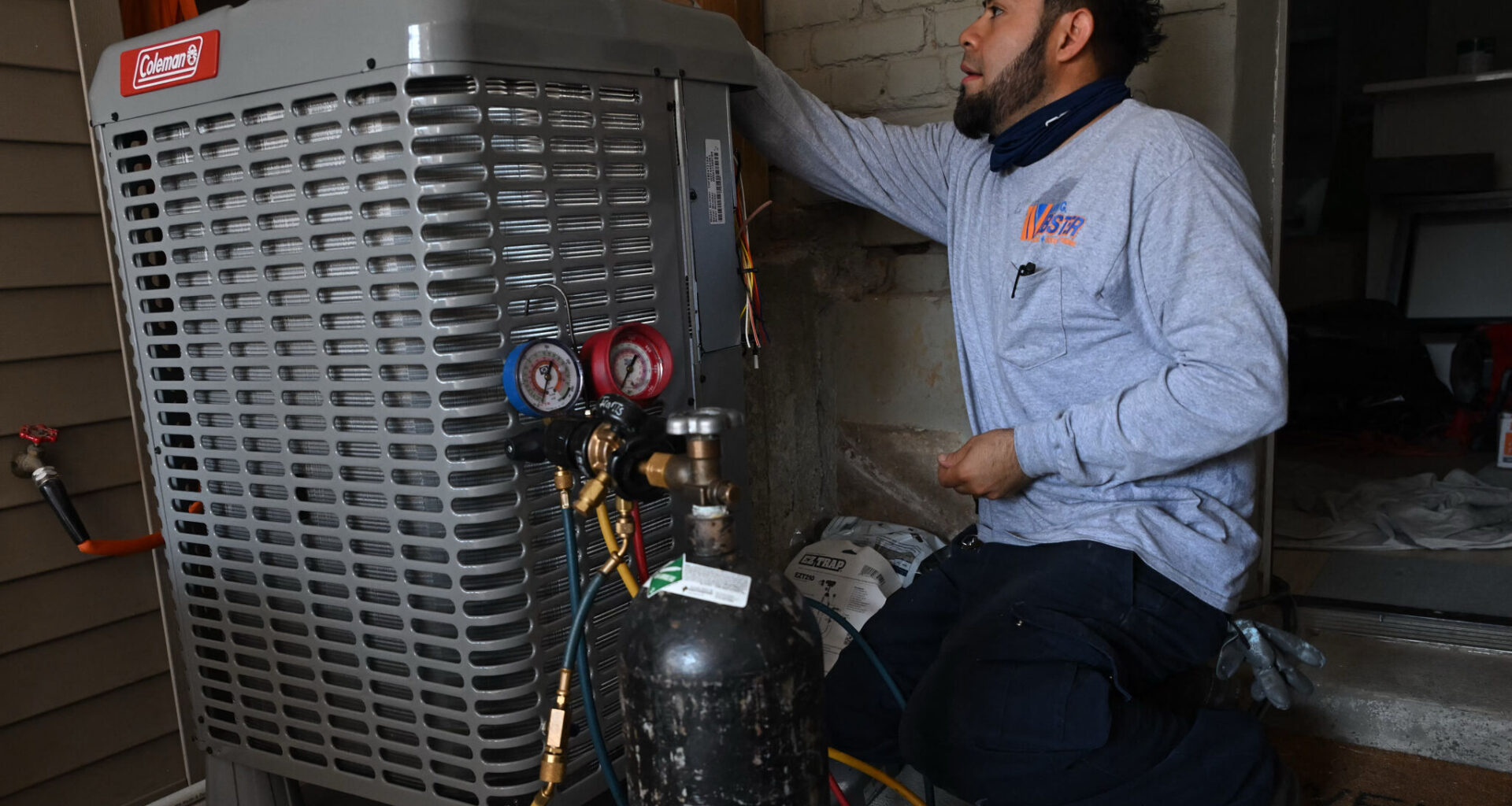
A technician installs a heat pump in Washington, D.C. in 2024. Heat pumps heat and cool homes, and also heat hot water. The Bay Area Air District wants to make their use widespread, as a replacement to natural gas appliances.
ANDREW CABALLERO-REYNOLDS/AFP via Getty Images
Bay Area air regulators appeared sharply divided over a controversial new rule that would ban the sale of natural gas water heaters in the region starting next year.
At a meeting Wednesday, eight board members advocated for a pause or to switch to a voluntary program. But they were slightly outnumbered by 10 board members, who want to move forward with the rule after adding amendments, including delaying the start date from January to October 2027 and exemptions for homes that face high installation costs or low incomes.
The landmark rule, which would require many homeowners to replace broken gas-powered water heaters with more expensive electric and environmentally friendly models starting in 2027, passed in 2023 as one of the most aggressive anti-pollution appliance rules in the nation.
Article continues below this ad
The rule would deliver cleaner air and prevent up to 85 premature deaths each year, the district said. It is also costly: air district staff said the installation of an electric heat pump water heater would cost roughly $3,500 more than a natural gas version. Some homes may need to pay more for electrical work or space reconfigurations, while others could opt for plug-in models that can reduce costs.
“It’s the wrong time to do this.” board director Mark Salinas said. “Everyone we talk to, what’s the top of mind issue right now? It’s affordability, it’s affordability of food, it’s affordability of electricity, it’s affordability of gas, it’s affordability. … Let’s wait and see if the economy gets better, and if we’re in a better position, so that families can afford this.”
San Francisco Chronicle Logo
Make us a Preferred Source to get more of our news when you search.
Add Preferred Source
The exemptions could apply to nearly 38% of water heater replacements. Several board members pointed to these amendments as the best way to ease affordability concerns while also addressing health and climate goals. The 24-member board — consisting of Bay Area mayors, supervisors and other local leaders — will vote on the exemptions in a meeting in October.
“Change is not easy. We shouldn’t pretend that it is,” vice chair Vicki Veenker said. “But resisting change isn’t easy either. It has a cost, and in this instance, the cost is health. The cost of a lost life or a loss of a quality of life is incalculable, but the cost of healthcare has been calculated.”
Article continues below this ad
The district said that up to $890 million of air pollution health impacts can be avoided each year.
“If you ask any family if they would prefer to be slowly poisoned and have their health and the health of their children be negatively impacted over the risk of maybe a slight cost increase, it’s kind of a no brainer,” board member Noelia Corzo said.
Still, board members were concerned about the economic pressures burdening homeowners now.
“I see this as most Californians will not be able to afford this,” air board member Gabe Quinto said. “The state with deficit years ahead will not be able to afford this.”
Some board members urged the district to replace the mandate with a voluntary program, including board members Salinas, Monica Brown, Dionne Adams and Steve Young.
Article continues below this ad
Greg Nudd, the district’s Deputy Executive Officer of Policy, said there is already a substantial education and incentive program in the Bay Area.
“The staff’s opinion is that the incremental benefit of us adding the cost that we were intending to spend on advertising this program probably would not substantially move the needle on voluntary adoption,” he said.
Board member Chris Clark likened the ban on gas water heaters to previous bans on asbestos and mercury and urged other board members to make similar challenging decisions to better the next generation’s future.
“I think that the recommendations before us aim to address many of the common concerns that we’ve heard time and time again: exemptions, costs, emergency replacements, space and electrical constraints, low-income property owners and implementation readiness,” he said.
Article continues below this ad