
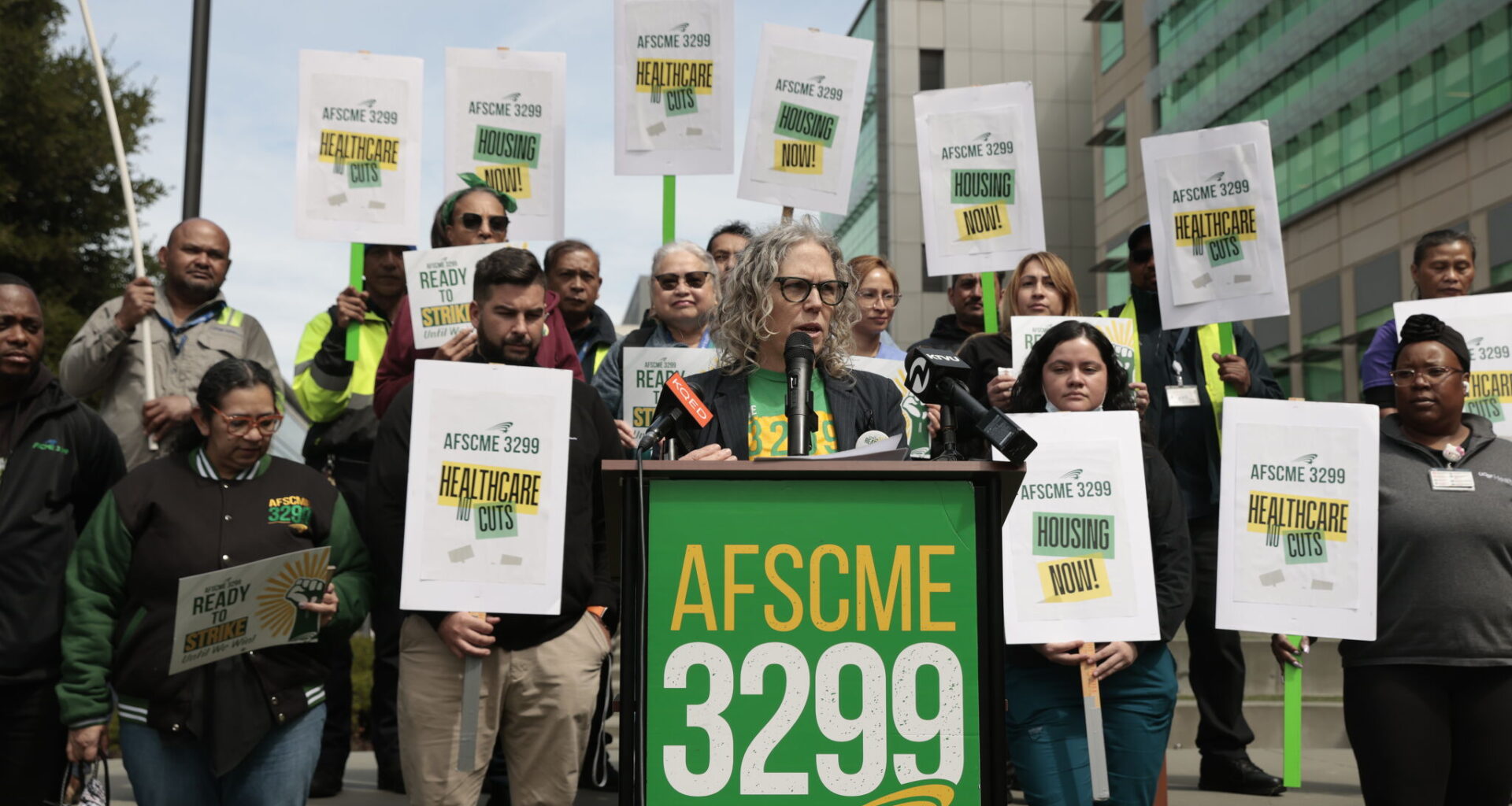
Kathryn Lybarger, executive vice president of AFSCME Local 3299, announces a planned open-ended strike in April at UCSF Mission Bay Hospital in San Francisco. A tentative agreement averted the strike, which had been planned to start Thursday morning.
Brontë Wittpenn/S.F. Chronicle
The union representing thousands of University of California medical and service workers reached a tentative labor agreement with UC early Thursday, narrowly averting an open-ended strike that had threatened to disrupt care at five medical centers and 10 campuses across the state.
About 40,000 members of AFSCME Local 3299 had been set to walk out in a labor dispute centered on pay and housing benefits for UC’s lowest-paid employees. Among those prepared to strike were radiology, lab and ultrasound technicians, respiratory and mental health therapists and nurses’ aides, as well as campus custodians, groundskeepers, security guards and food workers.
“We’re glad to have reached an agreement with AFSCME that recognizes the important work these employees do every day across UC’s campuses and health centers,” Missy Matella, UC’s associate vice president for labor relations, said in a statement. “This contract delivers meaningful pay increases and addresses some of the real affordability pressures our employees are facing, while allowing us to move forward.”
Article continues below this ad
The early morning pact followed around-the-clock bargaining and will go before union members for a ratification vote May 19-21. Contracts for the patient care and service workers expired in January 2024, and the union says its members earn an average of $62,000 a year.
Michael Avant, president of the American Federation of State, County and Municipal Employees Local 3299, said the tentative agreement “makes historic progress and delivers long-overdue security to the frontline service and patient care professionals who make UC run.”
San Francisco Chronicle Logo
Make us a Preferred Source to get more of our news when you search.
Add Preferred Source
According to AFSCME, key provisions include:
Pay increases: A $1,500 lump-sum payment and annual raises ranging from 4% to 6%, guaranteed 2% step increases each year and a minimum wage rising to more than $30 an hour by 2029.
Expanded wage protections: Guaranteed annual step increases for all workers, higher shift differentials and yearly lump-sum bonuses for employees at the top pay step.
Lower health care cost increases: A cap on employee health plan premium increases; union leaders say some rates could decline in 2027.
Stronger job and staffing protections, additional holiday benefits and leave.
Article continues below this ad
The contract would expire Nov. 30, 2029.
Avant said the tentative agreement gives workers “their largest wage increase ever and the most affordable healthcare rates at UC, alongside strong staffing and workplace safety protections.”
Earlier this week, UC officials had improved their offer to AFSCME, proposing a 34% pay increase over the life of the contract, up from 33% last month.
The union rejected the offer, noting that the proposal did not include the housing help that workers have been pushing for to help employees live closer to their jobs in high-cost regions.
It’s unclear what provisions the tentative agreement includes in this area, if any. AFSCME’s online announcement of the proposed deal said the union had gathered 1.3 million signatures to put a proposal on the California ballot for down payment loans for UC frontline workers.
Article continues below this ad
AFSCME had filed two unfair-labor complaints with the state, accusing UC of refusing to bargain over the housing aid, and of imposing working conditions the union had not agreed to.
Housing affordability was a major point of contention in the threatened strike.
While the union’s research indicates that UC’s revenues have steadily climbed and that its executives have been rewarded with lucrative pay and housing perks, AFSCME had said that its “frontline service and patient care workers are falling further behind.”
Ahead of the planned strike, the union shared stories of UC employees who sleep in homeless shelters, public housing, or their cars, or commute long distances to get to work because they can’t afford housing near their jobs.
The union has long pushed UC to provide down-payment housing assistance for its lowest-wage earners — custodians, food-service workers, drivers and data-entry clerks, for example — as it does for executives. California’s independent legislative analyst found that in 2023, UC gave executives 300 home loans totaling $296 million. The average loan was about $1 million and typically covered 90% of the home price. Not only did the loans have below-market interest rates, but the executives were also able to make down payments of just 10%, about half the usual rate.
Article continues below this ad
This week, UC Davis’ medical center emailed employees about participating in a food drive for employees and retirees, saying, “Did you know 50% of employees reported food insecurity across UC Davis in a 2025 survey? Want to help?”
“We got this email (unironically) asking us to donate to a food drive for our coworkers” because of the report, a UC Davis medical assistant and AFSCME member emailed the Chronicle. She criticized UC for earning “billions of dollars in profits while they tell their employees to get on food stamps.”
At UC Berkeley, which has no medical center but where many AFSCME members had been expected to strike, four commencement speakers sent a letter to UC President James Milliken and the UC regents saying they might not show up to send the students off.
“We are unwilling to cross a picket line,” wrote Alex Hanna, Veena Dubal, Laurie Palmer and Catherine Lhamon, who are respectively scheduled to address students’ sociology, geography, art practice and education ceremonies throughout the second half of May.
Noting that AFSCME workers are the “lowest paid workers in the UC system,” the letter said their “wages have been outpaced by inflation” and urged UC officials to “find a mutually agreeable contract before the graduation ceremonies begin.”
Article continues below this ad
Doctors and nurses were not part of the planned strike.
The union had alerted UC about the planned walkout in mid-April a month ago to give the medical centers — at UCSF, UC Davis, UC Irvine, UCLA and UC San Diego — time to create contingency plans to cover for the thousands of medical staff members who do MRIs and ultrasounds, mix chemotherapy, draw blood and perform numerous other key jobs that keep hospitals humming.