
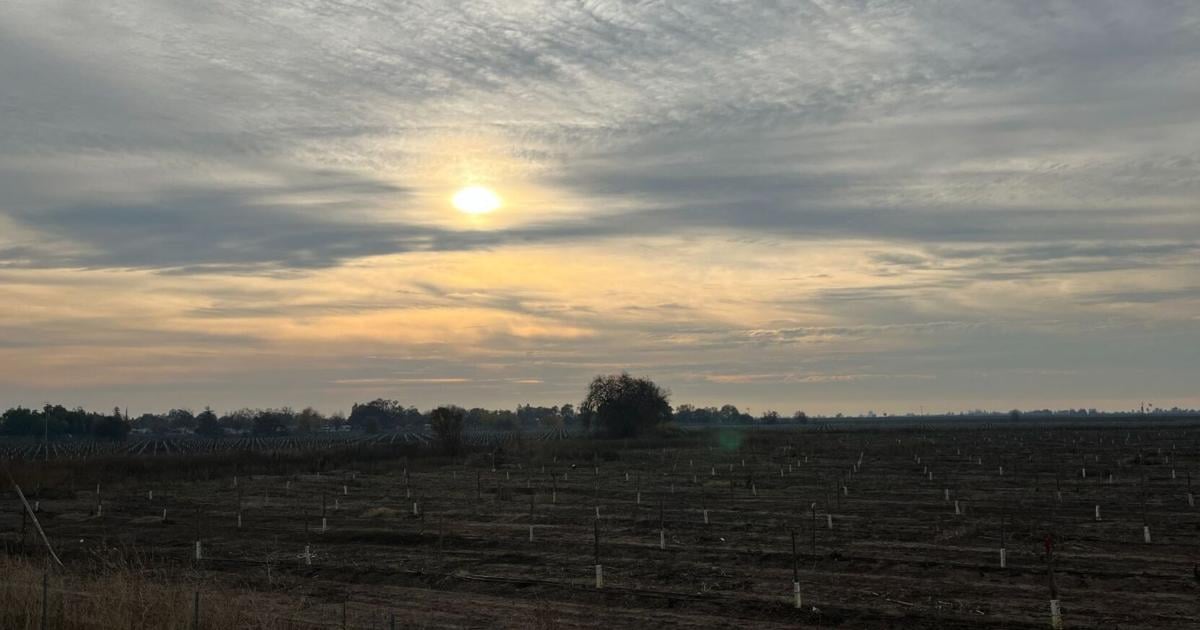
Kings and Fresno counties have some of the worst air pollution in the nation, according to a recently released American Lung Association “State of the Air 2026” report.
Local air quality isn’t just a violation of federal clean air regulations; it’s also a threat to the health and lives of residents. But recent federal actions may worsen air pollution in Kings and Fresno counties.
Both counties were designated as the most polluted places to live, with each receiving failing grades for ozone pollution, short-term particle pollution, and annual particle pollution. Only 20 counties across the U.S. failed all three measures.
Several local metro areas also have the distinction of ranking on the list of the top 25 U.S. cities most polluted by annual particle pollution list: the Bakersfield-Delano area was the most polluted, Fresno-Hanford-Corcoran was fourth, and Visalia was fifth.
Of the 25 most ozone-polluted cities, Visalia ranked second, Bakersfield-Delano was third, and Fresno-Hanford-Corcoran was fifth.
However, there is some good news. While the three metro areas still rank among the most polluted, Bakersfield-Delano, Visalia, and Fresno-Hanford-Corcoran each posted their best-ever numbers for short-term and year-round particle pollution.
But those recent gains are now under threat.
“The unprecedented federal attacks on California’s environmental protection efforts over the last year threatened the state’s ability to meet federal air quality standards, putting public health at risk for millions of Californians, especially those in the most polluted communities,” said Steven S. Cliff, executive officer of the California Air Resources Board.
As a result of federal rollbacks of state and federal regulations, emissions from motorized vehicles will increase by 42% by 2037. That increase in pollution will result in more than 14,500 deaths, 5,000 additional hospitalizations, 6,700 additional emergency room visits, and $145 billion in health care costs, said Austin Hicks, air pollution specialist at the California Air Resources Board.
While federal regulations prohibit states from enacting emission standards for new motor vehicles, California can request a waiver from the Environmental Protection Agency before the state can enact its own standards under the Clean Air Act.
In May 2025, Congress passed resolutions that override the EPA’s granted waivers for six clean vehicle rules, throwing the programs into uncertainty. California is challenging the laws in court.
The Clean Air Act requires the Environmental Protection Agency to set limits for dangerous air pollutants. Areas that fail to meet those standards must submit state implementation plans, which describe how those areas will attain national ambient air quality standards within a set deadline. The South Coast and San Joaquin Valley must reach attainment by 2037.
In January 2026, the EPA issued a partial disapproval of California’s state implementation plan for the Clean Truck Check program, which tests emissions control systems of heavy-duty vehicles driving on California roadways. While Clean Truck Check rules will continue to be enforced, the EPA’s partial disapproval means that the decrease in emissions generated by the program will not be counted towards the state’s requirement to meet national ambient air quality standards. That means more regulations will be needed to make up for this shortfall.
Because of the loss of expected emission reductions, local air districts like the San Joaquin Valley Air Pollution Control District, which oversees the Central Valley, may not be able to meet federal standards. Twenty four months after the EPA makes a determination that an area has not met a State Implementation Plan requirement, federal highway funding is withheld.
Because the California Air Resources Board and the San Joaquin Valley Air Pollution Control District already have some of the most stringent controls in the nation, identifying new control measures that will reduce emissions and air pollution is a significant challenge, said Ariel Fideldy, air quality planning branch chief at the California Air Resources Board.
The EPA has also repealed all greenhouse gas emission standards from its regulations for motor vehicles. The National Highway Traffic Safety Administration has also proposed rolling back fuel economy rules for passenger cars.
During the Biden administration, the EPA strengthened regulations on particulate matter by lowering the amount of allowed PM2.5 pollution.
“This was a monumental step forward,” Hicks said. Attaining the new 9 micrograms per cubic meter standard across California would avoid up to 2,050 early deaths each year.
But the EPA missed implementation deadlines for new particle pollution standards in February.
“The failure to designate areas in need of additional pollution controls represents an unnecessary and deadly delay in reducing exposures to harmful levels of fine particle pollution across the United States,” said the “State of the Air” report.
These federal actions will increase nitrogen oxide, or NOx, pollution by 165 tons per day by 2037. That increase is larger than the emissions from all of the medium and heavy duty trucks and buses operating in California today. Increased nitrogen oxide emissions lead to an increase in ozone and particulate matter pollution, said Hicks.
However, Sacramento is moving forward with clean air initiatives. Gov. Newsom’s Executive Order N-27-25 directed the California Air Resources Board to initiate development of the next generation requirements for clean cars.
“CARB is pursuing all regulatory and non-regulatory pathways available to us to continue air quality progress in the future,” Hicks said.
Among those under consideration are new tailpipe emission standards for passenger cars, new greenhouse gas standards for medium- and heavy-duty vehicles, green zones for clean electric vehicle vehicles, and more.
“Even with this long list of potential regulations and other creative approaches identified thus far, CARB cannot backfill the entire shortfall in emission reductions,” Hicks said. There remains an emissions reduction gap of approximately 91 tons per day of NOx in 2037 still needed to meet air quality standards.
“California has been clear that federal actions will not stop us from pursuing cleaner air,” said California Air Resources Board Chair Lauren Sanchez. “The health and wellbeing of communities across this state depends on it.”
Fine particle pollution can be very dangerous to breathe and can trigger illness, hospitalization and premature death, according to the American Lung Association.
Researchers estimate that PM2.5 is responsible for more than 50,000 premature deaths annually in the U.S. There is no safe threshold of PM2.5 exposure; even short-term spikes in fine particle pollution lasting from a few hours to a few days can kill.
When nitrogen oxides and volatile organic compounds “cook” in the sunlight, ozone forms in the atmosphere. Rising temperatures from climate change have contributed to ozone pollution. Ozone is a lung irritant that harms the respiratory system, and exposure can cause respiratory symptoms, decreased lung function, and even death. There is no known safe level of ozone exposure.
Children, people over 65, people with health complications, people of color, and people with low incomes are particularly at risk of health impacts. A 2024 study of U.S. children found that early life exposure to PM2.5 significantly increased asthma incidence in early and mid-childhood.
“We must oppose actions that delay and even reverse the crucial progress we have made and must continue to make. We must do this to give our next generations an opportunity to have healthy lungs, develop, grow and be as healthy and as functional as they possibly can,” said Afif El-Hasan, MD, physician-in-charge at Kaiser Permanente San Juan Capistrano Medical Offices.