
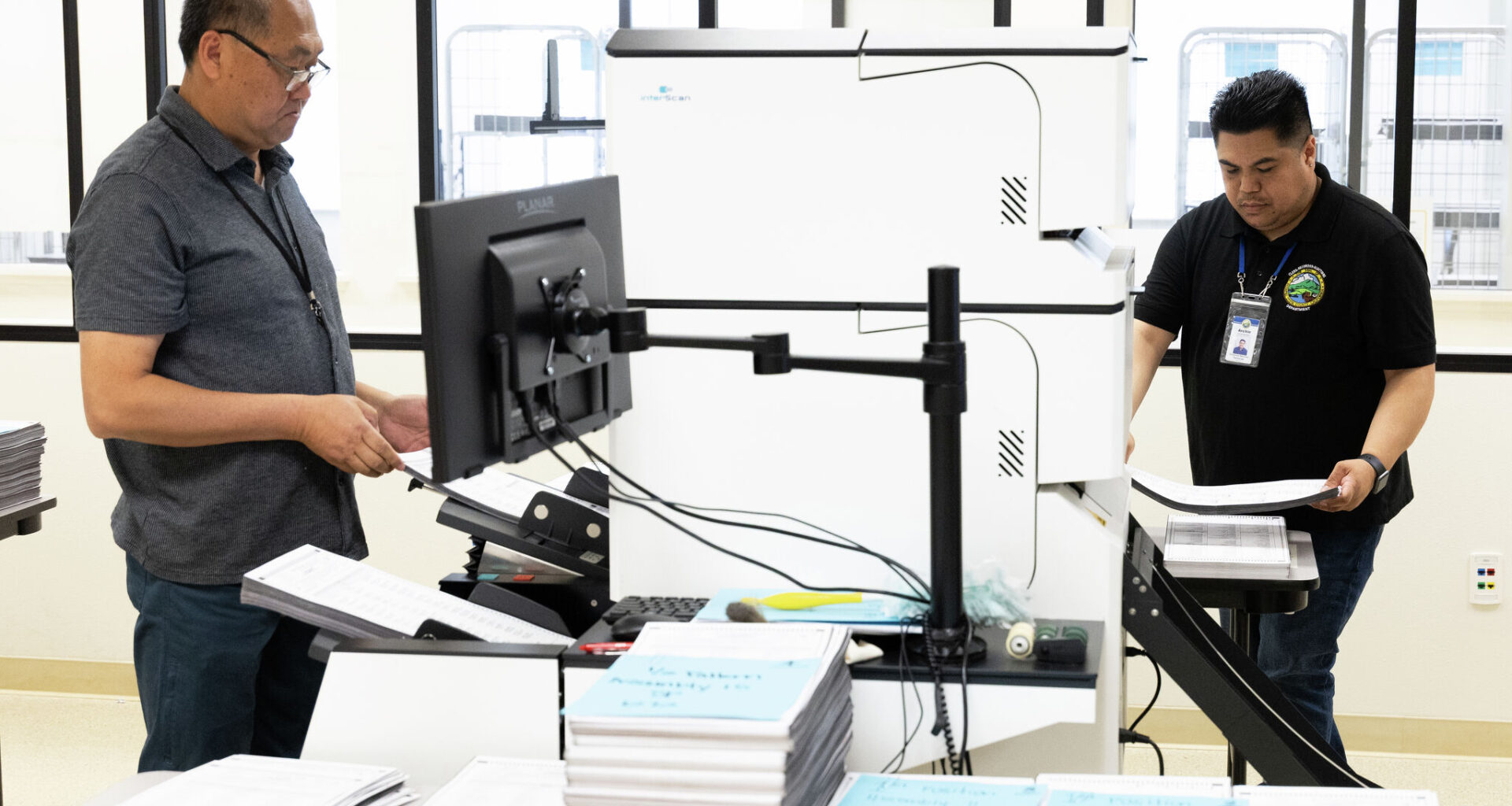
A team processes test ballots at Contra Costa’s election offices in Martinez on May 8, 2026. The Contra Costa County Elections Division performed the county’s official logic and accuracy testing on central ballot tabulation and processing equipment.
Benjamin Fanjoy/For the S.F. Chronicle
Kim Buck watched as test ballots zipped through a high-powered scanner to tabulate dummy results at Contra Costa County’s voting headquarters in Martinez.
The mandatory equipment test was Buck’s latest lesson as a student of the democratic process. Buck, a self-described life-long learner who retired from a career in finance, likes to know how stuff works. But she’s also been increasingly struck by odd — and, often, paranoid — questions she receives as a poll worker. That’s what brought her to a recent election office tour, which focused on how votes are counted or adjudicated when marked in a way machines can’t process.
Buck started volunteering at the Contra Costa County polls in 2021 — a time when voter skepticism intensified because President Donald Trump refused to accept his loss to President Joe Biden and election result deniers stormed the Capitol.
Article continues below this ad
Since Trump’s attempts to overturn the 2020 election, county clerks and registrars across California have created, expanded and better advertised programs aimed at voting transparency — like the tours and classes Buck attends. That work has ramped up as election officials prepare for the state’s June 2 primary.
Buck recalled a back-and-forth with a voter in 2024 who warned her poll workers like her were “controlled by the Chinese.” She had to reassure another man his mail-in ballot wasn’t “encrypted” with identifying information.
San Francisco Chronicle Logo
Make us a Preferred Source to get more of our news when you search.
Add Preferred Source
“That’s an example of a lot of the skepticism and paranoia that is brewing out there,” she said. “I’d like to be able to tamp down, at least what comes my way.”
In January, Trump repeated on social media unsubstantiated allegations about voting machine manipulation and foreign interference in the 2020 race that have been repeatedly disproven and rejected by the courts. On Mother’s Day, he wrote that Democrats were “totally unhinged” and said he wouldn’t let them “threaten the integrity” of the upcoming elections.
Article continues below this ad
“The Republicans had an Election Integrity Army in every single State to preserve the sanctity of each legal vote,” Trump wrote of the 2024 elections on Truth Social. “We will be doing the same again in 2026, but it will be much bigger and stronger.”
President Donald Trump answers questions after signing an executive order to limit mail-in voting as Secretary of Commerce Howard Lutnick looks on in the Oval Office on March 31, 2026 in Washington, D.C.
Alex Wong/Getty Images
Republicans in California have taken up Trump’s cause and adopted his rhetoric, sewing doubt among their supporters about election security. County registrars, who take an oath to follow state and federal laws, are alarmed by the recent actions of Riverside County Sheriff Chad Bianco, a Republican candidate for governor, who seized more than 650,000 ballots as part of an investigation into dubious election fraud claims.
Attorney General Rob Bonta and Secretary of State Shirley Weber have condemned Bianco’s actions, and the California Supreme Court has blocked his investigation from moving forward. This week, it ordered Bianco to produce evidence within 30 days demonstrating why the court shouldn’t permanently halt his probe. Michael Gates, who is running for attorney general, was part of the Department of Justice efforts under Trump to force Orange County to turn over its voter rolls. Courts in several states, including California, have shot down the demand.
Two Republican state lawmakers have successfully pushed to place a voter ID measure on the November ballot that, if passed, would require voters to show proof of citizenship before they can cast a ballot. Currently, California voters only need to show an ID and Social Security number when they register to vote.
Article continues below this ad
In Contra Costa County, Clerk-Recorder Kristin Connelly helps lead the “Certified Election Observers” program, of which Buck is a student. During the first class this voting cycle, one attendee incessantly asked questions about non-citizens voting in federal and state elections. It was clear he came with a mission, Buck said. When Connelly pointed to the miniscule percentage of voter fraud found in the state, he didn’t seem satisfied.
“He didn’t come back,” Buck said.
Sylvia Santiago-Mejia adjudicates test ballots at Contra Costa’s election offices in Martinez on May 8, 2026.
Benjamin Fanjoy/For the S.F. Chronicle
The program is intended to help fight misinformation. Connelly said the most satisfying outcomes are when skeptics leave classes and tours understanding the policies, time and care that goes into collecting and counting votes. Not everyone’s mind is changed, she said. Still, it’s important for election offices to show “they’re an open book,” she added.
“We want people to learn more, we want people to have their questions answered, and that does become more important than ever because, pick any number of polls, there’s all kinds of decline in trust in institutions,” Connelly said. “It’s really important to our representative democracy that people feel like their vote counts and that every vote is counted and that people don’t get to vote more than once.”
Article continues below this ad
Los Angeles County Registrar-Recorder/County Clerk Dean Logan said the design of the county’s sprawling ballot processing center that opened in 2024 was created with transparency in mind. The tally room is enclosed in glass so observers can easily look in. During election season, escorts take visitors to see mail-in ballots get processed through sorting machines.
“When people come to see that, I think it does give them a sense of how serious and secure the process is,” Logan said, “and a sense of comfort that despite all the noise they’re hearing, there’s a purpose to that processing.”
Los Angeles County, like many others, also livestreams the process beginning when the ballots arrive to when signatures are verified and votes tallied. Throughout May, election offices will be receiving steady streams of mail-in ballots from the Post Office and drop-off boxes. Given Los Angeles County’s size — with more than 5 million registered voters — its bustling operations look like a buzzing Amazon warehouse.
It isn’t required by law to stream the counting process, but Brittany Stonesifer, a voting rights advocate with nonprofit California Common Cause, said the number of counties doing so continues to grow — as does the number of election offices advertising tours and other accessible education, she said.
A voting box rests outside Contra Costa’s election offices in Martinez on May 8, 2026.
Benjamin Fanjoy/For the S.F. Chronicle
The California Voter’s Choice Act, which was signed into law in 2016, granted counties more flexibility to create an election model that prioritized convenience for voters. Stonesifer said those changes — mailing every voter a ballot, expanding in-person early voting, allowing voters to use any polling location in their county — set some groundwork for educational and transparency-focused programs.
Article continues below this ad
“But a lot of counties have kind of expanded further beyond that,” she said. “They definitely seem to have gotten more popular among general voters and community members. I think at first, it was a lot of voting rights organizations that were showing up.”
She’s attended tours and community meetings in Los Angeles and Orange counties. She said typically, they’re productive and informative. But they can also turn into an “airing ground,” where people try to spread misinformation about voter fraud or election workers.
Marin County Registrar of Voters Natalie Adona said the current political climate has some visitors coming in with assumptions that something is “wrong or bad” that guides their questions. Her team recently updated the pamphlets they give to visitors so they can better understand what they’re seeing as it happens. When it comes to access, Adona said she “tries to say, ‘yes’ as much as possible.”
“The truth is that the election’s process has always been open to people, it’s just only in recent years have people actually been interested in coming,” she said.
Adona is new to her role in Marin County, but she has worked across Northern California election offices for the last 17 years. She — like her colleagues — was shaken by the recent seizure of ballots in Riverside County. Adona said Bianco’s actions raise major alarm bells over ballots’ chain of custody and election interference. Sealed ballot boxes aren’t supposed to be opened unless they’re part of a formal recount or challenge. She said she once had to sue herself in court to get a judge’s permission just to open ballots she wanted to check weren’t turning moldy because of damage from a snowstorm.
“That’s how seriously me and my colleagues take this,” she said.
Stonesifer said the biggest change among counties in response to Trump’s comments suggesting rampant voter fraud — and the FBI’s seizure of ballots in Fulton County, Georgia in 2020 — has been better coordination between counties and the state attorney general. The attorney general’s office sends out bulletins about who to contact if federal immigration officers, National Guard officers or anyone else arrives at polling places and defies anti-voter intimidation laws.
A protester interrupts a news conference by Clark County Registrar of Voters Joe Gloria discussing ballot counting at the Clark County Election Department on Nov. 4, 2020 in North Las Vegas, Nevada.
Ethan Miller/Getty Images
“Before the last few years, we didn’t think that we needed to prepare for things like ICE at the polls,” Stonesifer said. “That has been something that both organizations and counties and the state have all increased their scenario planning and their communication and rapid response systems for.”
Buck, the poll worker, will be working the upcoming primary election on June 2. It’s a long day — usually around 15 hours.
“I’m more and more concerned about our democracy and more and more resolute that it’s really important that we maintain it,” she said. “So this is the way I wanted to be of help to do that.”