
Nearly every cable car has a secret. Hidden underneath the many of the benches — alongside GPS and electrical equipment — are small time capsules placed by the carpenters who repair the cars. Mark Sobichevsky, the longest-tenured employee of the Cable Car Carpentry Shop, who has been there 25-odd years, has tucked away photos of his granddaughters, and during the pandemic etched a phrase in one car that summed up his sentiments about the city at the time: “Should I stay or should I go?” It’ll likely be decades before the mementos are found by the next generation of carpenters.

As far as this generation goes, foreman Joseph Byrne is “the baby” of the group at 57 years young. The four-man team, with several lifetimes’ worth of experience among them, wake up at 4:45 a.m. every day to clock in by 6 a.m. at an idyllic light-filled Dogpatch workshop. Sobichevsky jokes that the coffee is his favorite part of the job.
“I love my job. So is it really a job if I love it? It’s like arts and crafts, that’s what’s keeping me here. I’m not building a house, I’m dealing with small pieces of wood,” he said.
Article continues below this ad
Carpenter Mark Sobichevsky talks about a cable car being rehabilitated at the Cable Car Carpentry Shop in San Francisco on May 8, 2026.
Douglas Zimmerman/SFGATE
Carpenter Luis Ferreira at the Cable Car Carpentry Shop in San Francisco on May 8, 2026.
Douglas Zimmerman/SFGATE
A vintage cable car being rehabilitated at the Cable Car Carpentry Shop in San Francisco on May 8, 2026.
Douglas Zimmerman/SFGATE
The enthusiasm runs through the rest of the team, who gave me a tour of the carpentry shop on a sunny Friday afternoon. There’s a high bar for joining the crew, with requirements including a four-year apprenticeship to become a journeyman before qualifying to even take a test to become a city carpenter. Currently the staff is all men, but a woman, Jane Koski, previously held the supervisor position for about 10 years. The whole shop smells like a freshly shaved No. 2 pencil, with piles of wood everywhere — long planks of white oak, mahogany, Douglas fir, Alaskan cedar — along with foreboding table saws and sharp wood shapers.
Article continues below this ad
“You better not be thinking about nothing else — your girlfriend, whatever. You’ve gotta be thinking about your fingers,” said Sobichevsky of the tools. Thankfully, the crew’s safety record is spotless.
Make SFGATE a preferred source so your search results prioritize writing by actual people, not AI.
Add Preferred Source
“We all have all our fingers,” said Keith McCombs. “… Since I’ve been here, November will be 11 years, no one has had a serious injury.” (Sobichevsky notes that one former worker did lose a thumb).
Carpenter Keith McCombs shows off a wooden brake block used to brake a cable car at the Cable Car Carpentry Shop in San Francisco on May 8, 2026.
Douglas Zimmerman/SFGATE
A tool used by carpenter Mark Sobichevsky at the Cable Car Carpentry Shop in San Francisco on May 8, 2026.
Douglas Zimmerman/SFGATE
Carpenters Keith McCombs and Joseph Byrne show the metal coverings used on the front of a cable car at the Cable Car Carpentry Shop in San Francisco on May 8, 2026.
Douglas Zimmerman/SFGATE
Although the carpentry shop feels firmly frozen in time — I didn’t notice a single computer as we tour the warehouse — the cable car system itself is at an inflection point. In April, San Francisco Municipal Transportation Agency approved a new fare structure, with the $9 ticket rising to $12 in 2027 and $18 in 2028. Single-ride tickets will be phased out, with these new prices entitling riders to unlimited Muni travel. It’s part of an initiative to combat SFMTA’s $307 million budget gap. The cable cars themselves also historically run in the red, with a 2019 study by the Cato Institute evaluating the cost of the program at $70 million while collecting $24 million in revenue. More recent data from a San Francisco Bay Area Planning and Urban Research Association (SPUR) study cites the cost of operating the cable car system at $871 per hour of service, nearly three times that of a Muni bus. According to SFMTA, operating costs for the cable cars amount to roughly $20 per ride.
Article continues below this ad
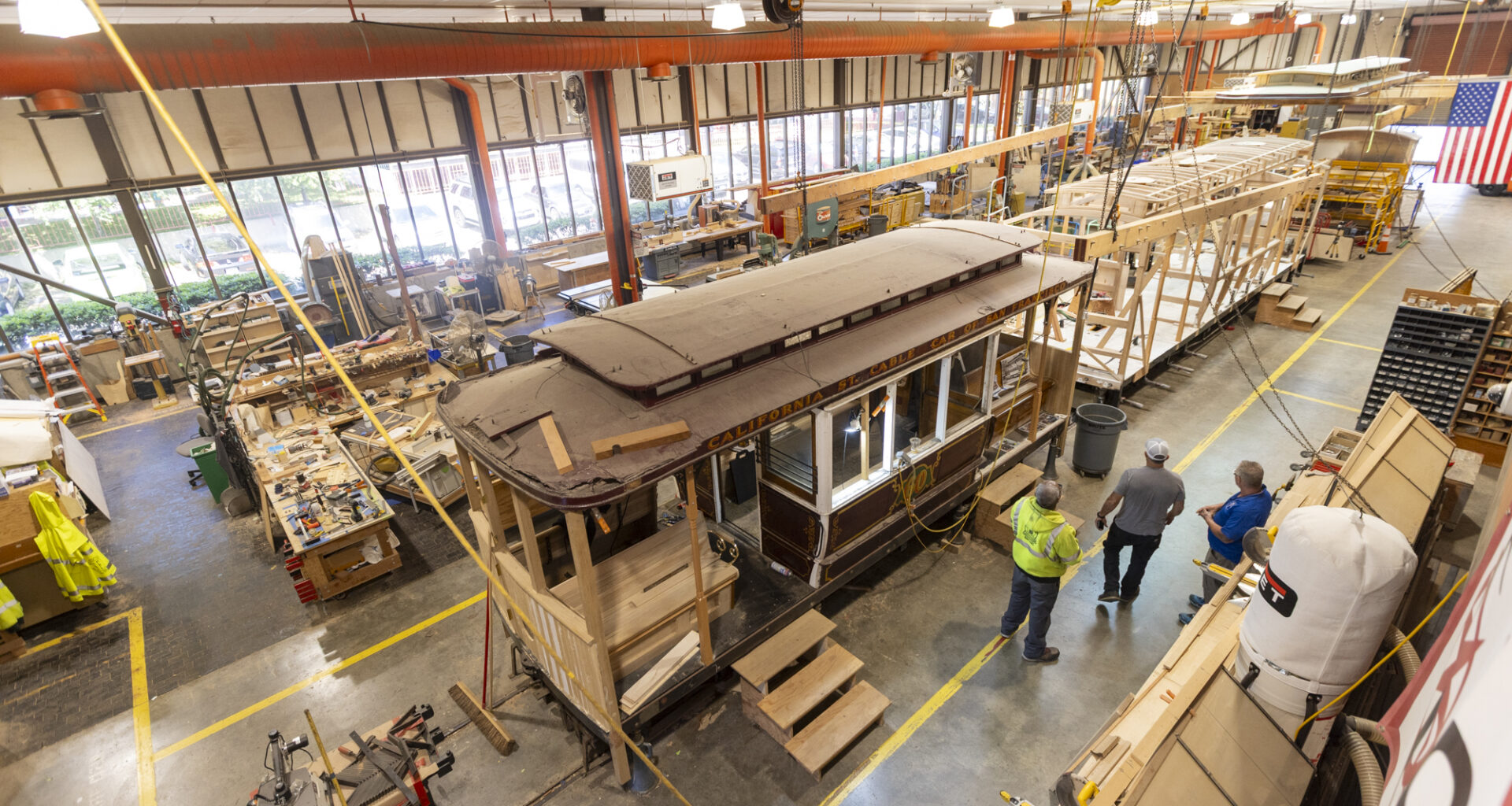
The budgetary concerns aren’t a surprise considering that the main car that they’re currently working on — No. 54, a California Street cable car built in 1907 — has already been in the shop for over a year. The job is essentially a complete rehab, with the old roof removed from the frame and hanging on wires overhead. The car’s design was revolutionary at the time for having open sections on both ends, allowing it to be operated from either side, and ultimately became the standard for the San Francisco fleet.
When Car No. 54 arrived at the shop in early 2025, much of the wood was completely rotten.
“It’s like the emergency room, we are getting them when they’re on their last heartbeat and we bring’em back to life,” said McCombs.
A vintage cable car being rehabilitated at the Cable Car Carpentry Shop in San Francisco on May 8, 2026.
Douglas Zimmerman/SFGATE
Carpenter Luis Ferreira talks about the work being done on the structure of a cable car being rehabilitated at the Cable Car Carpentry Shop in San Francisco on May 8, 2026.
Douglas Zimmerman/SFGATE
Some of the newly made wood features, a railing and a wooden light fixture, on the structure of a cable car being rehabilitated at the Cable Car Carpentry Shop in San Francisco on May 8, 2026.
Douglas Zimmerman/SFGATE
Sometimes conductors actually take a liking to the older cars, no matter how dilapidated.
Article continues below this ad
“What’s ironic is that the drivers like the old car because it was soft,” said Byrne. “Except when it rained, because the rain would come through the roof. They said it was the softest because it was all dry-rotted.”
The car is essentially being rebuilt from the frame up, a task that Byrne estimates will take another 16 months. There’s something skeletal about the car in its current state, the unstained white oak like bones, connected with smooth joinery that the carpenters show off with workman’s pride. Carpenter Luis Ferreira points to one particular butterfly joint, a 3-inch, hour-glass-shaped, darkly grained oak endpiece that slides absolutely perfectly into the larger wood frame.
“Whatever is exposed, you don’t see nails, you don’t see screws, it’s just snug,” said Ferreira.
Article continues below this ad
Carpenter Luis Ferreira holds pieces of thin wood pressed together and curved that are used for the roof of a cable car, at the Cable Car Carpentry Shop in San Francisco on May 8, 2026.
Douglas Zimmerman/SFGATE
A wooden joint fixture attached together on the structure of a cable car being rehabilitated at the Cable Car Carpentry Shop in San Francisco on May 8, 2026.
Douglas Zimmerman/SFGATE
Carpenter Mark Sobichevsky shows a workstation used to cut pieces of wood at the Cable Car Carpentry Shop in San Francisco on May 8, 2026.
Douglas Zimmerman/SFGATE
Byrne walked me over to a drafting table covered in large blueprints that break down the composition of the cars, which serve as a primary road map for recreating the many intricate parts that make up the body of a car. Sometimes, to make up for gaps in the blueprints, they’ll go out and measure other cars built during the same time period. It allows them to manufacture 98% of the parts in-house, with only rare specialized parts, like light fixtures, being outsourced.
Article continues below this ad
“It’s a big puzzle that needs to be put together,” said Ferreira. “Sometimes you grab a piece of material, you work on it, a week goes by. You twist on this, it cracks, you’ve got to start all over.”
Damage is visible on the top of a cable car at the Cable Car Carpentry Shop in San Francisco on May 8, 2026.
Douglas Zimmerman/SFGATE
Carpenter Keith McCombs shows a wooden bench that he helped built for a cable car being rehabilitated at the Cable Car Carpentry Shop in San Francisco on May 8, 2026.
Douglas Zimmerman/SFGATE
Window frames and broken windows on the upper part of a cable car being rehabilitated at the Cable Car Carpentry Shop in San Francisco on May 8, 2026.
Douglas Zimmerman/SFGATE
There’s something distinctly zenlike about how the carpenters describe their work of upkeep for one of the city’s most iconic elements.
Article continues below this ad
“It’s creating something from a blank piece of wood, creating it and seeing it put to use and people enjoying our craftsmanship,” said McCombs.
Ferreira thinks that the cable cars are such an enduring symbol that they should exist beyond just city streets and the Cable Car Museum. As he toured me through the lofted storage space, he pitched the idea of putting a cable car in the airport as a symbol to greet tourists, proposing that they could build a small car from scratch for the purpose. There’s a precedent for such a car — in the back of the workshop waiting to be repaired sits a shorter “Dinky” car, only three of which exist in the world.
A vintage cable car being rehabilitated at the Cable Car Carpentry Shop in San Francisco on May 8, 2026.
Douglas Zimmerman/SFGATE
Left to right, carpenters Mark Sobichevsky, Keith McCombs, Joseph Byrne, and Luis Ferreira at the Cable Car Carpentry Shop in San Francisco on May 8, 2026.
Douglas Zimmerman/SFGATE
Pictures show a vintage cable car that was turned into a cable car on wheels that is being rehabilitated into a cable car on rails at the Cable Car Carpentry Shop in San Francisco, on May 8, 2026.
Douglas Zimmerman/SFGATE
As for Sobichevsky, it’s enough just to see the cable cars in action.
Article continues below this ad
“I bring my granddaughter down to the turnaround and we ride the cars I build. I mean, this is my life. She appreciates it, my daughter appreciates it. I actually go down there and they let me in and talk to the conductors. And I’m like, ‘I built that.’”