
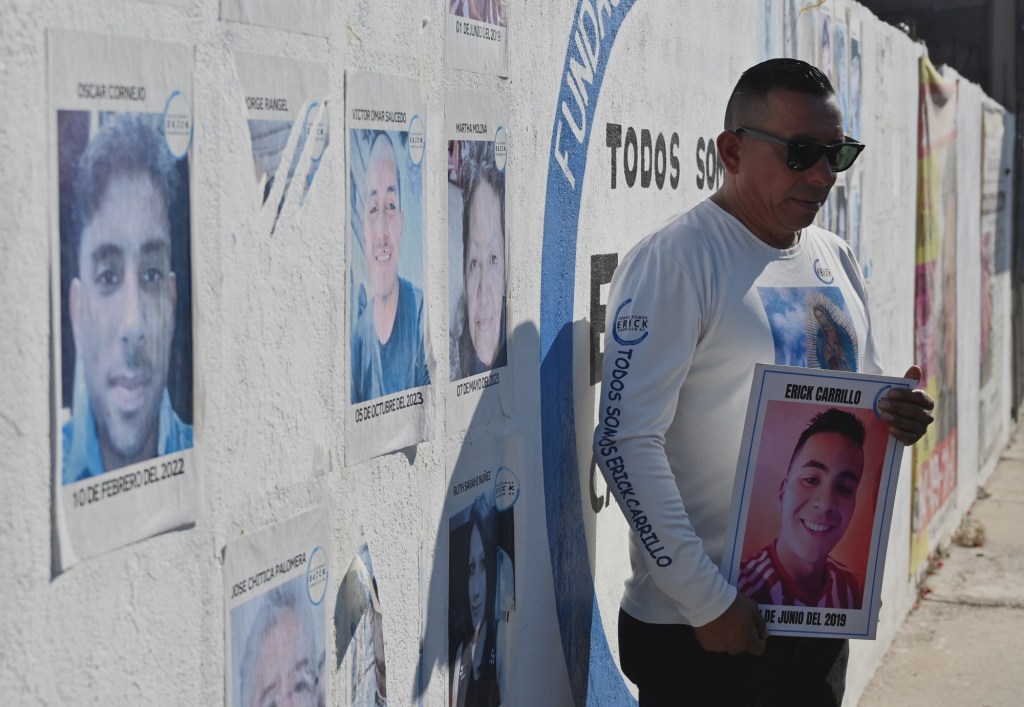
Since 2006, the number of persons who have gone missing in Mexico is estimated to have surpassed 130,000. The Office of the High Commissioner for Human Rights and the United Nations Committee on Enforced Disappearances have requested that U.N. Secretary-General António Guterres bring Mexico’s crisis before the General Assembly. The Committee on Enforced Disappearances warns that Mexico faces a serious problem requiring international aid to prevent enforced disappearances, which constitute crimes against humanity.
This includes cases in Baja California, where in 2025, Gov. Marina del Pilar Ávila Olmeda halted search efforts at a clandestine grave site in Tijuana, reportedly out of fear of discovering an even larger number of bodies. The exact count from this excavation remains undetermined — a fact that precluded a comparison with the notorious site in Teuchitlán, Jalisco.
President Claudia Sheinbaum rejected the U.N. report, as well as international assistance intended to prevent, investigate, punish and eradicate these crimes. The Mexican federal government denied a reality that requires external support, particularly in Tijuana, Tecate and Mexicali, where migrants in transit are highly vulnerable. The administration emphasized that the disappearance crisis originated in 2006 and stated that “the Mexican government does not tolerate, permit or support disappearances,” even as the numbers continue to climb.
One of the books that best describes the Mexican state’s current attitude is “The Philanthropic Ogre.” In this allegory by Octavio Paz, the “ogre” is the state — a fearsome monster that imposes order — but one that is also “philanthropic” because it protects the population.
From 1993 to 2005, border city Ciudad Juárez, Chihuahua, registered 379 femicides, while Baja California recorded 323 from 2002 to 2006. These figures indicated that Baja California had already become a higher-risk area for women, yet a gender alert was never implemented.
At the onset of this violence, Mexican academic and researcher Guillermina Baena Paz coordinated the book “Seguridad Humana, posibles soluciones a un conflicto” (“Human Security: Possible Solutions to a Conflict”) in 2009. In the essay “¿Cómo detener a los sicarios de la democracia? Baja California y la teoría del queso gruyère en la seguridad mexicana” (“How to Stop the Hitmen of Democracy? Baja California and the Swiss Cheese Theory in Mexican Security”), I examined the violent deaths and documented disappearances at the border since 2007.
The text raised critical questions: “Does an individual accused in more than 300 cases expose a crime against humanity that warrants prosecuting the government itself? How many crimes can one person commit before being captured by law enforcement? How much can civil organizations tolerate before initiating a political trial for the incompetence of the police and the public prosecutor’s office?”
The authoritarian “philanthropic ogre” no longer exists; it was buried by the state reforms pushed by Mexican President Ernesto Zedillo. These reforms granted autonomy to the judicial and legislative branches and established independent bodies for transparency, accountability and elections. These — along with other institutions like the National Human Rights Commission — formed the institutional bedrock necessary for free trade to function within a democratic society.
While these reforms allowed for a transition of power, they also created institutional power vacuums. In a weak democracy, these gaps were seized by criminals and have not been reclaimed by the state. Despite the grim death tolls and national mourning, Mexico’s issue is not just insecurity, but a lack of governability. The challenge is to recover democratic governance. Today, international cooperation is essential to foster institutions that guarantee peace, the rule of law and the sanctity of human life.
Saldaña Téllez, Ph.D., is a sociologist and author of “Tijuana: Walls and Borderlines” who lives in Rosarito. This was translated from Spanish by a member of the editorial board.