
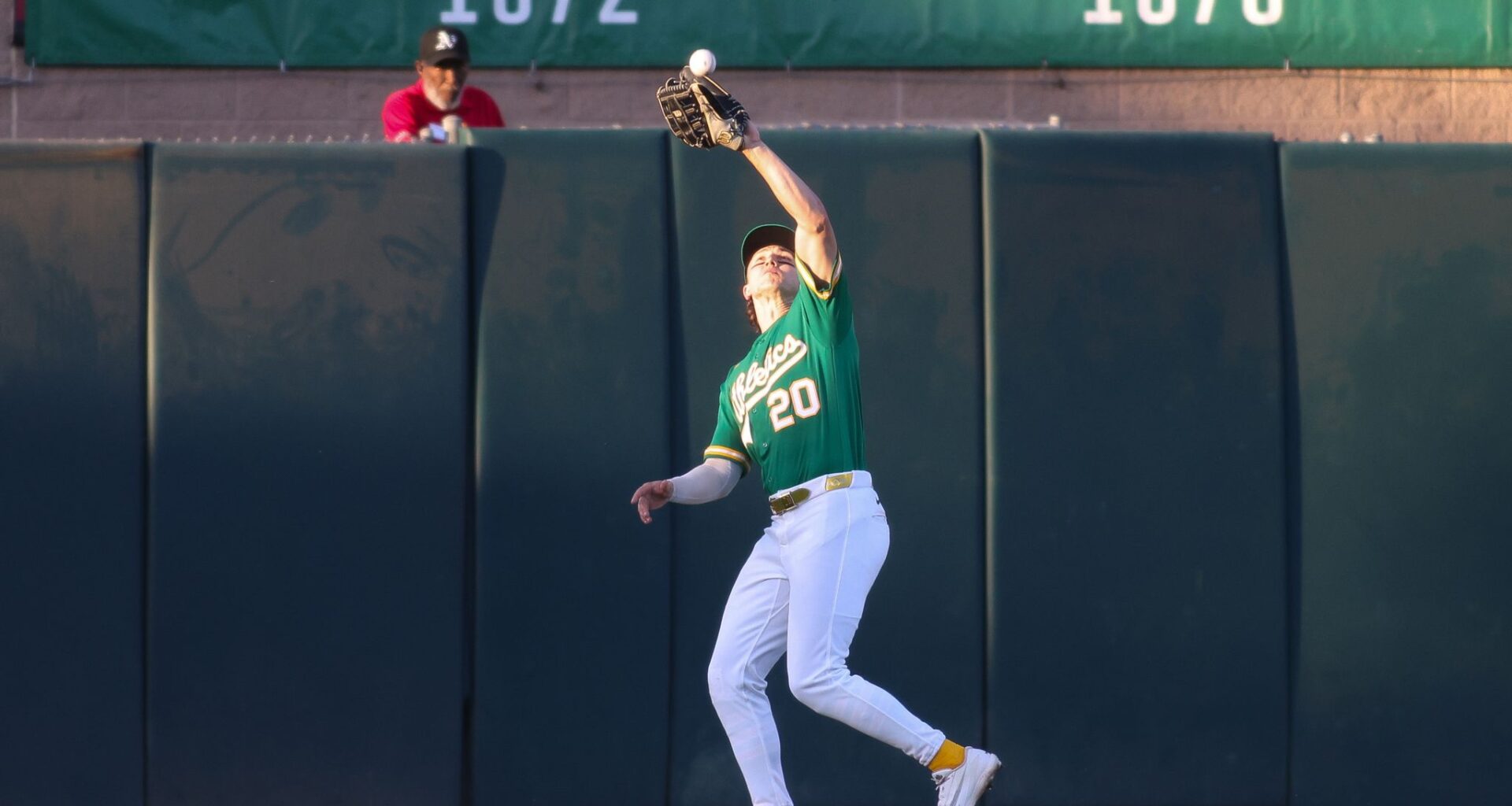
A’s center fielder Zack Gelof catches a flyball at Sutter Health Park in West Sacramento in April. A forecast of strong wind gusts could make flyballs an adventure when the Giants and A’s meet there Sunday.
Scott Marshall/Associated Press
The San Francisco Giants’ struggle to deliver power was expected to meet a new force this weekend, and it wasn’t to be an opposing pitcher or an injury that challenged their bats. Strong winds were forecast for Sutter Health Park in West Sacramento this weekend, peaking Sunday when the Giants take on the Sacramento A’s at 1:05 p.m.
Gusts were expected to be so strong that flyballs could be pushed 115 feet toward home plate, according to Ken Arneson, chief technology officer at Weather Applied Metrics. It would be the biggest deflection Weather Applied Metrics has measured since 2023, when the company partnered with Major League Baseball to track weather impacts at all stadiums.
“If the wind forecast stays as it is, flyballs to left field are going to get absolutely clobbered,” Arneson said Friday.
Article continues below this ad
The forecast Sunday afternoon calls for sustained northerly winds of 25 mph and gusts up to 40 mph, making for wind blowing in from left field at Sutter Health Park.
A’s southpaw Jeffrey Springs is slated to take the hill; the Giants could be expected to counter with a righty-heavy lineup, which could add even more drama to flyballs pulled down the left-field line.
San Francisco Chronicle Logo
Make us a Preferred Source to get more of our news when you search.
Add Preferred Source
Giants manager Tony Vitello said he may be inclined to alter the lineup.
“It depends on if he’s a flyball guy,” Vitello said.
Article continues below this ad
Springs has surrendered seven home runs through nine starts, tied for ninth among American League starters before Friday’s games. His flyball rate was the ninth highest in the majors among qualified starters.
The National Weather Service also forecasted gusts of 37 mph at 2 p.m. Saturday. In those conditions, flyballs to left were projected to be pushed toward home plate by as much as 115 feet, Arneson said. That means a would-be home run in calm conditions has a better chance of ending up as a bloop single amid the winds if the outfielder misreads it. Flyballs to center could lose more than 50 feet of distance, while wind could add 20-plus feet of distance to balls hit toward the right-field foul pole.
Right-hander Adrian Houser was scheduled to start for the Giants. Reigning American League Rookie of the Year Nick Kurtz anchors the A’s lineup, batting from the left side. That wind figured to give Kurtz and other left-handed hitters on the A’s roster a boost.
“I think if you made one change because of it, it would be outfield as opposed to lineup,” Vitello said. “I think there’s an argument for both.”
Vitello hinted that outfielder Harrison Bader was left out of the lineup against the Dodgers on Thursday to keep him fresh for a tougher defensive ballpark in Sacramento. Bader continues to work his way back from a hamstring injury.
Article continues below this ad
The current record flyball deviation in Weather Applied Metrics’ archive came on Opening Day this year, when the Chicago Cubs’ Ian Happ clobbered a would-be home run, except the wind pushed the ball in 113 feet, where it fell harmlessly into the glove of Washington Nationals left fielder James Wood.
Weather Applied Metrics operates three-dimensional physical models of every MLB ballpark’s typical wind patterns. Models ingest data from weather sensors installed throughout the ballpark the model to generate a real-time calculation of atmospheric effects on the game.
In 2025, the first MLB season at Sutter Health Park, 56 wind-aided home runs were measured. The evening delta breeze almost always carries balls toward center during evening games.
But winds this weekend were expected to be blowing in the opposite direction, out of the north, preventing potential home runs. Friday wasn’t predicted to be too windy, but early-inning gusts Saturday were expected to play a factor. The first two games weren’t expected to be anything like Sunday’s stiff north breeze.
Pitchers could also be affected by the unusual wind direction. Wind blowing out of left field could add a few ticks of velocity to fastballs, but also reduce the break of curveballs, Arneson said. That’s typical at most MLB stadiums, but not at Sutter Health Park.
Article continues below this ad
“Sacramento is the only park in the majors where the majority of pitches face headwinds,” Arneson said, but Sunday will feature tailwinds with a slight sideways component.
“The risk of hanging a curveball is pretty high,” Arneson said. “But maybe that doesn’t matter if it’s darn near impossible to hit a hanging curve out of the park because of the wind.”