
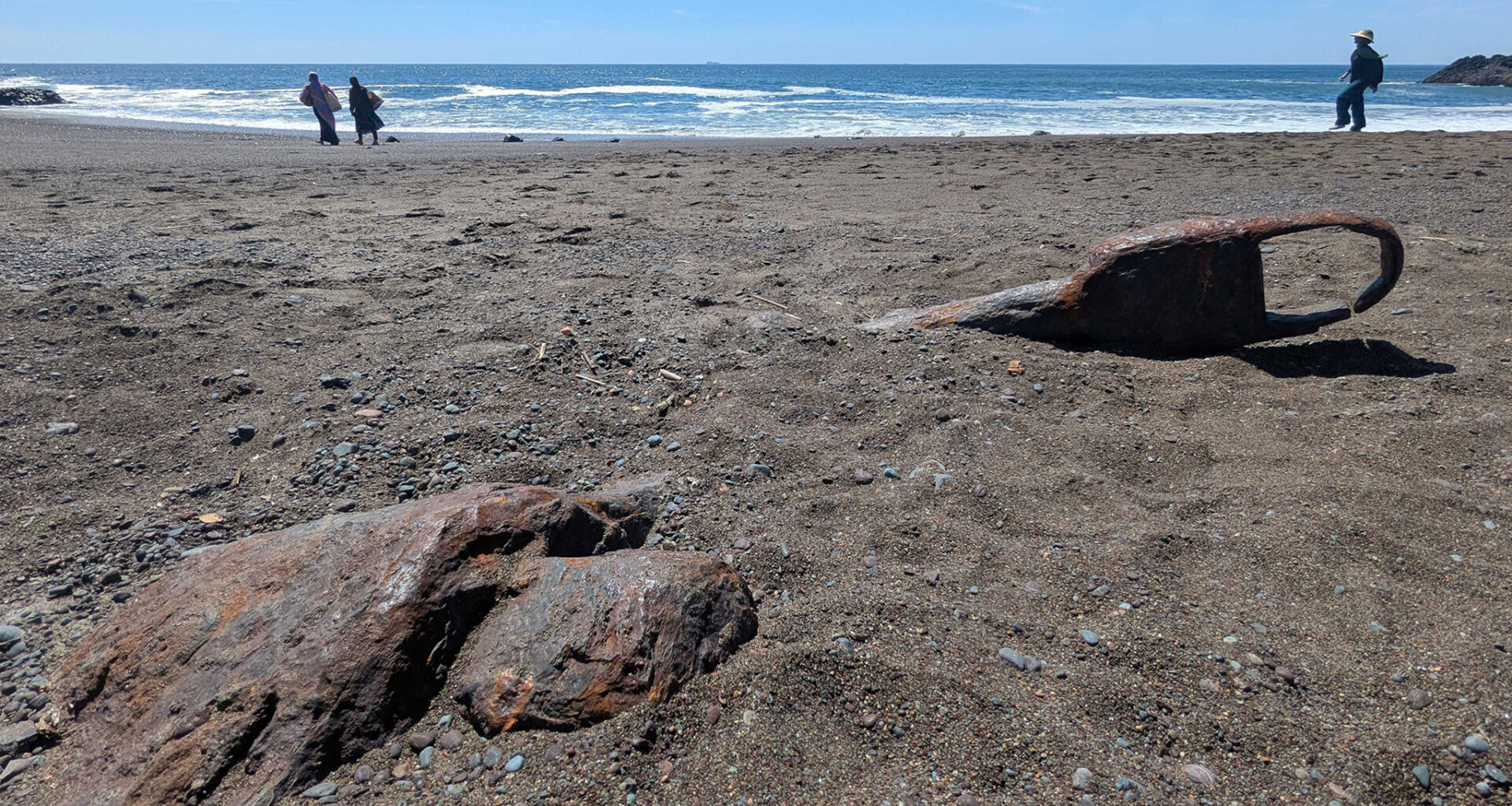
If the ocean is a graveyard, then perhaps the beach is its gravestone. On the shores of a narrow cove in the Golden Gate National Recreation Area, I saw this metaphor stir to life following the ebbing tide and evaporating fog.

Most hikers visit Tennessee Cove with recreation in mind, but that’s not how the area originally earned its reputation. The beach, cove and valley are named after an 1853 shipwreck. The SS Tennessee aimed for the Golden Gate Straight but crashed several miles short on the craggy coast. While the steamship hasn’t sailed in 173 years, it remains in the public eye — if you know where, and when, to look.
Since the metal mimics the surrounding red ribbon chert, it’s easy to overlook the decaying steamer on the eastern end of the cove. But the ocean hasn’t fully claimed it yet. When the tide is low, a pair of corroded engine rods, one resembling a hulking aluminum can tab, protrude from the sand like twin tombstones.
Article continues below this ad
A newspaper clipping from the San Francisco Chronicle’s “History Corner” on Feb. 5, 2005.
newspapers.com
Beachgoers pass by the shipwreck for the SS Tennessee at Tennessee Cove in Marin County, Calif.
Eric Brooks Special to SFGATE
The doomed voyage is among hundreds laid to rest along the Marin County coastline. While the captain and all of its passengers aboard the SS Tennessee survived the wreck, other ships were not as lucky, as one human soul remains unclaimed at the bottom of the unforgiving cove.
2 miles to the beach
The Tennessee Valley Trail is a short, popular hike about 20 minutes from San Francisco. Its trailhead is easy to find around the corner from the Tam Junction, and the mostly flat trail through the Marin Headlands is usually slammed by hikers on weekends.
Article continues below this ad
At just under 2 miles from the parking lot, Tennessee Cove is close enough for beachgoers to sling a picnic basket over their shoulder and make it back to their car before mid-afternoon. Most people opt for that pace, as the beach is often littered with sunbathers and kids enjoying relatively untouched black sand.
On a recent visit, I did the out-and-back hike in just two hours. The partially paved path offers views of the valley’s steep hillsides and wildlife, including raptors, swallows and, if you’re lucky, owls. Larger animals such as deer, coyotes and bobcats also roam but are rarely spotted on a trail as heavily trafficked as this one.
Article continues below this ad
Springtime conditions bring out California poppies, buttercups and lush green hills. In summer, green turns to gold, and the valley dries out.
A trail at Tennessee Cove in Marin County, Calif.
Eric Brooks Special to SFGATE
The wildlife in Tennessee Valley in Marin County, Calif., includes bobcats and coyotes, but if you’re lucky, you might see owls in the area.
Eric Brooks Special to SFGATE
Fog is often omnipresent in the morning, something the SS Tennessee learned the hard way.
Article continues below this ad
‘They were terrified’
The SS Tennessee disembarked from Panama and hit the beach on a Sunday morning in March 1853, according to author Brian Crawford.
In his book “Shipwrecks of Marin,” the historian estimates that there are 425 shipwrecks in the county. Even to this day, captains find themselves marooned on the unforgiving Marin coast.
“The main word is fog,” he told SFGATE in a phone interview. “It was really known as dangerous and pretty feared. The coastline is inhospitable.” Most ships that ended up hitting rock and sinking along the Marin those days, including the Tennessee, were attempting to pass through the Golden Gate but missed by a few miles, Crawford said.
Article continues below this ad
“That’s why Point Bonita and Point Lobos have many, many wrecks,” he added.
A runner at Tennessee Cove in Marin County, Calif., in December 2020.
Ezra Shaw/Getty Images
After deciding to abandon the steamer, the captain and crew brought hundreds of passengers on shore before unloading the ship’s contents — including 14 chests of gold. “They were terrified,” Crawford said of the wary travelers.
Survivors built an overnight camp on the beach, with a few hiking all the way to Sausalito to get help. The SS Tennessee? It never budged. The wooden ship, 211 feet long and around 1,200 tons all told, broke apart over time.
Article continues below this ad
“It’s pretty amazing to stand there and touch it … a shipwreck in the midst of all those people running around and having a day at the beach,” Crawford said.
When I stumbled upon it, a couple was enjoying a day at the beach just feet away, and I could sense how they were confused by why I was snapping pictures of the sand.
The SS Tennessee wasn’t the first ship to wreck in the cove, but it provided the namesake — perhaps due to the press coverage in its wake. The site of the ship’s demise later joined the National Register of Historic Places in 1981.
A metal rod, part of the engine of the SS Tennessee, is submerged in the sand at Tennessee Cove in Marin County, Calif.
Eric Brooks Special to SFGATE
The SS Tatus marooned there two years prior. Like the SS Tennessee, there were no casualties, but the shipwreck almost changed the inside of the California state Capitol, according to Crawford. The SS Tatus was carrying a copy of Gilbert Stuart’s famous portrait of George Washington. It was bound for the halls of state government in Sacramento.
Article continues below this ad

Stay informed, and entertained.
By signing up, you agree to our Terms Of Use and acknowledge that your information will be used as described in our Privacy Policy.
After the SS Tatus crashed, there was a frantic and successful effort to locate the painting. It was salvaged and still hangs in the California State Senate chamber today.
Years later, in April 1929, a diesel-powered fishing boat called Three Sisters crashed in the cove, taking the lives of its three crew members. “They were driven there by the fog,” Crawford said.
While the captain’s body was recovered in nearby Pirate’s Cove, one of the crewmember’s bodies remains lost to the tides, laid to rest in the ocean’s eternal grave.
Article continues below this ad