
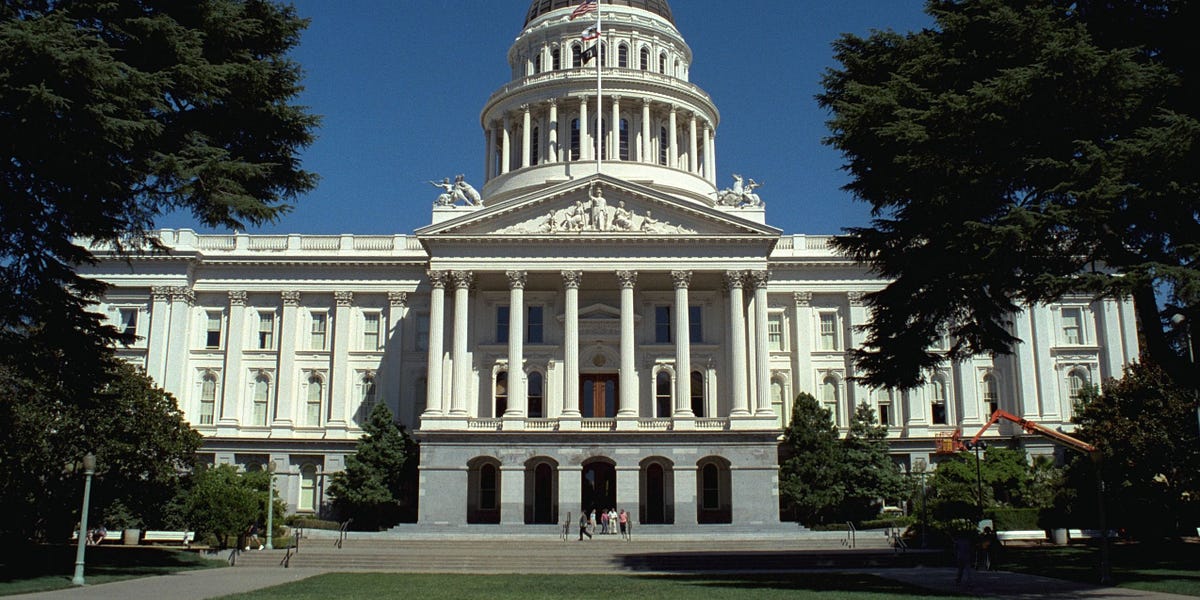
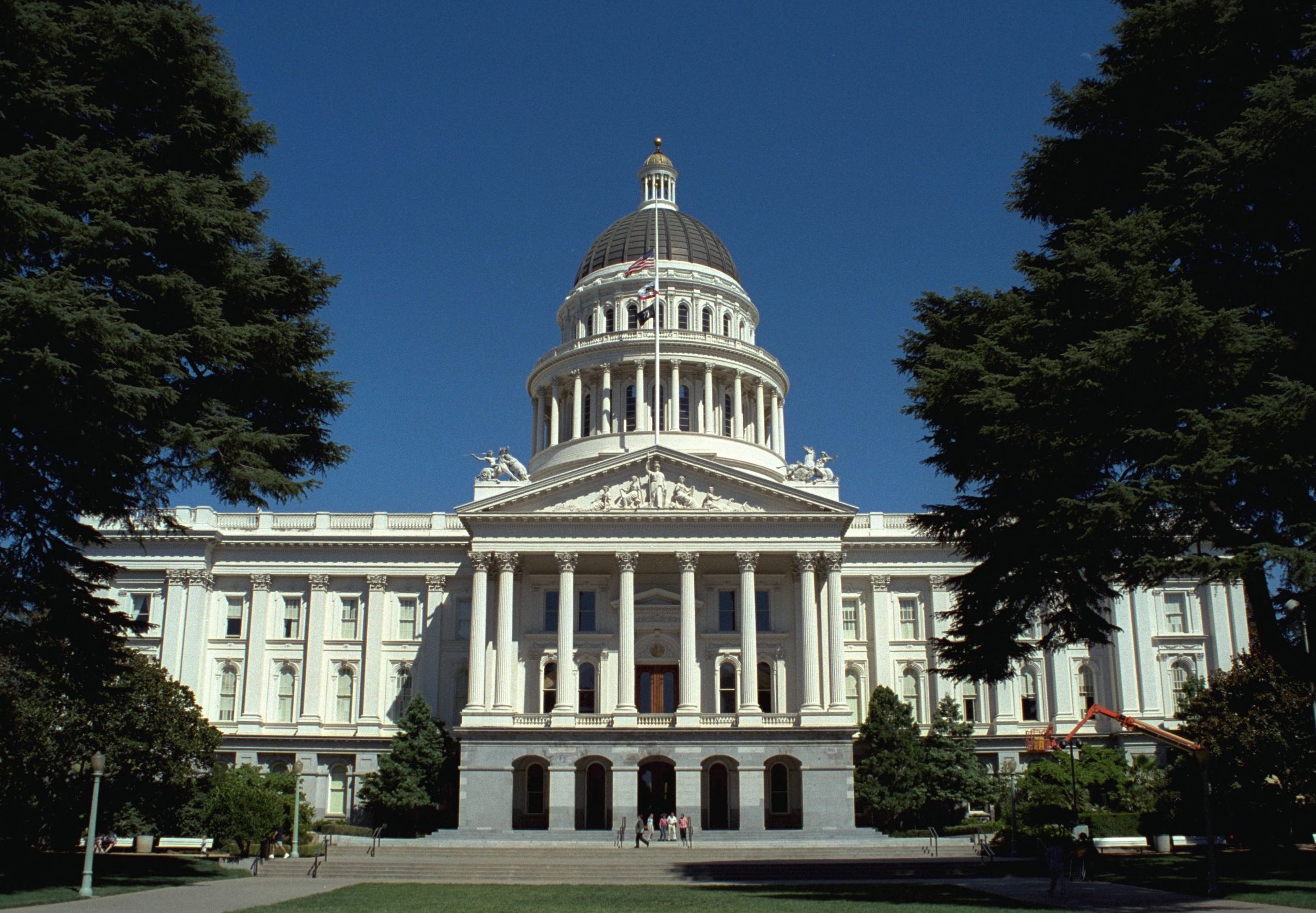
SACRAMENTO — State election officials are processing and validating more than 1.5 million signatures to qualify the so-called Billionaires Tax for the November ballot.
The California Secretary of State’s office has until June 25 to validate the signatures in the push of one of the more far-reaching tax measures in state and U.S. history, coming to a public vote.
Supporters of the proposal, known as the 2026 Billionaire Tax Act, need more than 870,000 signatures to be validated. Organizers have said they gathered nearly double the required amount to ensure the measure qualifies.
The measure, which has sparked an intense and fierce political battle, would impose a single 5% tax, payable over five years on the worldwide net worth of California residents worth more than $1 billion, based on residency as of Jan. 1. Supporters argue the tax is needed to offset the state’s emergency response to looming healthcare cuts, while opponents have challenged the constitutionality, broad asset coverage, retroactive design, application to unrealized gains and many more.
As the measure appears on the track to qualify, opponents are lining up for a massive legal battle over the structure, implementation and constitutionality of such an aggressive proposal.
The measure was authored by Brian Galle and Emmanuel Saez, a law professor and economist, respectively, at the University of California, Berkeley, and law professors David Gamage and Darien Shanske of the University of Missouri and UC Davis, respectively. The proposal was filed with the state by the Service Employees International Union-United Healthcare Workers West (SEIU-UHW).
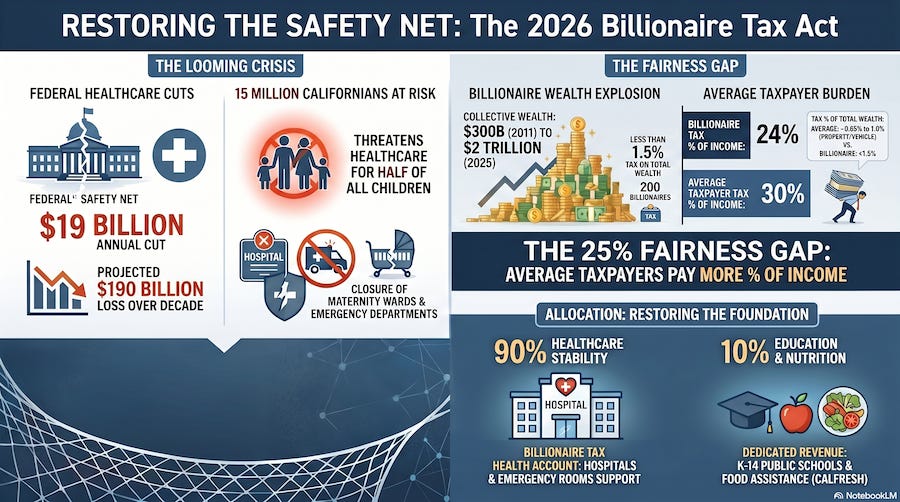 Inside the SEIU’s proposed billionaire tax measure. Steve Puterski graphic/AI
They claim the measure will raise at least $100 billion over five years, or about $20 billion per year, based on the 5% levy on $2 trillion in combined worth in assets from the state’s billionaires. The revenue would be split largely between healthcare programs, with the remainder directed toward education and food assistance, according to the initiative’s text.
“Most Californians and most billionaires recognize how reasonable and necessary this proposal is, both to keep emergency rooms open and to save California businesses from closing,” Suzanne Jimenez, chief of staff of the SEIU-UHW, said, per CBS News. “A very small group of the most controversial billionaires on the planet tried to stop Californians from being able to save their local emergency rooms and hospitals, but our current signature tally proves frontline healthcare workers will prevail in bringing this commonsense proposal to voters.”
Under the proposal, the tax would apply to cash, stocks, bonds, private businesses, venture capital holdings, investment funds, unrealized gains and others. Directly-owned homes are excluded, but real estate through business entities would be taxed.
Union leaders backing the measure say the state faces an estimated $19 billion annual shortfall in federal health funding tied to recent budget actions threatening Medi-Cal coverage and hospital operations statewide.
“This is about preventing hospital and emergency room closures,” Jimenez said in a statement. “The wealthiest Californians have seen extraordinary gains, and this proposal asks them to contribute once to help stabilize healthcare for millions of people.”
Although Jimenez and other supporters describe the tax as a one-time initiative, the measure contains no sunset clause. Instead, it amends the state constitution to authorize taxation of personal wealth and creates a single tax obligation based on the Jan. 1, 2026, residency and asset values, with payments allowed over several years.
That distinction, one tax event, but no formal expiration, is central to the opposition argument.
Critics say the tax’s structure has already triggered significant wealth flight since tax liability depends on residency as of Jan. 1. If the measure is ultimately passed by voters, the residency element is almost certainly going to be challenged in court, along with the taxation of unrealized gains and other illiquid assets.
At least six billionaires left the state in 2025, including Google co-founders Larry Page and Sergey Brin, Palantir founder Peter Thiel, former Uber Chief Executive Officer Travis Kalanick, once the measure was first announced, according to analyses by the Hoover Institution and tax analysts. Those departures, of about 200 billionaires in the state, are estimated to have removed between $500 billion and $536 billion in net worth from the state’s potential tax base.
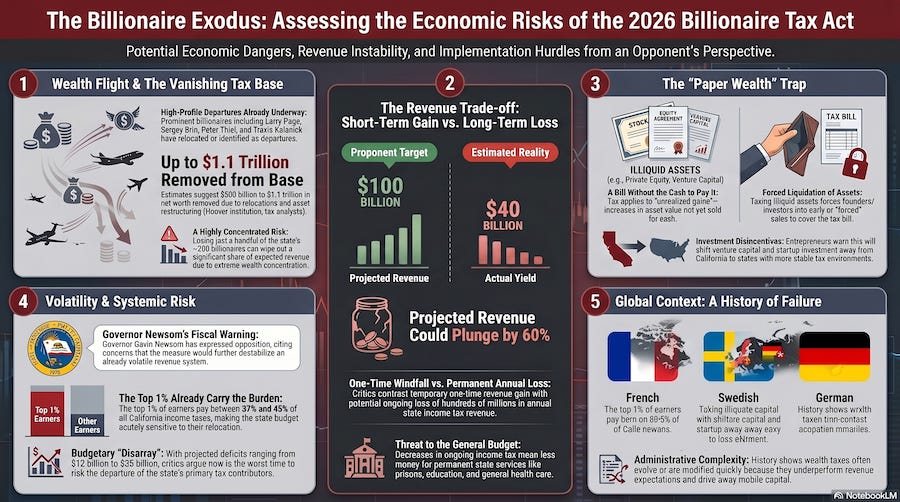 Opponents of the billionaire tax believe wealth flight will cripple tax revenue estimates. Steve Puterski graphic/AI
Brin told the New York Times, “I fled socialism with my family in 1979 and know the devastating, oppressive society it created in the Soviet Union. I don’t want California to end up in the same place.”
Other estimates, which include quieter relocations and asset restructuring reflected in public filings, place the figure between $1 trillion and $1.1 trillion. Under those assumptions, the projected revenue from the tax falls from roughly $100 billion to about $40 billion, once lost future income-tax receipts are included.
A significant portion of the state’s income tax revenue comes from the top 1%, making it acutely sensitive to moves by a small number of people, according to experts.
“That’s the danger of a highly concentrated tax base,” said Joshua Rauh, a Stanford finance professor and co-author of the Hoover analysis. “Losing even a handful of people can wipe out a large share of the expected revenue, and California is unusually exposed to that risk.”
Opponents have also railed against taxing wealth tied up in illiquid assets, such as founder equity, private companies, and venture capital stakes, and requiring payment on unrealized gains. Many opponents have said taxing unrealized gains creates a bill without creating cash, which has practical, legal and economic consequences. Opponents worry it will force cash payments from non-cash wealth.
Valuations can swing wildly from year to year, and there is no mechanism to recover taxes already paid. Entrepreneurs have said it will lead people toward early or forced sales, even when holding is the better option, and will shift investment away from California to other states.
Supporters, though, say unrealized gains are still “real wealth,” noting homeowners pay higher property taxes as value rises, retirement accounts are forced to realize gains, and unrealized appreciation can disappear at death due to tax basis step-ups, experts have said.
“This is taxing value that hasn’t been realized and can’t easily be accessed,” economist Arthur Laffer said during a recent debate. “That forces people to sell assets or move capital just to pay the tax, and history shows that behavior changes quickly.”
Democrat Gov. Gavin Newsom has publicly stated he is against the proposal as it would further destabilize California’s already volatile revenue system, which heavily relies on the wealthy. Compounding the issue, the state’s budget is in disarray.
Newsom and the Legislature had to cover an $18 billion deficit for the current fiscal year, which ends in June. For FY 2026-27, the budget deficit is estimated at $12 billion, with some projections warning of deficits between $20 billion and $35 billion in the future.
According to Newsom’s FY 26-27 budget summary, the top 1% paid about 37% of all income taxes with an average of 45% over the past 20 years. In FY 23-24, the top 1% paid about $116 billion in state income taxes.
Supporters, though, have said not all billionaires have left, that some relocation estimates are overstated, and the state’s economic advantages, notably in technology, remain powerful anchors.
Beyond revenue concerns, opponents have hammered on a provision in the measure that will allow the Legislature to amend the tax by a two-thirds vote, provided those changes are consistent with the initiative’s purpose.
Business groups, taxpayer advocates, economists, and billionaires, among others, say the language in the measure would allow future lawmakers to lower the wealth threshold, add asset categories, or extend the tax beyond a single year without returning to the voters.
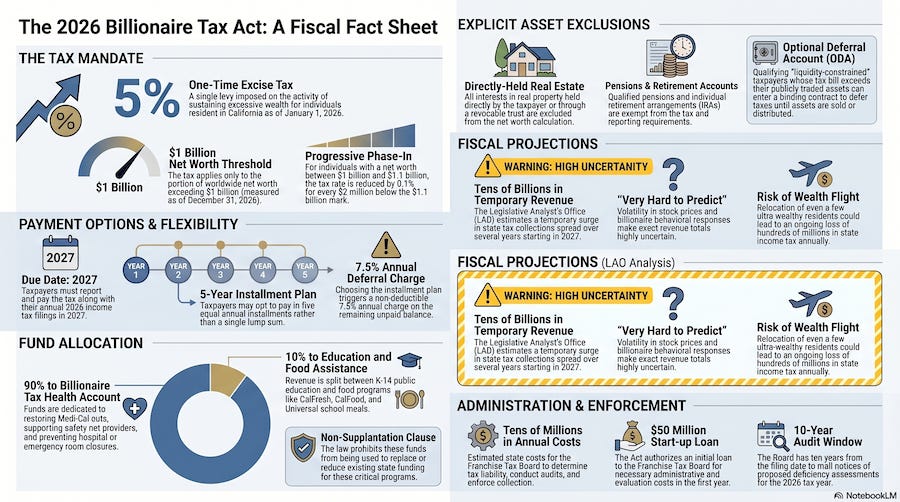 Inside the proposed tax on California billionaires. Steve Puterski graphic/AI
However, any changes to the measure would likely face serious legal and constitutional challenges.
“That’s why this debate isn’t just about billionaires,” Brooke Armour, a spokeswoman for the California Business Roundtable, said. “Once the framework is approved, voters are being asked to trust future legislatures not to expand it.”
The initiative’s authors say those fears exaggerate the clause’s reach and note that pensions and most retirement accounts are explicitly excluded. They argue any expansion would face legal challenges and political backlash.
“It’s going to be an experiment,” Saez explained. “We see the results, and then we decide whether that experiment works, whether it’s promising. But the focus right now is an emergency funding need for healthcare, not some abstract theory about taxation.”
California would be entering largely uncharted territory. No U.S. state has successfully enacted a broad wealth tax, and every modern attempt has stalled or failed, according to reports. Internationally, wealth taxes have produced mixed outcomes.
France, Sweden and Germany repealed broad wealth taxes after decades of capital flight and administrative challenges. France’s wealth tax raised about €4 billion to €5 billion annually, roughly 1% to 1.5% of total tax revenue, before being eliminated in 2017. Only Norway, Spain and Switzerland retain comprehensive wealth taxes, and in each case, revenue typically amounts to between 0.2% and 1% of GDP (gross domestic product). Those countries also modified their wealth taxes after initial flight and underperforming revenue totals, according to reports.
Supporters, though, argue California’s proposal differs because it is targeted, one‑time, and tied to a specific fiscal emergency. But as noted, there is no sunset clause or other mechanisms preventing a longer-term tax or the Legislature from trying to amend the scope of residents covered under the measure.
Opponents counter that nearly all wealth taxes began narrowly and evolved under political pressure.
State officials are expected to complete signature verification later this month. If certified, the initiative will appear on the November ballot and require a simple majority to pass. Legal challenges are expected if voters approve it.
Send story ideas and tips to ncpipeline760@gmail.com. Follow North County Pipeline on Instagram, Facebook, X and Reddit.