
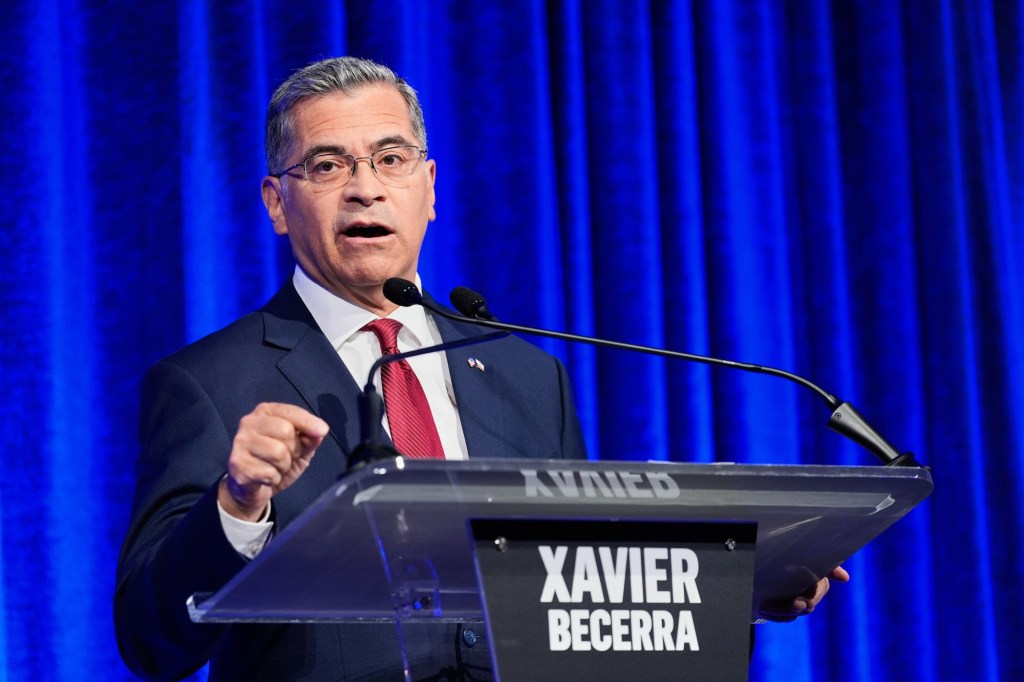
At a recent debate, Xavier Becerra discussed his plan to make housing “more affordable” in California. But his agenda would do the opposite if enacted. If his policy ideas become law, home prices will soar even higher.
Becerra, a former Biden Cabinet member, California attorney general, U.S. House member and state lawmaker, has worked in government his entire career. So it should be expected that he would propose solutions that would increase government intrusion in the state’s ongoing housing crisis.
“We want to be sure those who want to buy a house get in a house,” he said at the April 22 candidate debate.
He wants to convert renters “into homeowners by helping them with their down payment” through expanded assistance programs. He doesn’t seem to understand, or maybe doesn’t care, that this sort of government action will inflate housing prices. It creates an artificial demand for homes, which will lead to higher prices as more prospective buyers compete for an especially scarce commodity.
There are already more than 2,500 down-payment assistance programs (DPAs) across the country. States, cities, the federal government and nonprofits “collectively spend billions each year putting money into buyers’ hands,” says the Affordable Housing Initiative. As it turns out, the subsidies flow directly to sellers because with their additional purchasing power, “the buyers will simply bid more” on the homes they are interested in. Will yet another program among thousands, and billions more in taxpayers’ dollars spent, solve anything? If they haven’t already, they never will.
Researchers at the American Enterprise Institute looked at a $25,000 DPA plan, one pitched by Kamala Harris in 2024, aimed at 4 million first-time buyers over four years and found that it would push average prices higher by 4.1%. The AEI scholars further estimated that the “total inflationary boost to the entire stock of homes in” census tracts where at least 30% of the homeowners are first-time buyers would be $1 trillion.
Becerra believes his “principal job as governor” would be “to keep you housed.” In the instances in which someone unexpectedly lost a job or had a medical emergency and was “about to become homeless as a result of that now unaffordable expense,” he promises he will rush in with critical aid.
“Tell me what you need, how can I help you keep your home?”
And how would Becerra pay for this?
Things get a bit murky at this point. He claims that “it costs me so much more money to pick you up off the street,” and provide assistance and shelter “than it does to keep you in the home you have already paid for.”
“We spend tens of billions of dollars to try to pull people off of the streets. Do you think it’s working? It would cost a fraction of that amount to help someone who temporarily lost their job stay in their home if they for two or three months fall behind on their rent.”
How much is a “fraction”? He cites no source, just expects voters to take his word.
Any serious approach to mending the state’s broken housing market has to include an overhaul — ideally a repeal-and-replace effort — of the California Environmental Quality Act, or CEQA. No one will argue that the law wasn’t passed with the best of intentions. But it became a favored method to curb and often block home construction. Consequently, builders have been unable to meet the demand. The short supply of housing has forced prices to unaffordable heights.
Housing is obviously one of California’s most troubling issues. Polls consistently tell us voters consistently rank it among their biggest concerns. If Becerra wants to be the Housing Governor, he will need to aggressively address the “bureaucratic delays (that) are adding years and tens of thousands of dollars to the cost of every home built,” as he describes them on his campaign website, and he has to boldly lead on CEQA reform.
At the same time, he will have to drop his ideas about public subsidies and any other government intervention into a market that has been tortured into dysfunction by meddling officials. In fact, that should be his first step.
Kerry Jackson is the William Clement Fellow in California Reform at the Pacific Research Institute and co-author of The California Left Coast Survivor’s Guide.