
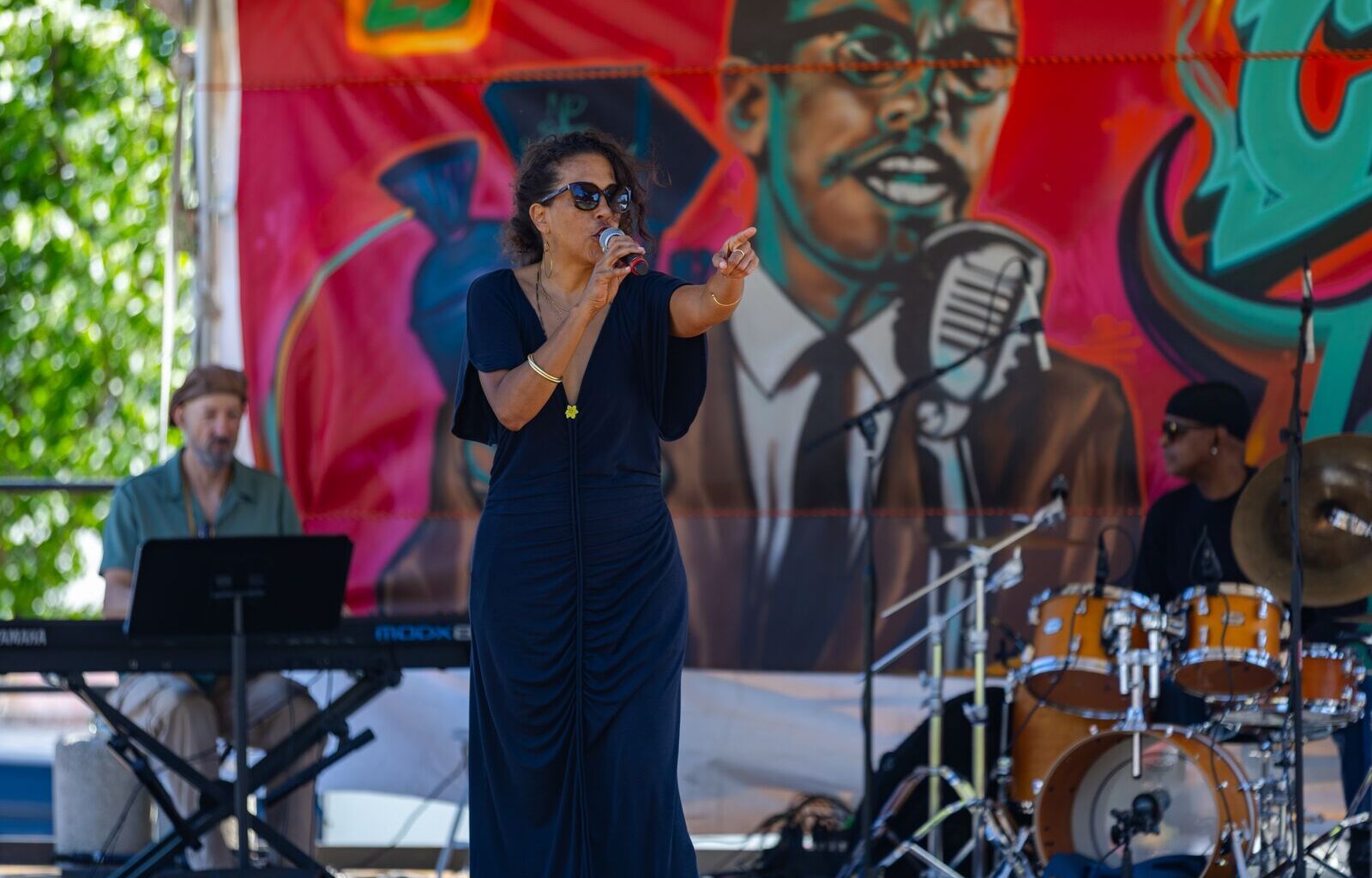
On Saturday, when Oakland hip hop artists RyanNicole and NuDekades stepped to the stage in San Antonio Park to trade verses touching on gentrification and economic empowerment, they drew nods from the audience. The performers were put voice to themes at the heart of the Malcolm X JazzArts Festival, now in its 26th year, an event that has become one of the city’s longest-running celebrations of music, culture — and political solidarity. All afternoon, music echoed across the park as families gathered beneath tents and lawn chairs, children danced near the stage while eating shaved ice, and elders greeted neighbors they had known for decades.
Organized by EastSide Arts Alliance, the festival offered up a day of free outdoor live performances — the lineup featured the jazz singer Daria Nile, the West African dance company Diamano Coura, the Futurelics, and Samba Funk! — hip-hop battles, and Afro Puerto Rican dance, along with spoken word artists, graffiti exhibitions, wellness and youth activities, and information from dozens of community organizations. Long lines formed at local vendors like Jollof Kitchen, where attendees waited for plates of West African soul food between performances.
 Sara Borjas reads poetry during the Malcolm X JazzArts Festival, now in its 26th year, on May 16, 2026.
 Roman Carrillo, right, performs with Cultura y Tradición during the Malcolm X JazzArts Festival at San Antonio Park. Credit: Estefany Gonzalez for The Oaklandside
One of the festival’s busiest areas was the Zumbi Court, where hip-hop dance battles drew lively crowds of spectators as young children and adults stepped into dance cyphers to compete. As participants found partners and took turns performing in front of a panel of judges, moments of nervousness quickly gave way to confidence and celebration. Audience members cheered loudly as dancers improvised routines, encouraging even some of the youngest festivalgoers to step into the circle.
 I.D., 23, left, and Jaryan Bague, 22, aka Jun, compete in a dance battle during the Malcolm X JazzArts Festival. Credit: Estefany Gonzalez for The Oaklandside
 Dru’Synncere, 13, know as “Dancing Diva,” competes in the dance off. Credit: Estefany Gonzalez for The Oaklandside
EastSide Arts Alliance, a collective of artists, cultural workers and community organizers, has long used art as a tool for civic engagement and social change in Oakland. In addition to the annual festival, the organization provides free youth art classes and cultural programming, creates public art projects, and organizes gallery exhibitions and community town halls focused on issues that impact East Oakland residents.
The first Malcolm X Jazz Festival was held in 1999, and for Elena Serrano, one of the organization’s co-founders, attending this year’s event carried a deep sense of personal significance. After retiring in December, this was the first festival where she was no longer involved in organizing the event and could simply take it all in.
“It’s a little surreal,” Serrano said. “But it feels really good that the next generation has stepped up and is doing it. I feel so comfortable and confident and amazed that I can just come and sit down and enjoy the festival.”
ʻJazz became the bridgeʻ
The annual festival was envisioned as more than a music event. In East Oakland’s San Antonio district — where Southeast Asian, Mexican American, Chicano, Native American and African American communities have long lived side by side — organizers saw culture as a way to forge solidarity across communities often divided by language, economic class and displacement.
“We wanted a festival that could bring those communities together, and we decided jazz could be the common language,” Serrano said. “There’s Latin jazz, Asian jazz, hip-hop — jazz became the bridge.”
 Anthony Johnson came out to San Antonio Park for the Malcolm X JazzArts Festival. Credit: Estefany Gonzalez for The Oaklandside
 Ro, 36, and their dog and Ruby, 7, watch a live jazz performance during the festival. Credit: Estefany Gonzalez for The Oaklandside
 From left, Chaney Turner, Demetria Huntsman, and Bushmama Africa, watch performances at the festival. Credit: Estefany Gonzalez for The Oaklandside
 Long time festival attendees Gustavo and Darcy Lopez watch live music under a canopy with their kids. Credit: Estefany Gonzalez for The Oaklandside
The festival, she said, has drawn inspiration from Malcolm X’s emphasis on international solidarity and coalition-building among marginalized communities.
“This neighborhood has been severely disinvested, but it’s super rich in culture,” Serrano said. “We wanted to lift up that culture, bring people together, and build enough power to create change in our own neighborhoods.”
That sense of cultural interconnectedness was visible throughout the festival, where artists from across the African diaspora and beyond shared stages. For Roman Carriollo, an elder who performs with the local bomba group Cultura y Tradición, the festival’s blending of jazz, Latin rhythms and community traditions reflected a deep historical connection stretching across continents and generations.
He described Puerto Rican bomba, jazz, blues and Louisiana musical traditions as branches of the same lineage, each carrying traces of African heritage shaped by migration and survival.
“When we look back at history, we’re connected by one source,” Carriollo said. “Everybody has their own traditions and folklore and the way they do things, but it’s all connected together from our roots in Africa.”
 Oakland resident Lauryn Marshall, 28, paints a community mural with her partner at the Malcolm X JazzArts Festival at San Antonio Park on May 16, 2026. Credit: Estefany Gonzalez for The Oaklandside
For many attendees, the festival also served as a rare community gathering space in a rapidly changing Oakland. Anthony Johnson, with the Black Cultural Zone, who works on the event staff, returned to the festival this year after tabling at the event last summer.
For Johnson, the festival’s importance extends far beyond music and cultural performance.
“It gives the community a safe place to enjoy each other,” he said. “It gives people from different cultures the ability to express themselves, and it ties everyone together.”
“*” indicates required fields